IN PRAISE OF ELLEN SELIGMAN, COLLEAGUE AND FRIEND

Ellen and I were colleagues at McClelland & Stewart for almost twenty years. When I became the Publisher in 1988, Ellen was the Editorial Director for Fiction. She was already a legend who had been at M&S for over a decade, and had established herself over that time as a superb editor who specialised in fiction.

My main role in this area, in fact, was simply to clear the way for Ellen to work her magic with the authors whose trust and affection she had earned. Their names, and their prize-winning books, are too well known to bear repeating here. It is the heartfelt tributes from these bereaved authors that speak most tellingly to the great qualities of Ellen Seligman.

An extra dimension was her superb eye for talent. At any Sales Conference when Ellen began to use her expressive hands as she wove her tale about a new writer (perhaps a poet named Anne Michaels who had just written a wonderful first novel), the Sales Force and the entire Marketing Team would sit up and pay very close attention, to their great benefit.

I have written elsewhere that I hoped that Ellen might some day write the inside story of her creative dealings with so many famous and grateful authors. Sadly, it seems that this will not happen. We have all been deprived of a fascinating book by her untimely death.

FROM BLOOMSBURY TO THE YUKON

Roger Fry was a senior member of the Bloomsbury Group, a respected art critic who mingled with Leonard and Virginia Woolf, Lytton Strachey, Vanessa Bell, Duncan Grant and the gang. He championed  modern artists such as Cezanne and Matisse,  and was such a prominent figure in Britain that his son, Julian, saw that he was likely to spend his life in his father’s shadow, as “Roger Fry’s son”.

So Julian came to Canada, and became a hard-riding rancher in B.C.’s Cariboo, where art critics were not an important part of life.

There he raised his son, Alan Fry.   Born in Lac La Hache in 1931, young Alan was a real Cariboo boy, raised around horses and cattle, and skilled with a rope and an axe. In 1962, he revealed an extra dimension when he published his book about growing up, Ranch On the Cariboo.

He came into my life when in 1969 he brought me an extraordinary manuscript, a novel based on his experience as an Indian agent working in rural B.C. for the Dept. of Indian Affairs. For a civil servant to produce such a hard-hitting book about how bad things were on a “fictional” reserve was amazingly brave. When How A People Die was published in 1970 it was a sensation. “The New York Times” ran a review by the Native American novelist N. Scott Momaday that said :“This small book is one of the most sensitive and incisive statements on the subject of human alienation that I have seen…”

Reviews in Canada were equally admiring, but the harsh portrait of a dysfunctional reserve, written by a civil servant, led to an angry chorus of voices wanting him fired. Alan went to his local band, and left his fate in their hands. After a meeting they reported that they wanted him to stay, and told the rest of the world that Alan was their guy, and everyone else should back off. A respected native leader visited the reserve in question, and wearily reported to Alan that things were, in reality, even worse than in the book.

Alan kept on writing, from his base on Quadra Island, near Campbell River, where I visited him twice. In 1971 he brought out Come A Long Journey, about a canoe trip down the Yukon river with the narrator and his Native friend Dave. The Revenge Of Annie Charlie (1973) dealt with Native conflicts with the RCMP in a humorous way. In 1974 he reverted to his old Cariboo ranching background with The Burden of Adrian Knowle .

Then he got tired of the bureaucracy in Indian Affairs, and quit. What should he do now? Well, he had loved the time he had spent in the Yukon, and decided to move there. But how? How could he get a grubstake when his only asset was his house on Quadra, surrounded by Douglas Fir trees? His Lac La Hache skills provided the answer.

With his axe he felled enough trees to make a two-storey log cabin, built the old way, with interlocking timbers and not a single nail. I visited the house, which was a thing of beauty. And now Alan had two houses to sell, to keep him going in the Yukon.

Just north of Whitehorse, beside Lake Laberge, he erected a tepee, and lived in it year-round, even during the months when he was surviving under 40 below ( where Celsius and Fahrenheit meet) temperatures in a tent. I was back in my warm office in Toronto, fascinated by all this, and in due course a book came out of it, a non-fiction guide called Survival In The Wilderness. Read it…..it may save your life one day.

Then a woman came on the scene, and the tepee life became less attractive than life in a house in Whitehorse….

I visited that house in January, to catch up with my old friend Alan. We’ve stayed in touch over the years, always with great pleasure. My pride in working with Alan over all this time was revived a few years ago when my friend Howie White, of Harbour, realising that How A People Die was still – tragically – relevant today, reissued a new edition of the great classic.

At 84, Alan is now not as young as he once was, and is fighting a number of health challenges. But as you can see from the attached photo, he and his editor and friend for so many years are damned glad to see one another. And I’m glad to pay tribute to an important Canadian author.

Alan Fry


GEORGE JONAS

In 1977 I published By Persons Unknown: The Strange Death of Christine Demeter, written by George Jonas and Barbara Amiel. From the outset, the collaboration of the husband and wife team was, let’s say, interesting. Both of them were highly talented, highly opinionated, and determined to produce an excellent book, so their standards were very high. If collaborating on a book puts pressure on any pair of authors, the pressure increases immensely if the authors are a married couple. I was fascinated to watch their outspoken relationship play out, often in my office,with George drawling cynical conclusions that usually ended the debate.
The book developed a very exciting momentum, as the superb chapters came in. Finally, in my role as editor I felt able to begin my copy on the back of the published book with the words, “In future years this book will be seen as a classic.” This is what happened, as the book won an Edgar Award,and provoked comparisons with Truman Capote’s In Cold Blood. It established both Barbara Amiel and George Jonas as major authors.
This joint success did not save their marriage. Courteously, they came to my office to tell me this news in person. I reacted, as most of us would, by flailing around, telling them how sorry I was to hear it, and offering to do anything I could to help them. George dryly suggested that it would be very nice if I could help with the laundry.
Later I saw George in action as a CBC Director. After the success of Alligator Pie, the children’s book by Dennis Lee illustrated by Frank Newfeld, a new book by the Lee-Newfeld team was obviously a big story. Big enough certainly, for me to arrange a launch party one afternoon at the old Boys and Girls House Library on St. George Street, with scores of excited nine-year-olds in attendance. And big enough for the CBC to send a camera crew to cover it, under George Jonas’s direction.
Since the new book was called Garbage Delight I had arranged for a City garbage truck (you would be amazed what a life in publishing involves) to deliver Dennis, hanging on to the back, in overalls, and the similarly-clad Frank in the truck beside the driver.
We had fifty kids on the sidewalk jumping up and down outside the Library, and George and I were set up with his cameras when I signalled that the truck should start, and come down busy St. George Street, to pull in at the cleared space beside the crowd of kids, and George’s cameras.
As the truck approached, the kids (and publishers) cheered loudly. Then the truck simply ….kept on going.
Something had gone wrong with Frank’s directions to the driver, who drove on a full fifty yards beyond the kids and the cameras. I tried to retrieve the situation by getting the kids to run to greet the  now-bickering authors, but it was not a huge success.
George was philosophical. As the crowd disappeared into the library, he said.”Can we run that through again?”
A fine, witty man. I was glad to count him as a friend.

AN EXCITING START TO THE NEW YEAR AT KINGSTON

Faithful readers will understand that my constant travels this Fall have delayed my blogging activities. So far, I’ve given performances of the new show, based on ACROSS CANADA BY STORY: a Coast-to-Coast Literary Adventure, in every province west of New Brunswick.
But right now, the exciting news is about Ontario, and specifically Kingston.
You may recall that Elizabeth Dowdeswell, the Lieutenant Governor, heard about my new book, and decided to launch it in her official Chambers at Queen’s Park. I have warm memories of the whole event, especially of my grandchildren sitting comfortably on the carpet while the speeches went on. Even better, in her speech the Lieutenant Governor revealed that she had read my book, and liked it, calling me “the cartographer of Canadian Literature.”
It got even better.
She liked my province-by-province account of our book world so much that she decided to send the book as her official Christmas Gift to all of the country’s Lieutenant Governors, and to the Governor General.
It gets even better. This New Year’s Day, there will be an Official Levee at the Grand Theatre in Kingston, starting at 1p.m.…….and I have been invited to attend!
I’ll bring along some copies of my books, in the hope that I may sell some. And I may even meet some friends, perhaps including you. I’ll be the bearded guy in the blue blazer with a distinctive orange tie!

REMEMBERING JEAN BELIVEAU

The national mourning in December for Jean Beliveau was extraordinary. It ran from the formal Memorial Mass in Montreal, attended by several Prime Ministers, all the way to a feature on him before a televised Maple Leafs game that silenced a raucous sports bar in the Beaches and had the fans getting reverently to their feet, their Leafs caps clutched in their hands.

But of course Jean Beliveau was extraordinary.

I was lucky enough to get to know him when at McClelland & Stewart we published his autobiography in 1994. Naturally, we planned a major author tour for him. It began in the West, and from Vancouver onwards the crowds were larger than we had ever seen. Every newspaper and TV and radio station was clamouring for interviews, and soon the whole event had taken on the dimensions of a Royal Tour. Signing books for the hundreds of admirers who had lined up to meet him made for very long days, city after city, and eventually Jean began to wear down.

Near exhaustion, he phoned from Winnipeg to ask for help. Typically, instead of brushing him off on the phone, our Chairman, Avie Bennett, flew out to give help in person. He and Jean decided that as the tour proceeded into the cities of the East, we should cut back on the original plans. We would cancel the media interviews, to allow him to concentrate on the massive signing sessions in the bookstores. That was a great relief to Jean. Problem solved.

After the weekend, however, Avie got a phone call from Jean. He said, “Elise has reminded me that I have never failed to do what I promised to do. So we should stick with our original plan. I’ll do the media interviews.” And he did. Brilliantly, with the dignity and the grace that were built into him.

It’s typical of Avie (and he and I were constantly in and out of each other’s nearby offices, so I knew him very well) that when he was briefly in Winnipeg that day, he was able to see another touring M&S author, Karen Kain, who was proudly promoting her memoir, Movement Never Lies. It was clear that the investment he made in our authors was worth it, even if publishing in Canada is such a tough business that the rewards tend not to be measured in dollars.

For similar reasons, he enjoyed his time as a part-owner of the Montreal Expos. He loves telling the story of strolling out of the stadium with two M&S authors on either side: Pierre Trudeau and Jean Beliveau. This allows him to set up the classic line: “Hey, who are those two guys with Avie Bennett?”

Another Jean Beliveau story:

Some years after we published his memoir Canada Post brought out a stamp in his honour. I happened to be visiting the great Montreal book event, the Salon Du Livre, and in my ramblings I came across a Canada Post booth, where Jean was signing for a crowd. They were lined up around the Hall, in their hundreds. I was standing there quietly, enjoying the sight of my old friend surrounded by admirers of all ages. I had no plan to intervene, since he was obviously very busy. But he paused in his signing, looked up, and saw me. And Jean Beliveau put down his pen, got up, came around the desk and across the aisle to greet me, shaking the hand of his “old friend Doug.” It was wonderful, and we had a warm conversation. But like a good publisher I was concerned about the delay we were causing for the people in the line-up, and I managed to move him back to the signing table.

During all this time, the people lined up showed absolutely no sign of irritation. If M. Beliveau wanted to get up and go to greet a friend, that was fine with them. But they looked at me with keen interest. I wasn’t a hockey player. So which NHL team, they wondered, did I own?

It’s too bad that Jean was never able to accept the invitation to be Canada’s Governor-General. He would have been a great, distinguished occupant of that role. And as we’ve seen, he knew all about Royal Tours.

EDITING TIPS FROM DOUGLAS GIBSON (#29): BOTH SIDES NOW

typewriter_SMLAs readers of this blog will recall, on occasion I tip-toe into the territory of giving advice on editing. Always with trepidation, because writing, in all its variety, tends to be resistant to rules, and editing is dictated by the writing that precedes it. So hard and fast rules about editing are hard to propound with total confidence.

Last month I was reminded of this when I had the “both sides now” experience of (A) editing, and (B) being edited. As an editor I had the pleasure of working, yet again, with my esteemed friend Terry Fallis, who has a new novel due out in the Fall. As I did my editorial stuff (jokingly telling Terry in the cover note that he would find the edited version “totally unrecognisable”) I was struck, as always, by how often the editor finds that with an experienced author the trick is simply to outline a potential problem area and to say, possibly in these very words, “You might want to think about this…”

Meanwhile, as an author, I’m benefitting, yet again, from the editorial attention of Jen Knoch of ECW, who is putting my manuscript under her microscope, suggesting that the reader doesn’t need to know this, but will be puzzled by that, and wondering if we really need this piece of history, and saying the equivalent of “You might want to think about this…”

It’s an intellectual challenge to respond to these questions and suggestions, and I know that my book is better as a result of Jen’s suggestions. I hope that Terry feels the same way.

But note my use of the word “suggestions” here. I recently heard about an editor – at a respected major publishing house – who was given a first novel to edit. The young novelist had heard about editors sometimes being very tough, so was relieved when the edited manuscript came back in electronic form as clean as a whistle. With not a single change suggested. It was only when he started to read this splendidly clean manuscript that he realised that the manuscript now contained scenes, and characters, that were new to him. The editor had not made mere suggestions, but had enthusiastically joined the project as, in effect, a co-author.

You’ll be glad to know that this editor – who had somehow missed Editing 101 – was promptly removed from the scene. But she may be floating around out there, somewhere.

ABOUT THE YOUNG POET, CLAIRE CALDWELL

In Scotland, my mother had a first cousin called Douglas Caldwell. (I may even have been named after him, since we had no previous Dougs in the family). After service in the Navy in the Second World War he disappeared, sailing for parts unknown.  More than thirty years later he got in touch, to reveal that he now lived in Canada, in Toronto,  the city that was now my home.

Even better, he revealed that he had three children , including a son named Doug, who was a Producer at CBC Radio, where I did free-lance things. It turned out that I and Doug and his wife Judy McAlpine, also a CBC Producer, had lots of friends in common. Exciting contact was made among these unknown cousins, and their children, and our lives were enriched as our families expanded.

That’s why in November Jane and I were delighted to have our house provide the setting for a launch party for a new book of poetry by Doug and Judy’s amazing daughter Claire. INVASIVE SPECIES is her first book, but followers of the poetry scene in Canada already know her as the 2013 winner of the Malahat Review’s Long Poem Prize. She is a credit to McGill, where she got her B.A., and to Guelph, where she earned her MFA.

As for the poetry (which inspired the National Post to single her out as an important new voice) let me just quote from the first verse of  “Bear Safety” (which Claire read aloud on our staircase):

Bears could be anywhere


On the subway at rush hour.

Between couch cushions.

In the drawer with dull pencils

and batteries and nothing

you need. In the eavestrough.

On a soccer field

during a lightning storm.

In the pocket of your dirty jeans,

your unlaced sneakers.

Run a hand under the sheets

before bedtime. Bears prefer to sleep

on Egyptian cotton.

They can usually tell if it’s cheap……..


INVASIVE SPECIES is published by Buckrider Books, an imprint of Wolsak and Wynn Publishers.

AN ASTONISHING STORY ABOUT HUGH MACLENNAN

As you know from Stories About Storytellers I’ve long had a huge admiration for Hugh MacLennan. There’s a whole chapter in that book about him, full of admiring stories, showing how this man bestrode Canadian culture, carving a trail for other writers. You’ll recall that he won three Governor-General’s Awards for Fiction, but — just as important — also two for Non-Fiction, thanks to his wide-ranging essays.

My new book will have a chapter on him.  While most of the chapters are centred on a Province (“Saskatchewan!” or “The Coasts of B.C.”) his is simply “Hugh MacLennan’s Canada”. As you’d expect, it deals with Halifax, and Montreal, and Quebec City, and Sherbrooke and his beloved Eastern Townships, including North Hatley, where he died in 1990.

But since Hugh was also the author of The Colour of Canada, and The Rivers of Canada (where as a young editor I played a role as a minor tributary) for this book of Literary Tourism  I have him take us right across the country, to the roaring Fraser in the West, and the mighty Mackenzie in the north. His love of the country comes through in every line he wrote.

He was such a major Canadian figure that he was often called up for national assignments. In 1958 the country was facing a General Election, with two leaders who  were not well known, Lester Pearson and John Diefenbaker (who had just won an unexpected minority). To allow people to get to know them better Maclean’s magazine selected Hugh to be one of a panel of three interviewers, with Pierre Berton as the Chair.

The interview with Diefenbaker did not go well . Here is how Pierre Berton described it in his memoir, My Times :  “When the interview ended and the prime minister left, I looked at Hugh MacLennan, who was clearly badly shaken by the encounter.   “The thought of that man being prime minister…” he kept saying. Suddenly he hurried to the washroom and threw up.”

There are other, much more surprising revelations about Hugh in the book.

NOBEL PRIZE GROOMING TIPS

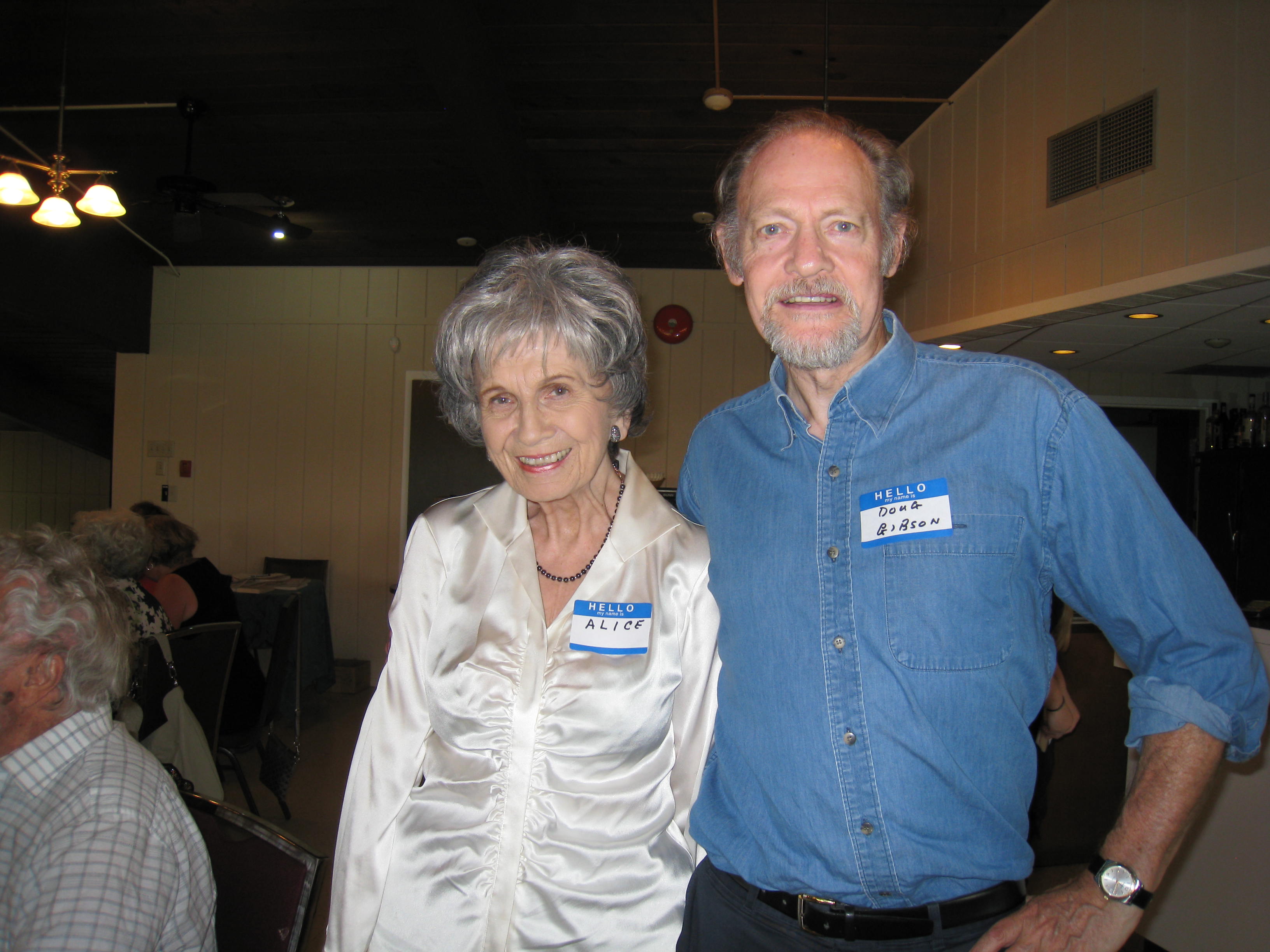
ALICE MUNRO 1931– Not Bad Short Story Writer

You’ll be glad to know that I was prepared for Alice Munro to win the Nobel Prize for Literature.

(Pause for arm waving, dancing and cheering.)

As I was saying, I was prepared. So thoroughly prepared that late the previous evening I did the full shower and shave thing, so that I could getup very early and sit, perfectly groomed (striped tie and all), in front of my computer before 6 o’clock. This meant that when the wonderful news came in and the ringing phones started to jump across my desk, I was able to say, “Yes, I can be in a cab to come down for CBC TV news right away,” and so on with all of the other stations.

You may have caught me babbling happily on one of the many shows that interviewed me. It was all inspiring, with every single interviewer beaming and delighted. The ultimate good-news story. A wonderful event for all Canadians with a superb author, one of ours, being honoured at last.

I’m very proud to have been part of it.