Peterborough and the Mafia

One interesting side of a publisher’s life is how the families of your authors regard you. In my book I write about how in mid-summer Alistair MacLeod was hard at work finishing No Great Mischief, and I was guilty of putting unremitting pressure on him.

As the book says, “In the course of these frantic weeks I had occasion to call Alistair in Cape Breton. The phone was answered by a MacLeod son to whom I introduced myself as the man who was ruining his father’s summer, ha ha. “Oh yes,” he said, heavily, and passed the phone to Alistair.”

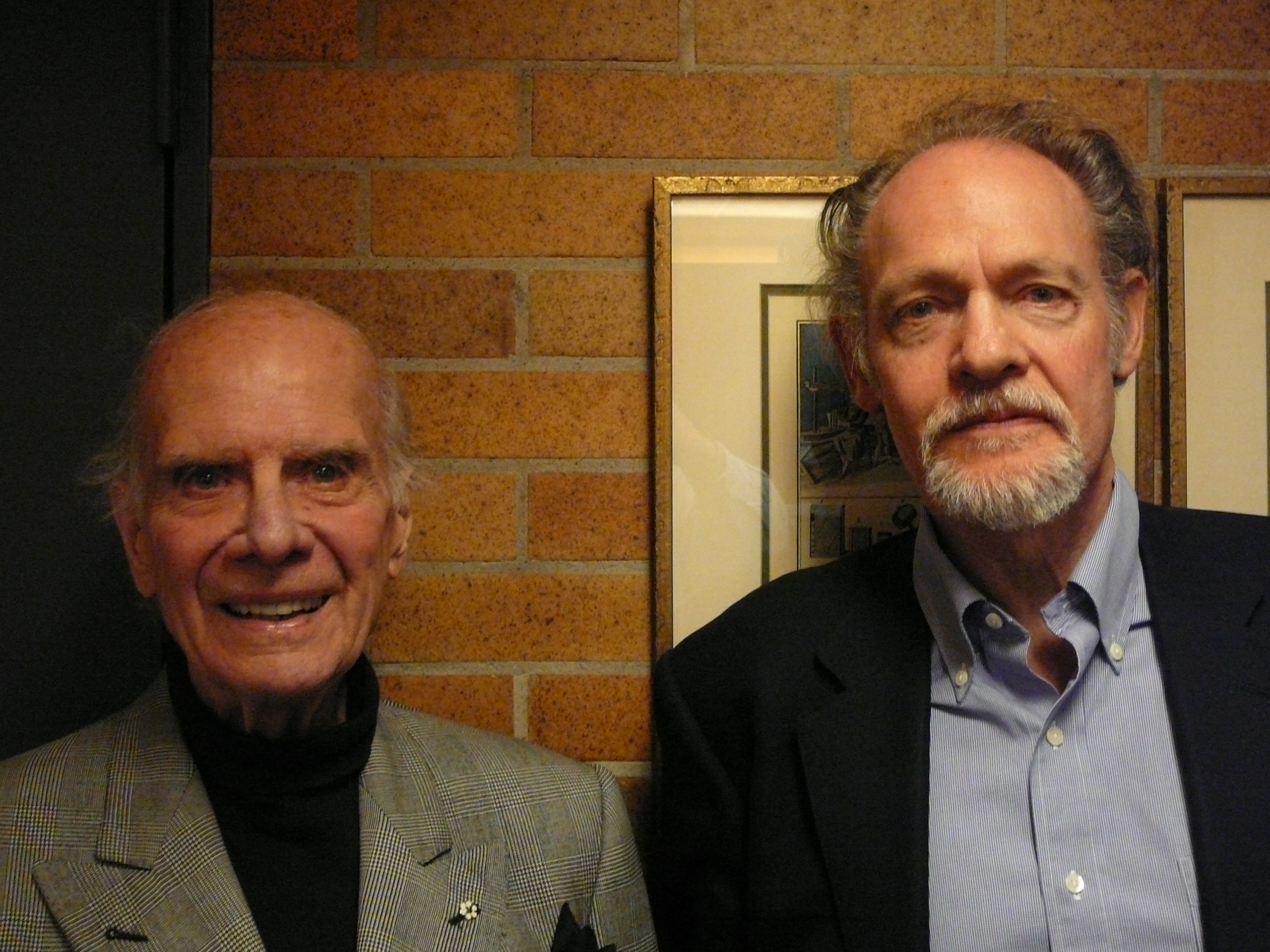
In the Peterborough event, held at Traill College downtown, Lewis MacLeod (who teaches in the English Department), was my host and the MC of the performance I gave there. He spoke of growing up aware of the name “Doug Gibson” as someone who distributed good things “like a second-rate Tooth Fairy” but who over time developed a more threatening side, “like a Mafioso.”

What an interesting take on the two sides of the Publisher/Editor, part Tooth Fairy and part Mafia enforcer!

In the audience were two others with family links to one of my authors, Orm Mitchell and his wife, Barb, the biographers of W.O. You can imagine my delight when Barb told me that in my acting out a phone conversation on stage, I “sounded just like W.O.!”

It’s wonderful that my friendship with W.O. and Merna has descended down to the next generation, where Jane and I are able to stay (not for the first time) with our friends Orm and Barb.

Recommended Reading

Now, a new book, where I played no role in the publication.

But my admiration for Robert Levine’s Free Ride (with its gentle and understated subtitle How Digital Parasites Are Destroying the Culture Business, and How the Culture Business Can Fight Back) led me to jump at the invite from my friend Duncan McKie to attend the recent music industry convention on March 23 at The Royal York, where Levine was the keynote Breakfast Speaker.

The key message of his Fall 2011 book, published by Doubleday, is that every single part of “the culture business” – newspapers, magazines, television, movies, books and music – is under siege from the “information wants to be free” online economy. And the preference for consumers to get online stuff free . . . and to regard copyright as an outdated concept that interferes with true freedom . . .  is driving every single one of these industries, and the creators they represent, over the cliff. Meanwhile technology companies build billion-dollar businesses on content that belongs to others . . . like authors, to give one example.

Common wisdom tells us that the music industry’s problems with pirates like Napster were solved by iTunes, and that it provides a useful model to solve this problem in other industries. Right?

Wrong.

Clearly iTunes is good for Apple, and for consumers who feel good about paying something for their music. But it’s bankrupting the music industry. The people working there know it.  The artists who are getting less studio time, as quality suffers, know it, too. And that’s why Robert Levine (with whom I chatted before his speech) was invited to confirm the crisis to a deeply worried Canadian audience.

Robert Levine deserves great credit for demonstrating that “we can’t go on this way” . . .  this means you, writers and publishers. Sadly his book is weaker in the area of providing solutions. But reading it makes us aware of just how big a problem creators now face, as the big Internet players fund advocacy groups that  frame the debate about “freedom” as opposed to fair return for copyright holders.

Serious stuff.

A Remarkable Book Launch for a Remarkable Book

On March 18, I went to an event at Ryerson University to celebrate the launch of an important book just published by University of Toronto Press. The book is The Literary Legacy of the Macmillan Company of Canada: Making Books and Mapping Culture, and the author is Ruth Panofsky, who is a Professor in the Department of English at Ryerson.

Canadian book publishing has not been a subject well covered in our books. The striking exception is The Perilous Trade, by Roy MacSkimming (which I would praise, even if I had not published it at M&S). Now this fascinating new book by Ruth Panofsky turns a spotlight on this now-disappeared company that for 90 years, from its creation in 1905, was one of Canada’s most important publishers, arguably M&S’s main rival in the great work of creating Canadian Literature.

A warning and a disclaimer: I am hopelessly prejudiced in this matter, because I was Editorial Director and then Publisher at Macmillan from 1974 until I left to set up my own imprint at M&S in 1986. So I am delighted to see attention paid to this vitally important company, and in such a thorough and wide-ranging way as Ruth Panofsky has achieved.

A further disclaimer: Ruth, who interviewed me at length, has chosen to tell the sweeping story in six sections, each attached to a leading figure. The last such figure is me, in a section entitled “Editorial Coda 1974-1986: Douglas Maitland Gibson.” And the portrait painted of me is very, very kind. If I were to quote many of the last 30 pages you might accuse me of being conceited, instead of the true situation, where I am humbled. Here are the last two sentences in the book.

“Moreover, Gibson brought Macmillan’s publishing ethos to McClelland and Stewart where it touched his own imprint, Douglas Gibson Books. In the end, notwithstanding the company’s gradual demise and the eventual disappearance of its imprint, Macmillan’s legacy endured in Gibson’s lasting relationships with writers and the landmark books he edited – many by authors with former ties to the venerable Macmillan Company of Canada.”

What can I say?

Except thank you to Ruth Panofsky to devoting her attention to this now-vanished company, and to U of T Press for bringing it out so expertly, and for staging a launch party where the author and Quill & Quire’s Steven Beattie staged a discussion that was so lively that even retiring members of the audience (that would be me!) felt obliged to get involved. An interesting event, about an interesting book.

“Get the Lead Out” at Massey College

On Wednesday, March 28, Massey College was the setting for a panel discussion by a number of grand old typesetters/designers/booklovers such as Stan Bevington of Coach House Books, Andrew Steeves of Gaspereau Press, independent designer Will Reuter, and so on. The thoughtful discussion (dealing with rare topics such as the delights of letterpress printing, and with Andrew’s division of those who bought The Sentimentalists after its Giller Prize win into “readers” and “consumers”) drew a full house, including two veterans of the Canadian publishing mainstream, William Toye of Oxford University Press and yours truly. Photo is by Don McLeod.

Editing Tips from Douglas Gibson (#14)

In this recurring feature, we’re sharing tips for editors from the desk of Douglas Gibson. Good for those starting out or old hands who need a reminder, these reminders form an engaging guide for sharp-eyed wordsmiths.

Tip #14
In her fine new book, The Literary Legacy of the Macmillan Company of Canada: Making Books and Mapping Culture, Ruth Panofsky quotes the “urbane, cosmopolitan and well travelled” editor Kildare Dobbs. He wrote that the fiction writer must have “intuition and moral taste,” avoid cliché, melodrama, and especially “the curliness of a Victorian bandstand.” A strong novel was carefully structured, appropriately paced, and “told with skill and perception” if not “flourish and wit.” When these qualities are lacking in fiction, Dobbs asserted he “would rather embalm a corpse” than undertake revision.

Missed the previous tips? Check out Tip #1, Tip #2, Tip #3Tip #4, Tip #5, Tip #6, Tip #7, Tip #8Tip #9Tip #10, Tip #11, Tip #12, and Tip #13.

Aurora Public Library

This March event was my first appearance at a library (apart from the Wolf Hall Theatre, in the London library), with the enterprising Blue Heron Books on hand to sell copies. I hope that there will be many other library events around the province and the country.

The talk was held in the Magna Room in the library, which reminded me of just how extensive the impact of Magna is on the community (and have you ever driven around the massive Magna main campus, modelled on Versailles, just east of town?) I did not get around to mentioning Wayne Lilley’s balanced but properly critical book Magna Cum Laude: How Frank Stronach Became Canada’s Best-Paid Man, which I was proud to publish half a dozen years ago. It criticized Frank for excessive interest in his money-losing racetracks, and for corporate governance that neglected share-holders, two themes that were to become headline news in the years after the book was published, when the Magna Chairman, a former politician named Mike Harris, was ridiculed for the rich pay-out granted to his friend Frank.

Ah, well, the Magna Room was a fine space, and I had an enjoyable evening.

There was one uneasy moment, when, in answer to a question, I spoke about Brian Mulroney sympathetically. This provoked the cynical question “Did you pay him in cash?,” which I pretended not to understand.

Toronto Cricket, Skating and Curling Club

My tour of many clubs as a performer reached new heights here. We had to close the curtains in my lecture hall, otherwise the audience would have been mesmerized, as I was, by the skaters whizzing by to the west, and the curlers scrubbing excitedly to the east. Some of the best figure skaters in the world train here (under staff like Brian Orser) and on a scouting mission before my show I watched a coach use a training harness (like a giant fishing rod dangling above the skater’s head) as the young skater tried a new, tricky, unfamiliar jump.

The evening went well, with Jane selling many copies of my book, some of them via a club chit system swiftly organized by her cousin, the admirable Doug Knights, the club’s manager.

Stories About Storytellers Companion Reading (#7)

Many early readers of Stories About Storytellers have remarked that they finish reading it only to rush to pick up one of the other books Doug has so lovingly described. So to make it easier, this recurring feature revisits some of those books and reminds you why they’re worth a read. Last time, we revisited The Game by Ken Dryden, and this we’re featuring . . .

Where the Wagon Led: One Man’s Memories of the Cowboy’s Life in the Old West, by R.D. Symons (1973)

The success of War Horse, both the movie and the play, reminds me that my very first author, R.D. Symons, wrote about his experiences with horses at the front in the First World War. Here is what he wrote in Where the Wagon Led: One Man’s Memories of the Cowboy’s Life in the Old West: “A lot of horses couldn’t take the shock of high explosive shells, and we’d often find one dead after a bombardment, without a scratch on him. One early morning when I went to the transport horse lines I found the colonel’s mount – a good horse, too – dead as mutton, and the nearest shell had exploded over a hundred yards away. I suppose his heart had just stopped with the fright.”

And later . . .  “Yet the smell of our own horses, live horses, always had a steadying effect on me. It somehow seemed to make a sense of sanity in a world otherwise quite mad. I’d often linger at the horse lines after evening ‘stables’ just to talk to our wagon teams and get the mingled smell of horses and hay and oats as the nags munched away. Sometimes the transport sergeant would stick around, too. He had been a cowboy in Alberta, and we’d talk about horses, and it was he who said one night, as a star shell burst over German lines. ‘Gee, don’t that look like the shooting stars we used to watch on night herd!’”

Bob Symons writes of a cavalry charge that he saw close up, when Australian Cavalry went at the German lines “at full gallop, and with drawn swords”:
“It wasn’t long before we saw the boys, still with drawn swords, herding a bunch of prisoners in our direction. . . .
“The way was now open for our infantry, and we soon moved forward, doing what we could for the cavalry casualties till the stretcher-bearers got into action. When a couple of our Canadian boys stopped to put a field dressing on one young chap, the only thing he said to them was ‘Is my horse all right, mate?’ They didn’t know, but someone said, ‘He sure is, Digger.'”

For Doug’s tales of R.D. Symons see 43-50 of Stories About Storytellers.

Edmonton

My time as the invited Corus Lecturer at Grant MacEwan University allowed me to spend an entire day on campus, visiting and chatting with classes. Very interesting, especially the sociology of facing a Media Studies classroom where the 30 students are all hidden behind vertical fixed computer screens, on which they are typing . . . who knows what? I had some success in attracting their attention, since some of them followed me to the John L. Haas theatre that evening, where the audience of about 300 seemed to enjoy the evening. The description (attached elsewhere in this website) by the West Edmonton Local uses nice words like “captivated.”

Roaming around downtown Edmonton next day I came on a fascinating Ukrainian-language bookstore, which I was informed is “the biggest in North America.” Who knew?

Close by, I came on a stretch of Jasper Avenue East made up of interesting old buildings erected around 1912-13. One of them, in the “flatiron” style, was named “The Gibson Block.” I regretted not having a camera with me, because I would have enjoyed posing beside it. Ho, ho.

Not so fast. When I investigated the historic plaque, I learned that the building was erected by one William Gibson (good) who came west from Ontario (good, and no doubt earlier from Scotland, very good) and erected this building, where the street level featured a well-known eating place called “The Gibson Café.” All very good, until I reached the line “with its now-notorious sign outside ‘White Help Only.”

Very, very bad.

I guess if we’re going to take pride in our names, we have to take the rough with the smooth.

— Douglas Gibson

Storytelling at the Royal Ontario Museum

I was contacted out of the blue by the ROM, asking if I, a storyteller, born in Scotland, could come to their “Celtic Weekend” as a “Scottish Storyteller.” I said that I knew some good Scottish stories, so, yes, could come along and tell them to a mixed audience of kids and parents.

A few days later, they were back with a further inquiry. This was a Celtic weekend, so could I tell Irish and Welsh stories, too. A little research provided good stories, so I said yes, and we were all set for two 40-minute sessions, at 12:00 and at 2:00.

I sat on a throne-like chair in front of a collection of movable stools occupied by a group of kids, who included my grandchildren Lindsay (7) and Alistair (5). When I told the Irish story, about Niall of the Nine Hostages who was “The Slave Woman’s Son,” I prefaced it with a word or two about slaves in different cultures, and unwisely referred to the Haida totem pole in the space just outside our room. I explained that a visit to the Haida Museum in Skidegate reveals that the Haida were sea-raiders who took slaves, which allowed them to have a slave-supported leisure society that could create great poetry and great art, like totem poles.

This was too much for Lindsay, who dragged Jane off to see the nearby pole, from top to bottom, then loudly returned to interrupt my tale-weaving with the words “What did I miss, Grandad?”

For future reference, the Welsh tale was about “The Lady from the Lake” and the Scottish one (where Alistair proudly told his neighbours, “I know this one. I know what happens.”) was “The Good Man Of Ballangeich,” about a king passing secretly among his people, doing mediaeval public opinion surveys in a very informal way.

Just before the second show, Jane and I were roaming around the main floor of the ROM, where an all-woman Celtic band was playing fine traditional music. When they paused to ask for a song from anyone in the audience, Jane asked them if they knew the old Irish song “The Wild Rover.” When they said yes, and invited her to start singing, she demurred, saying, “Not me, him!” and thrust me forward.

So it came about that the main floor resounded to three verses of me singing “The Wild Rover” while the audience joined loudly in the chorus “And it’s no, nay, never (CLAP, CLAP, CLAP, CLAP) No, nay never no more . . .” Etcetera.

And then as I took my bow, still blushing in disbelief, the PA system cut in to announce that “The Celtic Storytelling Session is just about to begin on the fourth floor” and I had to rush off. Believe it or not, some of the audience actually followed me upstairs, for my second storytelling session.

So clearly my resume has to be updated, to include the sacred title “Celtic Storyteller.” I think we’ll leave out the entry about Irish drinking songs.