NOBEL PRIZE GROOMING TIPS

ALICE MUNRO 1931– Not Bad Short Story Writer

You’ll be glad to know that I was prepared for Alice Munro to win the Nobel Prize for Literature.

(Pause for arm waving, dancing and cheering.)

As I was saying, I was prepared. So thoroughly prepared that late the previous evening I did the full shower and shave thing, so that I could getup very early and sit, perfectly groomed (striped tie and all), in front of my computer before 6 o’clock. This meant that when the wonderful news came in and the ringing phones started to jump across my desk, I was able to say, “Yes, I can be in a cab to come down for CBC TV news right away,” and so on with all of the other stations.

You may have caught me babbling happily on one of the many shows that interviewed me. It was all inspiring, with every single interviewer beaming and delighted. The ultimate good-news story. A wonderful event for all Canadians with a superb author, one of ours, being honoured at last.

I’m very proud to have been part of it.

ALICE MUNRO SAYS GOODBYE TO THE WRITING LIFE.

 In 2006, Alice Munro said that she was not going to write any more. Many journalists seized on this terrible news and reported it as fact, and it flashed around the Canadian literary world like summer lightning

 Wiser heads, however, checked with me, her long-time editor, and found me dismissing the idea, with the words that “Alice is a born writer, and she’s not going to stop writing.”

   Fortunately for the world, I was right, and she has produced two collections of stories since then.

  Sadly, I’m not saying that this time.

   In fact, when she came to Toronto in June, to accept the Trillium Prize for Dear Life, I was with her in a private room at the Toronto Reference Library when the enterprising Mark Medley interviewed her and asked her about her future writing plans. When she told him that she had no such plans, and had stopped writing, (“I’m probably not going to write anymore”), I stayed silent.

  Recently Charles McGrath, of the New York Times, visited her in Clinton and returned with the same story. His fine July 1 article, “Alice Munro Puts Down Her Pen To Let The World In” reflects the fact that he is an old friend and editor of Alice’s work, and a great admirer. It’s a superb account of Alice’s life and work, and I recommend it highly.

  So what has changed? For a start, Alice is now 82. In April she lost her beloved husband, Gerry Fremlin, and life is harder now. On the subject of growing old, which Charles McGrath rightly notes is “a subject that preoccupies some of her best stories”, she says “I worry less than I did. There’s nothing you can do about it, and it’s better than being dead. I feel that I’ve done what I wanted to do, and that makes me fairly content.”

   “Fairly content”…now there’s an Alice Munro expression, (just like “better than being dead”). I suppose I can say that the millions of readers around the world who know her work can be “fairly content” that she wrote a lifetime’s worth of wonderful short stories that can be read and re-read for ever. My own recommendation, by the way, is The Progress Of Love, which I discuss on my Book Club website, complete with 20 Discussion Points.

   I accompanied Alice to two award sessions in Toronto in June, in both cases whisked by limo to the event, then escorted (with me hovering at Alice’s elbow, the escort escorted) to the reception and the dinner. At both the Libris Awards session, where I spoke to introduce Alice to the nation’s booksellers, who were giving her a Lifetime Achievement Award, and at the later Trillium Prize event, there was a strong sense that people in the audience knew that this was a special moment towards the end of a long , unmatched career. The affection and respect in the sustained, standing ovations were very obvious, almost tangible. And the people who took the opportunity to come to our table to greet Alice (“Yes, I once met Alice Munro!”), sometimes were literally kneeling to greet her , and were always visibly affected when they staggered away, dazed by the experience of meeting her, although she was always friendly and unaffected (“Who do you think you are?”)
It was wonderful to be so close to such powerful experiences, although my role was to watch for signs of strain, then to swoop Alice back to her limo, and back to the family waiting for her at the hotel.

Stories About Storytellers Audiobook

dougstudioSummer has arrived, and with it long drives for much-needed vacations. If you’d like the companionship of this author, and the multitudes within Stories About Storytellers, the audiobook is available for order from Audible, and provides over 17 hours of company on the road.

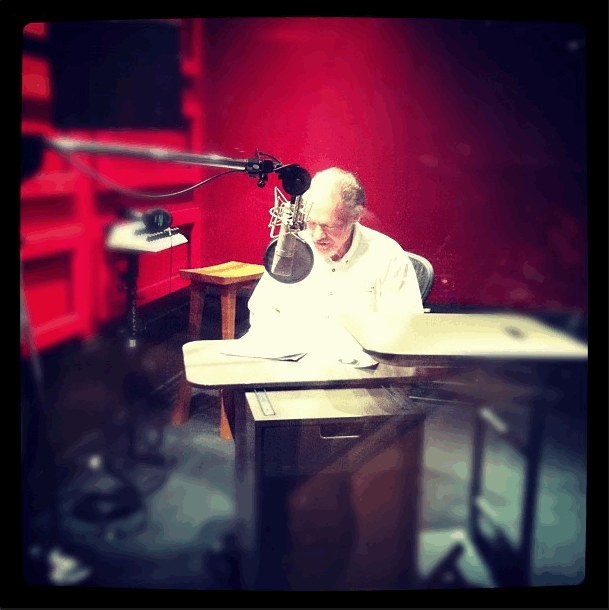
Points of interest about this particular incarnation of the book include that (a) the Introduction by Alice Munro is read by my multi-talented editor, Jen Knoch [ed. note: a daunting task!] and (b) that although I have read more than 100 movie reviews for CBC microphones over the years, it was a shock for me to find out how reading a book aloud is very, very hard work. To be precise, with gulps of air and gulps of hot soup to keep the Scottish-accented voice healthy, day after day, it took me over 20 hours of reading over 5 days to get the whole book on tape.

The good news, of course, is that when the book (as in this case) is written in the first person, and read by the writer, the listener knows that this is the way the author meant it to sound. It does add to the listening experience, which is why I did it.

And, of course, being a professional reader in the studio day after day, accompanied by the patient Kevin at the controls, was a fascinating new experience for me. I’m still working  at expanding my resume. You never know.

My New Book Club

We all know how important the avid readers who belong to informal book clubs are to the world of books.

I’m doing something new for them. I’ve produced a Storyteller’s Book Club where I deal with five classic Canadian books, and provide 20 Discussion Points about each one of them for the club members.

What’s special here is the I edited all the books I discuss. Well, with one exception. I didn’t edit Hugh MacLennan’s great novel The Watch That Ends the Night, but I did edit books by my friend Hugh, which allows me to talk about how I might have edited the book. As for the others, I can take the club members behind the scenes with Alice Munro, Mavis Gallant, Robertson Davies and Alistair MacLeod.

Check it out at on the Storytellers Book Club page.

Kenojuak Ashevak (1927—2013) . . . In Memoriam

Most Canadians were aware of the death of one of our greatest artists in the dark, early days of the new year. Some of our writers did a good job of explaining her importance, notably Sandra Martin in her obituary in the Globe and Mail. It made the appalling point that after Kenojuak was shipped south from Baffin Island to a TB sanatorium, she returned to find that her young daughters had died in her absence. And Patrick White added a fond, rueful account of his brush with greatness.

Sarah Milroy, also in the Globe, paid a fine tribute, summarizing Kenojuak’s career in this way: “She was one of the first of the Inuit artists, born and reared on the land, to enter into the experiment of art making at Cape Dorset, and one of the most talented. Her famous work The Enchanted Owl was replicated on postage stamps in 1970. In 1982, she was made a Companion of the Order of Canada.” Later, Milroy writes of an encounter with the old lady, now in a wheelchair, at the AGO: “her countenance that day was radiant with astonishment and a kind of elfin glee. While she never expected such success, she enjoyed every bit of it.”

“Elfin glee” is very good. That certainly catches the beaming old lady I got to know a little on Baffin Island. This was because my friend James Houston was the man who discovered Kenojuak’s talent, and encouraged her to turn it from sealskin bag decoration to making prints. It was James Houston (and a chapter in my book is devoted to this remarkable man “Artist, Author, Hunter, and Igloo Dweller”) who not only set up the trade in Inuit sculpture but went to Japan to learn the trade of print-making at the feet of an old master, so that he could go back to the Arctic to introduce print-making at the Cape Dorset artists’ co-op.

And Kenojuak was his star pupil. Our Hokusai, you might say, if you were to follow the Japanese theme.

In that chapter I talk about how fortunate I was to be invited by Adventure Canada to join  a cruise that was intended to follow the travels of James Houston. The cruise (along the south shore of Baffin Island), took me for the first time to the North that I had published such exciting books about, but never seen. On board ship, alongside James’s widow, Alice, and his sons John and Sam, Jane and I met “celebrities like Kenojuak Ashevak, the most famous Inuit artist of all, a beaming, tiny elder whom I got to know despite a language barrier.”

I was able to make myself useful, providing an arm when we had to walk over rough ground, on occasions such as the time that we assembled at the base of some striking red cliffs just outside Cape Dorset to scatter Jim’s ashes.

Earlier, I had been present in the historic Cape Dorset artist’s studio, when Kenojuak (then aged almost 80) entered, throwing off her parka, and heading straight for a drawing board. Sitting before it she seized a pen and with bold strokes began to draw wide sweeping lines with her left hand. I was amazed by swift, unhesitating way she drew what would soon be a new print, right before our very eyes.

Later, as my book records,

when I saw John’s film about his father, I was fascinated to see Jim talk about the fast, confident way Kenojuak’s left hand moves as she draws. Jim asked her about that, and she told him that she just follows “a little blue line” ahead of her pen.

“A little blue line!” Jim snorts. “I wish I had a little blue line would do that for me!”

At the end of the cruise, on our last morning I suggested through friendly gestures to my new friend that we should swap our Adventure Canada name tags. Kenojuak laughed happily at the idea, and the swap was made. I suspect she did not keep mine as carefully as I have kept  the “Kenojuak Ashevak” name tag that sits on our mantelpiece, not far from one of her magnificent prints. It’s like having a calling card from Claude Monet.

When the news of her death came to us, that name tag received much thoughtful, affectionate handling, often as I stood in front of my recent December birthday present from Jane. It is “Filigreed Raven” a stonecut from Cape Dorset in 2012, one of the very last prints created by Kenojuak.

The Al Purdy Show in Toronto

Al Purdy For months a group based in Toronto has been building on the work started by Jean Baird and Howard White in B.C. to preserve Al Purdy’s historic A-Frame house in Prince Edward County. Thanks to Jean and Howie’s inspired work over the years, the building has recently been bought. Now it’s up to us to save it and  restore it so that it can be used as a literary centre.

Hence the February 6 fundraiser at Koerner Hall. I’m part of the local committee, chaired by George Goodwin, and involving the talents of Marni Jackson, Leslie Lester, Christopher Goodwin, Alexandra Manthorpe, Patrick White, Don Oravec, Duncan Patterson, and Valerie Jacobs. The event itself is being organized by the excellent Laura McLeod.

I’ll be appearing on-stage in a modest role in what looks like being a great and memorable event, an affectionate celebration of Al Purdy, whom I knew well, and published with pride.

Now read on and buy your tickets while you can . . . and spread the word!


THE TRAGICALLY HIP’S GORD DOWNIE
TO APPEAR AT AL PURDY TRIBUTE

“When Al Purdy died, among the stuff in the newspapers was
his answer to this same question:
‘I write like a spider spins webs and much for the same reason,
to support my existence.’ I really liked that.”
— Gord Downie

For immediate release

TORONTO, ON  (January 9, 2013) The Al Purdy A-Frame Association announced today that Gord Downie, Canadian poet and lead singer of The Tragically Hip, will be appearing in the THE AL PURDY SHOW on February 6.

Downie considers Al Purdy an important influence as a poet and lyricist.  In addition to Gord’s performance, the show will include readings from Margaret Atwood, Ken Babstock, George Bowering, George Elliot Clarke, Michael Enright, Phil Hall, Steven Heighton, Dennis Lee, Gordon Pinsent, Robert Priest and Karen Solie, as well as musical guests, Bidiniband with The Billie Hollies, and The Skydiggers.

Proceeds from the evening will support the Al Purdy A-Frame Association’s efforts to conserve the late poet’s home and to maintain it as an educational resource and a place for writers to come together and work for years to come.  The show will take place at Koerner Hall — The TELUS Centre for Performance and Learning — 273 Bloor Street West in Toronto at 7:30 pm. Ticket prices range between $25.00 and $50.00.

“This event is a true celebration of one of the most popular and important Canadian poets of the 20th century,” said Jean Baird, President of the Association. “Al loved hanging out with people, talking about poetry and having a good time. We want the evening to capture this spirit. Plus, we have some nifty surprises planned.”

Al Purdy and his partner Eurithe began building the A-Frame cabin on the shores of Roblin Lake, in Prince Edward County, in 1957.  It was here that Purdy came into his own as a poet, and the A-Frame became a gathering place for many of the writers who would shape Canadian literature.  Over their 43 years at the A-Frame, Al and Eurithe hosted Margaret Laurence, Milton Acorn, Michael Ondaatje, Margaret Atwood and hundreds of others in the writing and arts community. The menu usually included spaghetti, and lots of Al’s wild-grape wine.

“This event will be very exciting for Purdy fans,” said Jean Baird. “For the first time, Eurithe Purdy has donated books and other items from Al’s personal collection for auction.”

These include Purdy’s signed and numbered editions from his own extensive library, rare first editions by other poets, and original artwork from Leonard Cohen.  Book-lovers, mark your calendars!

In October 2012, using donated funds, The Al Purdy A-Frame Association, a national non-profit organization, acquired the property.  As part of its mandate to promote Canadian literature and Canadian writers, the Association’s first goal is to preserve the home as an educational resource and a work retreat for future generations of writers.

Tickets can be purchased by calling 416-408-0208 or by visiting alpurdy.ca

#  #  #

For further information:
Laura McLeod
Producer
647-631-6000
lschatzker@gmail.com