The Launch Party

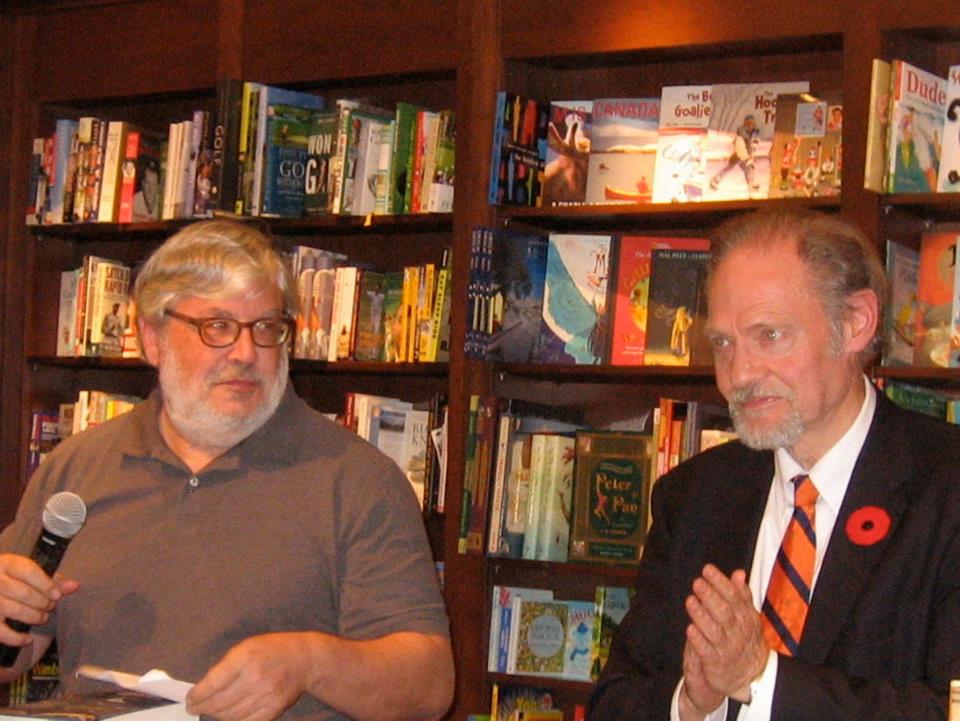
Doug being introduced by ECW Publisher Jack David

During my days as publisher at M&S I took a jaundiced view of launch parties for individual books. It turned our hard-working publicity department  people into almost full-time cocktail party organisers, and provided expensive free drinks for thirsty media types who couldn’t remember the name of the book they were supposedly celebrating, and writing or broadcasting about. To get away from this pattern, we held one big celebration, at the AGO (with all of our authors distinguished by a rose or corsage). It became a major attraction of the fall season, year after year, with a huge turn-out. It was so successful that Quill & Quire complained mildly about the company’s “Imperial style.”

Now that I’ve had the experience of attending a launch party for one single book, and one single author  — me – it occurs to me that I underestimated the sheer selfish pleasure that an author experiences in that brief spell in the sun, as congratulations beam around. Certainly, the event at Ben McNally’s store (which in my brief speech of thanks I called “a beacon of enlightenment in the dark canyons of Bay Street”) was a very pleasant one, with friends popping up from all over. I was tied down at the signing desk from the start, and so wasn’t really at the party. But my friends played their part so nobly that we ran out of books to sign (with over 120 gone) and the ECW gang was pleased.

The next morning, like a sitcom character I was swinging my right arm and wondering aloud what was wrong with it. Jane pointed out that I’d just signed over 120 copies of my book. This is an occupational hazard I could learn to enjoy.

— Douglas Gibson
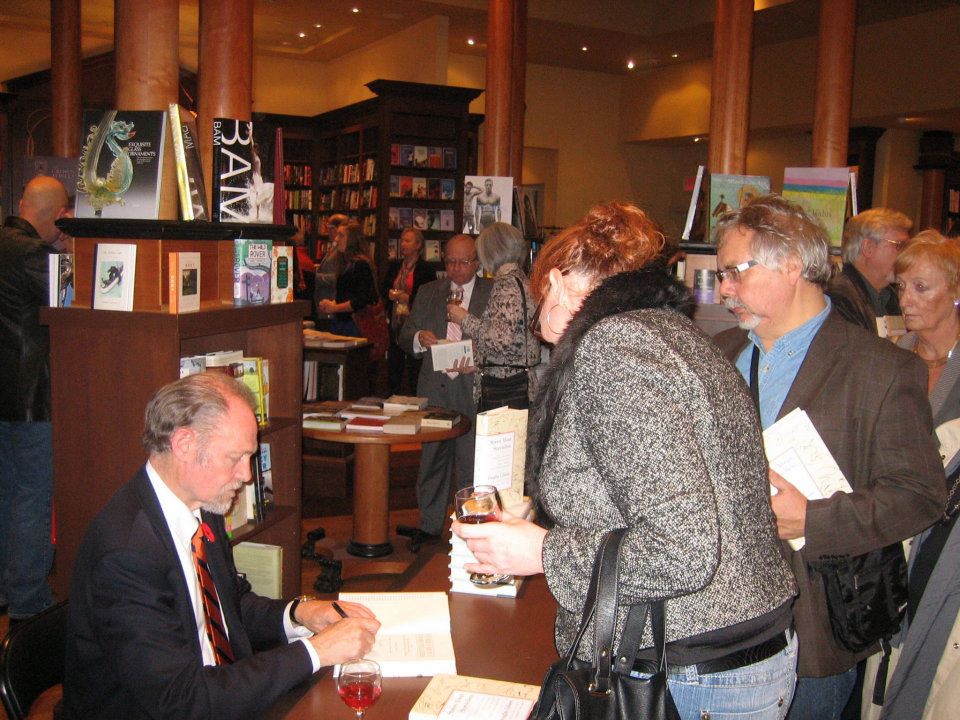
Doug's permanent position for almost three hours.
Editing Tips from Douglas Gibson (#6)

Every two weeks we’re sharing tips for editors from the desk of Douglas Gibson. Good for those starting out or old hands who need a reminder, these reminders form an engaging guide for sharp-eyed wordsmiths.

Tip #6

When an author is struggling to write a book, a shrewd editorial trick is to ask the struggler to come up with the book’s title and subtitle. This tends to concentrate the author’s mind, and to give both a destination and a course towards it.

Missed the previous tips? Check out Tip #1, Tip #2, Tip #3Tip #4, and Tip #5.

The Grand Farewell Tour

One of the most interesting aspects of this tour is that people treat it as a Grand Farewell Tour. They come forward to remind me of long-forgotten incidents. I guess it’s much better than waiting for the post-funeral reception, when (mostly) affectionate stories about the Dear Departed circulate.

Three examples. The admired novelist Catherine Bush reminded me that as a young person she was once complaining  to me about how many books she already had, so that she was reluctant to buy any more. Apparently I scolded her, saying, “If people like you don’t buy books, who do you think is going to buy them?” The scolding worked, and has stayed with her.

Carolyn Wood, now the head of the Association of Canadian Publishers, volunteered the information that when she applied for a first job in publishing she sent out dozens of letters. Most went into a black hole. Four or five received a form reply. One received a personal letter, apparently from me, which she has never forgotten. This, I hope, will go some way to atone for the thousands of rejection letters, the millions of unreturned phone calls (a publishing world satirical show in the 1980s had Anne Ledden, posing as an M&S phone receptionist, apologising to irate callers with the words, “Mr. Gibson is not familiar with the use of his instrument”) and all the other rudenesses that besmirch my publishing career.

Finally, Linwood Barclay recalls a conversation where he, a genuinely modest man, was marvelling at the upturn in his fortunes which mean that his new books now hit Number One on the U.K. Bestseller lists. I, apparently, assured him “that he was now just accepting his due.” He liked that. Linwood has a wonderful/terrible story of how fate slaps new authors around. When his first book came out, he shyly went to the bookstore in the local mall. To his delight he found a pile of his books, with the tag “Recommended by Jamie.” Lyndon went in search of this perceptive staff member, who had taken the opportunity to give his book a personal recommendation. He found “Jamie” and, eagerly shaking his hand, told him how delighted he was to be singled out for his personal praise. Jamie seemed a little surprised. When Linwood, still babbling, took him to the pile of books, Jamie reacted irritably. “Oh they moved that,” he said, taking the “Recommended by Jamie” sign out from Linwood’s pile and inserting it into a neighbouring stack of books by another author. Linwood watched, open-mouthed. And remembered.

— Douglas Gibson

Editing Tips from Douglas Gibson (#5)

Every two weeks we’re sharing tips for editors from the desk of Douglas Gibson. Good for those starting out or old hands who need a reminder, these reminders form an engaging guide for sharp-eyed wordsmiths.

Tip #5

Generally, less is more. Yet there are times when more is more — when what the editor spots as repetition is actually beneficial emphasis, and should be kept.

Missed the previous tips? Check out Tip #1, Tip #2, Tip #3, and Tip #4.

Harder Than I Thought: A Publisher Tries to Write a Book

Over on the Indigo Non-Fiction blog, Doug Gibson has written a guest post titled “Harder Than I Thought: A Publisher Tries to Write a Book.” The piece begins,

In theory, it should have been easy. After all, in a career of over 40 years, I had edited well over a hundred books, and published thousands. In the role of midwife/cheerleader (“Push! Push! You’re almost there, Alistair!”) I had been involved in the creation of hundreds of books. I knew all of the best tricks and techniques for planning then writing books. Indeed, I was such an expert that I had been known to express impatience with authors who were slow in completing their manuscripts. What the hell was the matter with them?

To find out where things go from there, head over to the Indigo blog.

Editing Tips from Douglas Gibson (#4)

Every two weeks we’re sharing tips for editors from the desk of Douglas Gibson. Good for those starting out or old hands who need a reminder, these reminders form an engaging guide for sharp-eyed wordsmiths.

Tip #4

Consistency may be the hobgoblin of little minds, but most of us have little minds that find it very useful in matters of spelling, punctuation, and style.

Missed the previous tips? Check out Tip #1, Tip #2, and Tip #3.

Being an Author Is Hard

For a new, first-time author sentences  like “I love you and want to bear your children” or “Congratulations, this is the Lotto Corporation calling to tell you that you have just won a million dollars!” pale into insignificance compared with the magic words “Hey, Doug, I’m really enjoying your book!”

That was the greeting I received from Ron Graham (the well-known author, and, obviously, highly intelligent and discerning reader) as I entered Massey College at the U of T yesterday.

Thrilled, I went on to confide to him my shy first steps as an author, doing things like trying my hand at autographing books in the store (which, by the way, I have now done by invitation). He told me of his first visit to a bookstore to see a pile of his just-published first book, lying there throbbing. He hung around, sensing that something was bound to happen.

Sure enough, a young man, browsing through the store, came to his book and picked it up. He leafed through it, read a couple of passages, and then, to Ron’s almost audible horror, put the book down and walked away.

A minute later he came back, and started to leaf through it again. Ron, quivering with excitement and unable to stand the suspense, was on the point of going up to him and offering to buy the book for him. Before he could do that, however, the young man looked around, slipped the book into his bag, and walked briskly out of the store.

Ron, left standing there with his mouth open, is still not sure what he should have done.

Being an author is hard.

— Douglas Gibson