A NOTE FOR TORONTO READERS (WITH WAGON WHEELS AND WASHBOARDS)

I’ve spent a lot of time roaming across the country with my Stories About Storytellers show. Now, as the winter keeps us in its grasp , I’m giving three  shows in Toronto Libraries in March.

They are in the TORONTO REFERENCE LIBRARY on Thursday, March 5, at 7.00.

DEER PARK LIBRARY  (Yonge and St. Clair) on Tuesday, March 10, at 6.30.

RUNNYMEDE LIBRARY (Bloor West) on Thursday, March 12,at 7.00.

If you’ve read or heard about my show, now’s your chance to see it. The show runs about 70 minutes, is all about books and authors, and will get you out of the cold. It may even make you laugh.

As for me, it will be exciting to polish the show before I take it to China, to Beijing and Shanghai at the end of March.

It may be a good thing to get away to “The Bookworm Festival”, and far from our culture where “Metro” last week ran an article headed “Books stack up nicely as décor”. One paragraph reads as follows “Because many readers consume literature digitally these days, physical books also evoke nostalgia — not unlike displays of other authentic objects that originated in earlier eras, like wagon wheels or washboards.”

BURNS-LOVERS ALERT — “THE ADDRESS TO A HAGGIS” TRANSLATED

The Scottish poet Robert Burns was born on January 25, 1759, which means that the anniversary celebrations this month will deafen Canadians from coast to coast. There are, after all, reputedly more statues in Canada to Burns than to any other figure. And every year hundreds of thousands of whisky- lovers from St. John’s to Victoria become temporary Scots to celebrate the man and his work at thousands of noisy Burns Suppers across the land.

As a literary Scot, I offer a public service here and now – a translation of what the heck the person at a Burns Supper who “addresses” the haggis is actually saying!

First, a word about the background. Every Burns Supper centres around his famous poem,“ The Address to a Haggis”. The haggis is marched into the dining room and “addressed” in Burns’ words before being served.

In the Ayrshire countryside where “the Ploughman Poet” lived and worked, meals were very basic, usually featuring oatmeal, herring, turnips, kale and potatoes. Meat was rare, so even the sausage-like haggis – “a peasant dish compounded of meat left-overs, oatmeal, spices and offal all pouched in a sheep’s stomach” as one scholar described it – was a special treat.

Tradition has it that Burns wrote an early version of his tongue-in-cheek poem in praise of the haggis as a surprise for a group of Ayrshire friends who expected the usual mumbled grace before the meal. Later, when he was an acclaimed poet visiting Edinburgh in 1786, he wrote the expanded version that audiences around the world know today.

Or hear today.

The big problem is that when the ceremonial haggis is borne into the room today amid scenes of napkin-waving enthusiasm and is then loudly addressed in Burns’ words, most of the diners don’t have a clue about what is being said.

It will be clear to them that a basically simple event (“Here’s the haggis. Looks good. Let’s cut it up and eat it.”) is being transformed as a joke into a mock-epic ceremony of pretended deep significance.

But the language might as well be Swahili: words like sonsie, painch, thairm, hurdies, dight, kytes, rive, sconner, nieve and jaups, among many others, are a mystery.Even worse, many of the familiar words that seem to point a way through the fog of misunderstanding – puddin’, wordy, hums, rash, nit, flood and taps among them – have totally unexpected meanings.

As a service to my Canadian fellow-citizens, to demystify the event, I offer my own translation. It has, as they say, met with some approval, with Margaret Atwood kindly calling it “brilliant” (modest cough).I make no claim that it is definitive, since many of the lines offer alternative versions that also make sense. But I can claim some expertise. Born in Kilmarnock, I grew up among farming folk in Ayrshire, and in my youth the old farmers for whom I worked in the hayfields still spoke in very much the same way as the poet. This was so much “Burns Country” that in the Stewarton kirkyard his uncle lies buried near my great-grandparents.

Later, at St. Andrew’s University, I studied Burns, and put my local knowledge to good use to win the Sloan Prize for composition in the old Scots tongue.

And I am, heaven knows, a veteran of many Burns suppers, starting in my long-ago student days, and continuing through many speeches at events in Toronto, Hamilton, Montreal, and even as an import back to Scotland.

No doubt other suggested translations will occur to knowledgeable readers. It goes without saying that the 1% who do understand the poem consider themselves to be the only living authority on its meaning.

With proper humility, then, I offer up the following to allow attentive readers to astound their table companions with their learning.

Address to a Haggis

by Robert Burns

Translation by Douglas  Gibson
Verse 1: The Haggis is Greeted

Fair fa’ your honest, sonsie face

Great chieftain o’ the puddin’-race!

Aboon them a’ ye tak your place

Painch, tripe or thairm:

Weel are ye wordy of a grace

As lang’s my arm.

Greetings and good luck to your honest,

cheerful face

Great chieftain of the intestine-based race of foods!

You rank above all other dishes coming from

The paunch, tripe or guts;

You truly deserve a grace

As long as my arm.

Verse 2: Tribute is Paid to its External

Dimensions and Attractions

The groaning trencher there ye fill

Your hurdies like a distant hill

Your pin wad help to mend a mill

In time o’ need,

While thro’ your pores

the dews distil

Like amber bead.

You fill this platter that groans beneath your weight,

Your hips swell like a distant hill,

A skewer on that scale would help to mend a

In time of need,

While through your pores the dews distill

To form amber-coloured beads of moisture.

Verse 3: The Personification of Rustic Labour Slices the Haggis

His knife see rustic

Labour dight,

An’ cut you up wi’ ready slight,

Trenching your gushing entrails bright

Like ony ditch;

And then, O what a glorious sight,

Warm-reekin’, rich!

Watch as rustic Labour wipes his knife,

And cuts you up with easy skill,

Digging a great trench in your bright

moist innards

Just like a ditch;

And then, O what a glorious sight,

Steaming, warm, with good rich smells!

Verse 4: An Imagined Group of Diners

Demolishes the Haggis

Then, horn for horn, they stretch an’ strive,

Deil tak the hindmost, on they drive,

Till all their weel-swall’d kytes belyve

Are bent like drums;

Then auld guidman, maist like to rive

“Bethankit!” hums.

Then, wielding their horn spoons they dig in,

Stretching and competing,

Every man for himself, on they drive,

Till in due course all of their

well-swollen bellies

Are stretched tight as drums;

Then the master of the house, the one most likely to burst,

Stammers the usual grace after meat, “God be thanked!”

Verse 5: Effete French Dishes Are Disparaged

Is there that owre his French ragout,

Or olio that wad staw a sow

Or fricassee wad mak her spew,

Wi’ perfect sconner,

Looks down wi’ sneering, scornfu’ view

On sic a dinner?

Is it possible that anyone- over his French“ragout”,

Or his “olio” stew that would bloat even a sow,

Or his” fricassee” that would make her vomit,

In total disgust –

Could look down in a sneering, scornful way

On such a dinner as this haggis?

Verse 6: Those Who Eat Effete French Dishes Are Disparaged

Poor devil! See him owre his trash

As feckless as a wither’d rash,

His spindle shank a guid whip-lash

His nieve a nit;

Thro’ bloody flood or field to dash

O how unfit!


Poor devil! Just look at him eating his trashy fare,

As feeble as a withered reed,

His skinny leg, thin as the end of a whip,

His dainty fist small as a hazelnut;

How unfit he is to play a dashing part

In battles at sea or on the land!

Verse 7: By Contrast, Tribute is Paid to the Formidable Nature of Haggis-Fed Men

But mark the rustic, haggis-fed,

The trembling earth resounds his tread

Clap in his walie nieve a blade,

He’ll mak it whissle;

An’ legs an arms, an’ heads will sned,

Like taps o’ thrissle.

But consider the haggis-fed man from the country,

The very earth trembles beneath his heavy tread,

Put a blade into his mighty fist,

And he’ll make it whistle to good effect,

Shearing off opponents’ legs and arms, and  heads

As easily as cutting off thistle tops.

Verse 8: The Gods Are Invoked To Keep

Scotland Supplied with Haggis

Ye Pow’rs wha mak mankind your care,

And dish them out their bill o’ fare

Auld Scotland wants nae skinking ware

That jaups in luggies;

But, if ye wish her gratefu’ pray’r

Gie her a Haggis!

You Powers who look after mankind,

And distribute food among them,

Old Scotland wants no watery dishes

That splash around in their bowls;

But, if you want her prayers of gratitude,

Give her a Haggis!

Address to a Haggis : The colour commentary

Verse 1

In the old days Burns extremists in Scotland would greet the entry of the haggis by standing on their chairs, putting their right foot on the table, drinking a dram of whisky, then tossing the empty glass back over their shoulders to the floor.

This is no longer advised. Because this is a mock epic, however, the person addressing the haggis tends to adopt a properly exaggerated tone, full of dramatic gestures.

Verse 2

Hurdies, translated here as hips, can also mean buttocks. Pin can mean hip-bone, but some believe that Burns was also making a pun on the virile nature of the jutting skewer. A mill would of course, contain the largest piece of machinery known to the poet’s audience.

Verse 3

The reference to His knife allows the orator to brandish the knife to great effect, before the actual moment of slicing. One hero in my presence turned in mid-brandish to lunge at the attendant chef who was standing respectfully beside him, and proceeded to impale his white chef ‘s hat. It is very important that this move be rehearsed with the chef.

A knowledgeable orator will pronounce dight, slight, bright and sight as licht, bricht,and sicht – as in “braw bricht moonlicht nicht”.

Verse 4

Deil tak the hindmost” – devil take the hindmost – i.e. the slowest, has entered the general language. As has the parallel proverb based on spooning from a common dish: “ He who sups with the devil will need a long spoon”.

Verse 5

Note that sow rhymes with ragout and spew. If you wonder where hog-calling competitors of the U.S. got their “sooo-eee” call, look no further. The Scots (and the Scotch-Irish settlers from Ulster) who poured into the Appalachians to settle the American West originated the call when out on their homesteads in search of their sows, using the equivalent of “piggy, piggy”.

Verse 6

The orator usually lets himself/ herself go at this point, since the whole verse is ideally delivered through a sneer, with “Poor devil” properly pronounced “ puir deeil”, which goes well with a sneer.

Verse 7

Frequently a sturdy attendant is singled out as the rustic, haggis-fed, and his manly frame indicated , his shoulders clapped resoundingly, and so on. Equally effective is to single out a small, frail, bespectacled, undeniably urban figure for this role, preferably a blushing lawyer or accountant.

Verse 8

The final line, “Gie her a Haggis!”, is usually delivered as a climax ,with all the company joining in. Frequently this is followed by everyone drinking a toast of whisky. Or simply drinking more whisky, showing that they have grasped the essence of the event.


A NEW YEAR, A NEW BLOG, A NEW BOOK!

You may have wondered why I let my blog slip in recent months. The answer is the best one possible, for me, at least. I’ve been busy writing a new book.

This was a major surprise to me. Whenever friends, or interviewers, asked me if I had another book up my sleeve I would answer honestly, saying ,”Look, Stories About Storytellers is about my forty years in publishing,I don’t think I’ll live long enough to come up with material for another book So no, I don’t think I’ll ever write another book.”

But then, to promote that book I turned the book into a one-man stage show, and decided to see where it would go. It went everywhere. And roaming the country from this Festival to that University, to this neat bookstore or that Library , with Jane as my “lovely and talented assistant”,  we came across dozens of stories. Too good not to share. Enough for a book.

So, in September 2015 our friends at ECW Press will bring out ACROSS CANADA BY STORY: A Coast-to-Coast Literary Adventure.

It will remind you of my first book, because I’ve persuaded Anthony Jenkins to enrich it with his caricatures, once again. This time there are no fewer than 30 of his superb drawings, of our major authors. With this book I’ve widened my range beyond just those authors that I edited, to include major figures like Margaret Atwood, Marshall McLuhan, Guy Vanderhaeghe, Carol Shields, Michael Ondaatje, and dozens of others.

As a Literary Tour the book will take you from Newfoundland to Haida Gwaii, and from Moose Jaw to Grand Manan, as we visit all ten provinces. It will set your feet itching to travel ,as I recall exciting events we enjoyed roaming around cities, small towns, mountains and islands . And as the books and authors spill out in the stories you’ll find that you’ll be tempted to read — or to re-read — dozens of our best books.

You heard it here first.

Stories About Storytellers, Now in Paperback

stories_PBAs of April 2014, Stories About Storytellers is available as a paperback! This new edition includes a new chapter on Terry Fallis, an account of Alice Munro’s Nobel Prize win, and a print version of the  Storytellers Book Club, which debuted on this site.

The paperback version is available at all the usual retailers, including your local independent, Indigo, and Amazon.ca. It’s also available from the man himself, as he continues to tour Canada with Stories About Storytellers, the show, this year. Stay tuned for more engagement dates!

The Perils Of Translation

One of F.R. Scott’s best poems “Bonne Entente” begins:

“The advantages of living with two cultures

Strike one at every turn,

Especially when one finds a notice in an office building:

‘This elevator will not run on Ascension Day'”

It’s unfortunate that there were no poetry-lovers among the hot-shot soft-drink marketers who thought that it would be a great idea to mix up random words in English and French inside bottle-caps to amuse the lucky purchasers. You probably saw the result. An offended couple drew a bottle cap that combined the English word “you” with the French word for “late”, which unfortunately is “retard.”

When we consider that the perfectly respectable word for “shower” in French is “douche” you begin to glimpse the awful possibilities here (although you might develop a fine party game, devising amusing combinations). The marketers panicked, and shut the programme down.

I have recently been involved in studying the work of Sarah Binks, the Sweet Songstress of Saskatchewan. Sarah was a uniquely gifted translator. For example, translating the famous love poem by Heine  which begins “Du bist wie eine Blume” Sarah rose to new heights with the line “You are like one flower.”

Closer to home, the possibilities for mis-translation extend beyond the English-French divide. Noah Richler’s book, This Is My Country, What’s Yours? contains the fine story of a white official from the south trying to explain the modern industrial world to his Inuit audience, “Time is money!” he explained. This was faithfully translated by the interpreter “A watch costs a lot.”

BAYFIELD DAYS AND NIGHTS

Late in July we drove down to Bayfield, in Alice Munro’s Huron County.  

   After Stratford the car knows the way… through Sebringville (Ontario’s longest hamlet, I’m told) then Mitchell (former home of Orlo Miller, who wrote Death To the Donnellys for me) then Dublin (home of “The Liffey Drain”) then Seaforth. Here we took a turn south, wrenching the car wheel away from the traditional route on to Clinton and then Goderich,  to go straight to Bayfield. Along the way we saw the Bannockburn Bridge (worth a photo shoot, since I’m organising a Bannockburn reunion next June, the 700th anniversary of the 1314 battle, where Robert The Bruce defeated Edward The Second-Rate) with the next village, appropriately, named Brucefield.

Bayfield is a place well known to Alice. She once did a “Long Pen ” signing event there , as a favour to her friend the bookseller and her friend Margaret Atwood, the Long Pen’s inventor. We know it, too. In fact my wife Jane is a former resident. When she was based in London, working as a Speech Therapist at the old Victoria Hospital, she and her first husband had a summer place in Bayfield, so we’re always glad to have an excuse to head for “Ontario’s West Coast”.

After wandering around the busy Main Street (on a summer Sunday it’s as crowded with strollers as Yonge Street) we settled in at The Little Inn. In the evening we met Mary Brown, the brave bookseller who organised the event, at the Town Hall, an old church built in 1882. There were the usual technical difficulties before the show, but it all worked out well, with me performing my act at floor level, in front of the stage, and introducing my “lovely and talented assistant”, Jane, who would be changing the slides for me. We even had a Q. and A. session , which was fun, including a woman with memories of being hailed as a  fellow “stubblejumper” by W.O. Mitchell.

Among the audience were old friends of mine , lost for 30 years, and a number of Alice’s friends, from Goderich, Clinton, and even Blyth including one lady who once shared waitressing duties with her. There was a flash of Huron County understatement when one woman told me she was at the show because a friend had seen my show in Stratford and had reported that it was ( I swelled, expecting superlatives, although she was really  too old for “awesome”) it was … um …  “quite interesting.”

When we visited Alice at home in Clinton the next day, she liked that story, and matched it with a story from some years ago when she was visiting a bookstore and offered to sign the pile of copies of her latest book. The bookseller refused the offer…  “because then I couldn’t return them if they didn’t sell.”

GOOD CHEER AT BONNECHERE

 For 11 years the little Ottawa Valley town of Eganville has played host to the Bonnechere Literary Festival. The moving spirit (there is always a moving spirit for these things) is a Force of Nature called Doyne Ahearn. She contacts you, tells you just how remote her Festival is (about 5 hours from Toronto) and how they can’t really afford to pay anything, but you can stay with her and Frank in their big log house and get to know the Ottawa Valley, including nearby Foymount,  the highest inhabited town in Ontario.

 How can you say no?

  Well, I tried, just as others such as Nino Ricci before me had tried, but Doyne wore me down. Not the summer of 2012? OK, we’ll put you down for 2013.

   So Jane and I planned an anti-clockwise sweep, first up to Peterborough, then to Marmora and the gold-rush country near Madoc, then via Bannockburn (!) up to Bancroft , then sidling north and east to Cormac, near Eganville.

  Our arrival at the famous log cabin coincided with the descent of amazingly thick clouds of flies, but Doyne and Frank soon introduced us to the joys of “bug suits”, and we were able to go swimming off a raft moored in the bug-free middle of a lake, Lake Doyne. The raft, by the way, was reached by means of a circulating rope ferry system, the rope pulled by Jane or me as keen, bug-suited Charons.

   A fine dinner was followed by a tour of the Valley, far from the county seat of Renfrew, the boyhood home of Robertson Davies. In Eaganville we learned about “the Catholic side “ of town, as it was in the old days (and as late as the 1920s Orange-Catholic hostilities were so fierce that the military came in “with cannon”, we were told, to keep the opponents to their own side of the Bonnechere River that divides the town). In these saner times we saw the fine old Museum, and the Library, which the Literary Festival helps to maintain.

  Late in the day “extreme weather” took over. Rain fell in sheets, thunder rolled and lightning flashed. The pre-show dinner at the best restaurant in town was shaping up well, with our mouth-watering orders taken by the friendly waitress when everything went black . The power was off.

It stayed off, and dinner was cancelled. Show time approached. Since my show was due to take place in a windowless church basement, the lack of power was fatal.  For safety reasons we would not be allowed in the dark basement.

   With 30 minutes to the show, it was time for plan B. I suggested that with the thunderstorm rain now gone we could bring chairs out to the parking lot and I could do the show there, in the open air. We had started to bring the chairs out when the lights went on…and, after some heart-stopping flickers, they stayed on.
And the show went on!

  We all had fun, and a few books were sold. Doyne told me that we attracted the very first standing ovation the Festival had seen in its eleven years; I could get to like the experience, especially when Jane joins in. And I was very pleased to receive a fine original painting, entitled “The Storyteller”! Local delicacies made up a very welcome “gift pack”.

   When we got back to Doyne and Frank’s place, the power was off there, so we went quietly to bed. And the next day, after a lavish breakfast, we set off for the long ride through Algonquin Park, armed with Frank’s fascinating book on the subject. As my father’s son, who grew up around saw-mills, I found the Logging Museum a constant delight. And then, after Algonquin Park, via Huntsville, Rosseau and Foot’s Bay, we were back at beloved Loon Island, the cottage on Lake Joseph owned by our good friends, Hope and Phil, who live next door. After four days of swimming (why do they put the navigation buoy we swim around further out in the lake each year?), canoeing, rowing the skiff, cruising the lake admiring the moon and stars, and gathering buckets (oh, all right, cups) of the world’s best blueberries, it was time to head south to Barrie and Toronto, after almost 900 Ontario kilometres.

Not a bad way to spend a summer.

THE PIGGERY TAKES FLIGHT

 North Hatley is a very special place in Quebec’s  Eastern Townships, near Sherbrooke. If you don’t know it, try to arrange a visit. If you can afford to stay at Hovey Manor, take the chance. If, however, you’re invited to stay with Pat and Norman Webster at their house on Lake Massawippi just beyond Hovey Manor, cancel all appointments and head off there as fast as you can, because you’re in for a wonderful time.

  North Hatley played a large part in my life, since I married into a summer family, and Sally and I spent many happy summers in North Hatley (and winter visits to ski cross-country), and her family’s lakeside cottage is still there. As my readers know, that was where I first met another cottager named Hugh MacLennan.

  So when Pat Webster suggested that I contact the Piggery Theatre (and you’ll never guess what the building was before it became a theatre) to offer to give my show, I was delighted. After a few phone conversations with Ruth McKinven, representing the little theatre, we were all set.

  I stupidly failed to specify the sort of equipment that my show would require, but this is a rural community where everyone helps out in an emergency just before a show. Miraculously, a screen came from here, a projector was picked up from there, and we started just 20 minutes late. The old Piggery held about 100 people, in comfortable seats, and the show seemed to go well, with Alison Pick commenting that the contents had really changed since she saw it in Moose Jaw. I had made special local changes to deal with Hugh MacLennan and the North Hatley book, I’ll Tell You A Secret by Anne Coleman about her teenage infatuation with “Mr. MacLennan”. I even produced a literary reason why Hugh, immersed in writing The Watch That Ends The Night, might be eager to spend so much time with this teenaged girl.

   After the show I received a remarkable email from an old friend, Michael Ogilvie, who had been in the audience. He had been struck by my story about Hugh’s funeral at the McGill Chapel, and wanted me to know how that had come about. My book records how McGill stupidly removed from his office this iconic teacher who had been with them since 1951. Hugh left feeling hurt, and relations between him  and his wife Tota and McGill were badly strained.

  When Hugh died in 1990, however, Michael Ogilvie realised that his aged aunt, Tota, was in no condition to organise a funeral for her late husband. He himself was flying off to the Maritimes, but he knew that this was a crisis. So although he had never met David Johnstone, the Principal of McGill… and now Canada’s very popular Governor General… at Dorval Airport he looked up his home phone number and called him at 6.30 in the morning, introducing himself to the surprised female family member who answered the phone as “Hugh MacLennan’s nephew.”

  David Johnstone came to the phone (think pyjamas, and a bathrobe) and cut short a possibly complicated conversation with the breathtakingly wise and generous words “I assume you’re calling, Michael,  to give us a chance to bring Hugh home….”

  Michael was very grateful, and McGill proceeded to organise the whole fine event in the Birks Chapel, from the string quartet playing Hugh’s favourite music, to the four speakers honoured to be asked to talk about his life, including the most grateful of all, his Publisher.

   We are very lucky to have a Governor General like David Johnstone.

Gibson’s Stage Show Returns to Toronto

After around 50 performances, in places from Haida Gwaii to Halifax, Douglas Gibson’s Stories About Storytellers stage show is returning for a rare midtown Toronto performance. On Tuesday, May 7th at 7:30 p.m., Doug will be bringing his memoir to life at the Heliconian Club (35 Hazelton Ave.). For tickets, call 416-922-3618.

Update: This show is now sold out. Watch the events page for more Toronto shows.

The Al Purdy Show (Part Three)

So we came to the night of the show, February 6 at 7:30.

As the whip-cracking Director of the show, Laura McLeod was tough on all of us who were going to appear onstage, insisting on everyone showing up for sound checks at 6:15. This allowed us lots of time to mingle in the Koerner Hall Green Room, where I got to meet  Alex Gagliano, from Upper Canada College, the young man who was going to be reciting a Purdy poem from memory, on behalf of Scott Griffin’s poetry-promoting project. The room was loud with poets renewing old acquaintance, and there was an air of pleasure as well as the usual backstage excitement. We were all very glad to be part of this.

purdy

Photos courtesy John Degen

In my dual role, performer and front-of-house-greeter, I was able to roam among the audience in the drinks area, where I saw lots of friends, thanking them for coming, and pointing out the amazing silent auction items that Valerie Jacobs and her crew had spent much of the afternoon laying out. Later the Random House blogger for Hazlitt was to report that in the cocktail party crowd somebody pointed me out as “the bearded guy,” kindly describing me as “Al Purdy’s first publisher.” (Wrong! In fact, Sandra Campbell’s forthcoming biography of Lorne Pierce of Ryerson Press, Both Hands, establishes that this grand old man, usually associated with poets like Bliss Carman, Charles G.D. Roberts, and Duncan Campbell Scott, was actually Al’s first publisher, with a 1945 chapbook!) I even met Josh Knelman, who kindly recalled my days as a soccer coach for youngsters like him. Then I was able to join my family group (including my second cousin, Claire Caldwell, who as a young poet made the ideal guest) and enjoy the first half of the show.

Because I had seen the script, I knew the opening was going to be spectacular. With a black and white photograph of the A-frame filling the screen onstage, the house lights went down and Al Purdy’s voice filled the hall, reading the opening lines of “The Country North of Belleville.” After a few lines, the house lights slowly rose and Gordon Pinsent walked onstage. As Al’s voice faded away, Gordon seamlessly took up the poem with the words:

“Yet this is the country of defeat
Where Sisyphus rolls a big stone
Year after year up the ancient hills . . .”

Gordon finished the poem, to enraptured applause, and introduced the rest of the evening  as a “ literary barn-raising.”
And we were off.

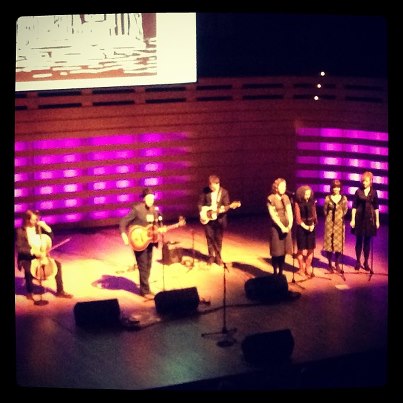
Marni Jackson’s brilliant script was based around two principles. Everything should centre around Al and his poetry; and there should be constant variety on the stage. So Gordon Pinsent was followed by Gord Downie, the lead singer of The Tragically Hip, who read “At the Quinte Hotel” then sang a song and played guitar.

Steve Heighton turned the event into a fashion show by wearing one of Al’s distinctive shirts (and recommending other items at the Silent Auction) before reading “Necropsy of Love.”

It was time for a Greek Chorus, with Gillian Savigny, Leigh Kotsilides (no typecasting there!), and Moez Surani, led by Robert Priest. They sang and then produced a choral version of “In Search of Owen Roblin.” Then Robert introduced young Alex Gagliano, who recited “Thank God I’m Normal” with its ringing final line, “ Why — why the sonsabitches!”

Michael Enright then brought his CBC gravitas to the proceedings, telling us the story of Al Purdy’s life. Then, in the role of M.C., which he was to adopt increasingly, he introduced more music in the form of author-musician Dave Bidini, of The Rheostatics, here appearing along with Bidiniband and The Billie Hollies. bidiniband

That rousing musical interlude led to the 35-minute intermission, where two of Patrick White’s friends, reluctant attendees, were exulting that this Al Purdy was clearly “the coolest guy ever!”

Here my account of the evening becomes scattered, because after the intermission I was backstage throughout (except for my moment in the sun, when I got to talk about my role as Al’s publisher, to pay tribute . . . very briefly . . .  to George Goodwin and the organising committee — “You’ll find their names in the programme” — before praising Eurithe, and Jean Baird “with us tonight from Vancouver.” Then it was “on with the show,” and an introduction for Ken Babstock).

But from my perch in the Green Room, watching the fuzzy screen, or from the wings, I enjoyed the video produced by Brian D. Johnson, then Phil Hall and Karen Solie doing their duet reading of “Shall We Gather at the River,” George Elliott Clarke, as Toronto’s Poet Laureate, reading “In Cabbagetown,” and then the Skydiggers (Andy Maize, Josh Finlayson and Michael Johnstone), who filed off, brushing shoulders with me as the applause from their music still rang around the hall.

After Ken Babstock, Michael Enright brought Margaret Atwood onstage for a sit-down interview (hey, we haven’t had an interview yet!), which was great fun (as listeners to The Sunday Edition were to learn). It ended with Margaret reading “Wilderness Gothic.” Dennis Lee then talked briefly about Al and read “In My Grandfather’s Country,” which sounded even better from the wings, where the cast was assembling for the Finale, where George Bowering led us in “Say the Names,” with chosen poets hollering out “Lillooet” or “Nahanni” on cue.

saythenames

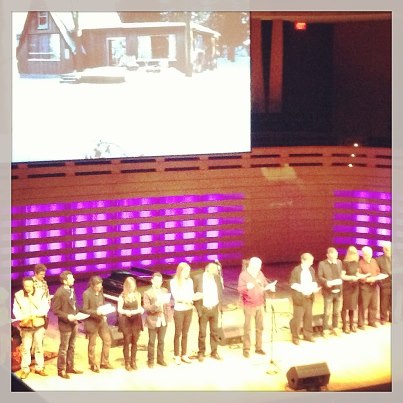
For this finale, which turned into a curtain call, Michael Enright and I bracketed the poets ranged along the stage. Beside me was Gordon  Pinsent, whom I had telephoned so many months ago to ask if he would perhaps be interested in helping with this event we were planning. To be with him as the waves of applause . . . no, more than that, the waves of affection . . . came washing over us from the audience was unforgettable. Then in an unrehearsed way we waved to the audience and walked off, dazed and delighted.

Later, when I was able to leave all the happy handshaking backstage, the audience was still filing out, and were clearly delighted, saying very kind things.

And, after the nail-biting lead-up, we ended up selling over 700 tickets! In fact, we ran out of programmes, because we had to set the number of the print run a couple of days in advance, when printing 500 seemed sensible. And we made money, and Duncan Patterson’s plans to fix up the A-frame can now go forward.

And, yes, as I had predicted to the Metro Morning audience, it was the sort of once-in-a-lifetime event where others will say . . . “You were there?”