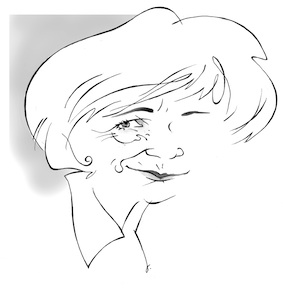
Douglas Gibson at Toronto’s Metropolitan United Church

On Sunday 20, January, the Metropolitan United Church in Toronto (at the heart of downtown, at Church and Queen ) will be hosting Doug Gibson’s show immediately after the lunch that follows the Sunday Service given by the Reverend Malcolm Sinclair.

The church service begins at 11:00, the lunch is held around 12:30, and the show will run from roughly 12:45 until 2:00. All are welcome.

Books will be available for sale and for autographing.

After more than 40 shows around Canada from coast to coast, this will be one of Doug’s rare public appearances in Toronto.

Alice Munro Is Not Often Associated with Disappointment

As many of you will know, this year’s Toronto International Festival of Authors was supposed to feature an appearance by Alice Munro on October 19. To be more precise, it was supposed to be an on-stage conversation between Alice and me. All of the tickets were sold, the media were panting, the excitement was building . . . and then Alice’s health meant that we had to cancel it.

I tried very hard to make it possible.

But there were warnings. For example, Alice was unable to come, as planned, to my stage show at the Blyth Festival on September 28th.  And can you imagine my anticipated pleasure at presenting my section on “ALICE MUNRO: Not Bad Short Story Writer,” in Blyth, the heart of Alice Munro Country, with Alice herself in the audience?

Blyth, I should explain, played a major role in Alice’s life. Her father, Robert Laidlaw, was born on a Blyth farm, went to school there, and eventually set up his  trap-line along Blyth Creek, to augment his role as a young Huron County farm boy. He went after muskrats, weasels, mink and even foxes, which led him to his life raising foxes for their fur, in nearby Wingham, where Alice grew up.

Alice, too, has strong links with the Blyth Festival Theatre. In the 1990s (as Robert Thacker recounts in his classic biography, Alice Munro: Writing Her Lives) she acted in two theatrical fundraisers there. In her words, quoted by an interviewing journalist, “In one  play – both of them were murder mysteries – I was an aging but still sexually voracious professor of English . . . And in another I played a lady writer who comes into the library and demands to know if any of her books are available. I loved it.”

Thacker continues, “When the journalist asked her why she would do this since she was well known for avoiding publicity connected with her writing, Munro’s response was interesting. “Well, that’s because I have to be me,” she says to explain her dislike of such self-promotion. “With acting, I love the mask.”

It was at a Blyth Theatre fundraising chicken supper that Alice played the mischievous waitressing role recounted by Val Ross in my book, and repeated in my stage show . . . the one that Alice was unable to attend.

But our Alice Munro Country weekend didn’t end after the show, which later featured a very interesting and informative panel discussion of Alice’s work. After spending the night with friends in Stratford, we headed back west to attend an event in Alice’s honour at the Wingham Golf Club, where the winners of a local writing competition were celebrated. The former Bayfield bookseller, Mary Wolfe, gave a fine account of Alice and her work, and Jane and I returned to spend the night at the Ben Miller Inn, on the Maitland River (always a source of unearned pride to a man with my middle name).

Later that week, to leave no stone unturned, I headed back from Toronto to Huron County to chat with Alice, to see if there was any way to salvage the Harbourfront event. I drove west from Stratford, on Highway 8, the old Huron Line that the settlers followed. As usual I found myself contentedly ticking off the familiar towns . . . Sebringville, Mitchell, Dublin (celebrated in my book for the realism of the settlers who named the majestic local waterway, “the Liffey Drain”), Seaforth, Clinton (Alice’s town, though tourists seeking directions to her house will encounter a veil of protective ignorance) and Goderich, where we were to meet for lunch.

I had not seen Goderich since last summer’s tornado tore through, and was shocked by the damage. When Alice and Gerry met me for lunch at the restaurant at the top of the hill going down to the Goderich harbour, I noted that Baillie’s, the restaurant on the “square” where Alice usually liked to meet friends, and where her books were displayed, had been wiped out, almost as if it had been the target of the storm. Alice chose to consider the gloomy possibility that this was the sign of a jealous God at work.

So she was her usual amusing self, but it soon became clear that all of my plans to make her Toronto stage appearance as undemanding — and as untiring — as possible for this 81-year-old were simply not going to work. So we had a nice lunch, and both of her arms remained untwisted. When we hugged goodbye, she noted fondly that we had been through “some interesting times over the years.” I was able to reply that I didn’t regret a moment of those, let’s see, 35 years.

But I do regret the Harbourfront show that we never gave. Speaking selfishly, it would have been a type of pinnacle for me. Speaking for the audience, and for Alice Munro admirers everywhere, I’m convinced it would have been a very memorable evening.

From Shore to Shore

Waking up to a fine fall day at The Blomidon Inn in Wolfville is a perfect start. Roaming around the inn’s varied gardens is a very good way to ease into the day. But walking into the little town then drifting down to the dykes that created the Acadian settlement is another level of happiness.

In my book I talk about my fascination with the dyking system introduced by the early Acadian settlers. So you can imagine my delight in being able to walk along the top of the historic dykes that run very close to downtown Wolfville. A class of lucky young students from Acadia was being introduced to the natural wonders of the dykes, but I walked east, away from town, noticing that the fields walled off from the sea are still so rich that some of them are devoted to growing fine crops of corn. And the Fundy sands were still red, the waters of the Bay were still blue, and the great wedge of Blomidon still stretched into the bay, like a backdrop to an Alex Colville painting.

I had seen, but never visited, Cape Blomidon, but this was the day to fix that. I drove west, then turned right towards Blomidon and reached “The Look Off” (do locals shout warnings of “Look off!” rather than “Look out!”, I wonder?). From that height you can see much of the Annapolis Valley laid out before you with the “sleepy little town” of the Acadia school song in the middle distance, looking very fine.

I drove on to the Blomidon Park (although I was tempted to drop in on Ami McKay) and climbed down the steps to walk along the beach. I wasn’t exactly dancing on the shore, but it was a delight to get red Fundy sand on my shoes, and to dip a hand into the salt water. Then it was back to the idyllic town of Canning for a fine lunch, then ho, for Halifax, and my last event. Although I did load up on local apples, Gravensteins, at a roadside stand.

Alexander MacLeod is a well-established teacher at St. Mary’s University (as well as being my friend, and a fine fiction writer, with excellent bloodlines). He had kindly arranged for me to stay at The Waverley Hotel, east on Barrington Street in downtown Halifax. It was a revelation! A traditionally furnished old Victorian hotel, where Oscar Wilde once stayed (with no comments about his room’s wallpaper ever recorded). I warmly recommend it to all literary visitors.

As for St. Mary’s, Alexander drove me to the fine old campus and established me in the room where I performed my show to about 40 kindly people, including my old friend Harry Thurston, the notable writer about the natural world. Harry, I’m glad to say, later wrote that he found my show “entertaining and moving,” which was a pleasing combination.

The next day, after a pre-breakfast stroll down the hill to where early bird fishermen were hauling dozens ( “I’ve got about 40 in the bucket here, so far”) of mackerel out of the Atlantic-facing harbour, it was time to leave that particular shore, and fly back to Toronto. But I’ll be back.

From the Sackville to Sackville

I gave my show at the theatre in the Art Gallery of Nova Scotia on a Saturday night, to an audience that included the veteran publisher Jim Lorimer and John Houston, the filmmaker son of my old igloo-dwelling friend James. Some old friends from my Speech at King’s College were there, too, and were polite about a sound system that had some problems. Books were sold, and signed.

The next day I went down to the Halifax waterfront, admiring the historic corvette, HMCS Sackville, that is tied up alongside as a floating museum. It’s a fine memorial to the Battle of the Atlantic that was largely fought out of Halifax and St. John’s, and the ship always draws me to it because in the 1970s I published the classic memoir of that war, The Corvette Navy, by James B. Lamb. These U-boat hunters were surprisingly small ships, and in mid-Atlantic they “rolled like pigs,”  but they won their part of the war.

Another reason for being on the waterfront is that it was the location for Halifax’s Word on the Street Festival. I roamed around the tented areas, visiting publishers’ booths and meeting old friends like Goose Lane’s Suzanne Alexander and Lesley Choyce of Pottersfield Press. But my main role was to be the host/interviewer for two author events. The first was with Ami McKay, author of The Birth House and, now, The Virgin Cure. Although the interview set-up had Ami and me arching like gospel singers at stand-up mikes at opposite sides of the stage, she is such an impressive performer that the interview/reading/Q & A went very well, and I was able at the end to escort her to a long signing queue.

Next it was Marina Endicott, talking about and reading from her new novel, The Little Shadows, which is terrific. In fact, I opened my interview with the words “Where have you been all my life?” She is precisely at that stage in a writer’s career when the prizes she has won and the nominations she has enjoyed are attracting readers to her work. For example, I admired The Little Shadows so much that I have since read her previous novel, Good to a Fault, with great pleasure. Both books are highly recommended.

Happily, Marina is as good a reader as she is a writer, and her time on stage flew by.

This was just as well, because I had to jump in my car and drive west all the way to Sackville, New Brunswick. I was to read at Mount Allison, at The Owens Gallery. Driving into Sackville, I encountered town and gown separation at its worst. Two young teenage girls at the town’s main crossroads had no idea where the Owens Gallery might be. It was perhaps four minutes walk along the very street we stood on.

The Marshlands Inn is the grand old Victorian hotel in town, where I had stayed on my previous visit (when, as my book describes, I became an Acadian), and it was there that I was picked up by Christl Verduyn, an old friend from her Trent university days, now on the Mount A. faculty. She and the student newspaper had done such a great job publicizing the Sunday evening event that we had 64 people in the audience, with some standing.

The show seemed to go down well, and I was especially pleased to meet long-range visitors from Moncton.

Afterwards, I was taken for dinner to Joey’s in downtown Sackville by  my friend Chris (of Sybertooth Inc., a gallant Sackville-based publisher that has picked up the Bandy Papers Series that I was proud to publish originally.) He and his wife drew me useful maps of how to explore the Tantramar marshes. The next morning, after wandering with my binoculars in town, I drove to High Marsh road, rambled across and through a covered bridge, then spotted a birdwatcher who confirmed that the dozens of little birds exploding into the air  around us were indeed migrating Savannah Sparrows.

It was time for me to migrate east to Wolfville, on the Bay of Fundy.

Stories About Storytellers Comes to the East Coast

Having already ranged all over Ontario, the Prairies, and the West Coast, Douglas Gibson is bringing his stage show to the Atlantic provinces at long last.

Between September 20rh and September 26th, he’ll be doing his stage show at the Art Gallery of Nova Scotia, Mount Allison University, Acadia University and St. Mary’s University. You can also catch him hosting Marina Endicott and Ami McKay at Halifax Word on the Street and giving the Flemming Lecture at King’s College.

For more information on dates and showtimes, head over to the events page.

Sunshine Sketches of a Little Coast

For 30 years they have held a literary festival at Sechelt. That very first year I was glad to send Jack Hodgins (from his Lantzville home on Vancouver Island, right across the Strait of Georgia from the Sunshine Coast ) as one of the five authors attending. He had a wonderful time, and reported back with great enthusiasm.

Over the years, as the little festival grew into the established “Sunshine Coast Festival of the Written Arts,” in my role as Publisher I was pleased to send a steady stream of authors to this festival, assuring them that they would “have a great time.” They always did.

This year, in my new role of author, I got to see for myself. The hard-working Jane Davidson had secretly attended my performance at the Vancouver Writers’ Festival last October, and followed up with an invitation to attend the Sunshine Coast Festival that she runs.

So August saw Jane and me flying in to Vancouver, then dashing off to catch a seaplane that skimmed up the coast to land us at Sechelt. There we were met by Sally Quinn, a welcoming volunteer who identified herself brilliantly by displaying a copy of my book . . . always visible to an author’s eye at 100 paces. A quick tour of Sechelt took us to the Festival site, where we met Jane D. (astonishingly calm, given that over the next three days she would be receiving more than 20 performing authors from across the country, yea, even unto Michael Crummey’s Newfoundland, and Linden MacIntyre, fresh from Edinburgh). I also got to see the hall where all of the readings/performances take place. It is an all-wood open structure, the ceiling held up with tall pine poles, lending the air of a West-coast longhouse (crossed with a Cathedral, as one admirer put it). Ten seconds on the empty stage were enough to show me that this was a very special space, open yet intimate.

Since one of the strengths of this fine festival is that all events take place there, with no competing events at different venues, Jane and I were to spend many happy hours in the audience at that theatre over the weekend, enjoying the varied readings, Q and As., conversations, and performances. I’m happy to report that my own tightly scripted but apparently informal Stories About Storytellers show was reviewed by the local paper as “polished ramblings.” Aha!

Most of the time we sat with our host and hostess, the authors Sharon Brown and Andreas Schroeder, who live just outside Sechelt as “Roberts Creekers.” (Over time, we warned them, “Roberts Creakies” may apply.) We had the great good fortune to stay at the cabin down by the shore that Sharon and Andreas (whom I have published with great pleasure over the years) provide for lucky friends. And the blackberries! Words fail.

One of the high points of the festival is that at the end of each session, the great Hall is cleared, and everyone files out to drink, chat, or (usually) line up for the next session starting in 30 minutes. As a result, the placid queues along the Rhododendron-lined paths are a great place to meet old and new friends, and to chat about books and authors.

The local support for the festival is all you would hope for, and people are proud of what they have built up over the years. One retired man who sought me out to sign his copy of my book said it best. When I commented on what a great thing for the community this festival must be, he said, “This is why we moved here.”

A footnote: on Sunday Andreas took us for a quick tour of Gibsons, just to the south. For someone with my name, the place is a goldmine for delusions of grandeur. A quick tour reveals “Gibson’s Cinema,” “Gibson’s Curling Club,” “Gibson’s Swimming Pool” and so on and on. At the waterfront (near where The Beachcombers was filmed) is a statue of Captain George Gibson, who founded the town in the 1880s, rowing his produce down the coast to Vancouver. I posed proudly with my arm around his oilskin-clad shoulders, and felt right at home.

Praise from the Sunshine Coast

The Coast Reporter . . . Voice of the Sunshine Coast” recently ran a very nice report on this year’s superb Festival of the Written Arts at Sechelt under the heading “Making history — 30 Years of Festival.” The final paragraph reads,

“But it was the respect for history that dominated this 30th festival. It could be felt in the work of (Jane) Urquhart whose books turn on scenes from Canada’s past, and in the humorous anecdotes about Canadian literary giants, as told by editor Douglas Gibson. The polished ramblings of this career editor and publisher, more than any other speaker, reminded the audience of how this country’s literary tradition is still youthful, and how it has blossomed into adolescence over the last 30 years, completely in step with a festival that has proudly fostered its growth.”

Read the full article here.

Arnprior Is a Priority

The day after my time swanning around the Chateau Laurier as one of the Honoured Guests at Politics and the Pen, I was picked up at the hotel and whisked an hour west to Arnprior. The whiskers were my old friends David Lewis Stein and his wife, Alison. Dave is famous as the author (whom I’m proud to have published) and Toronto Star columnist who dressed like a Damon Runyon character, a fedora always perched on his head. He was also famous as the man who really knew Toronto city politics, inside out, and was the ultimate streetwise, big-city guy. And now he has retired to Arnprior, a little town of about 8,000 in the Ottawa Valley, where Alison’s family has ancient links.

How are they doing? Very well indeed, to judge from my happy stay with them at the big Victorian house that sits about 100 yards away from the distinctive Arnprior Museum, where Alison puts in volunteer time. About fifty yards down the main street is Gwen Storie’s bookstore.That evening the amazing Gwen and her staff rearranged the store to accommodate 40 paying customers ($15.00, including a delicious snack in the bakery next door) and I gave my show.

And we sold 26 copies! If you walk down the street in Arnprior, the odds that the first person you meet has a copy of my book at home are pretty good!

The more serious message is that a good local bookstore can act as an important community centre, and I’m glad to do all I can to help the Gwen Stories of this world.

Uxbridge (Or, More Formally) Tuxbridge

Uxbridge (or, as Terry Fallis amended it, since it was a formal dinner, “Tuxbridge”) staged a fine “Book Lover’s Ball” on April 14 in aid of the local Library.

The setting was the local “Wooden Sticks Golf Club,”  a name that spoke to the ancient tradition of golf clubs with hickory handles. I was able to mention that in my ancient Scottish village, I actually grew up playing golf with “wooden stick” clubs, which at the time seemed normal to me. But then, true to my “make things last” Scottish roots, that evening I was wearing the tux that my parents gave me as a 21st birthday present. Dinner jackets don’t change much over 47  years, and nor does my lean shape — nor my respect for my parents’ admonition that if I looked after the tux properly I “should get many years of wear out of it.”

The excellent Terry spoke about his three books (The Best Laid Plans, The High Road, and this fall’s Up and Down, which will prove that he can make readers laugh, and also make them cry) and delighted the audience after the salad course. I did my stuff after the (very fine) chicken course, talking about a few of the authors featured in my book, and telling stories about them.

But the best speaker of the evening  — and by far the best storyteller — was Michael, a local dentist. He spoke about his family’s experience  escaping from Vietnam as “boat people” who were sponsored by kind people in Uxbridge. The local librarian made a special point of always asking him what he was reading, and, like dental patients flossing before an appointment (an interesting professional analogy), he read voraciously, to be always able to answer her question.

When the family was moved away from Uxbridge to downtown Toronto, although his parents both worked two jobs, things were hard for the young family in a tough area. In time their Uxbridge friends contacted them with an offer that would bring them back to Uxbridge, with a down payment on a house supplied by an anonymous benefactor. The family accepted gladly, on one condition: that they learn the name of the benefactor, in order to pay him or her back.

It was the librarian.

Now here was Michael (like his brothers and sisters a successful professional) giving back to the Uxbridge community by providing major sponsorship for this fundraiser for the Uxbridge Library.

Stories really matter, don’t they?