STRATFORD, CLINTON, AND ALICE MUNRO

ALICE MUNRO 1931– Not Bad Short Story Writer

ALICE MUNRO 1931– Not Bad Short Story Writer

My two Stratford shows – in the grand old City Hall building, right downtown, near the Avon theatre – were inspiring for me. The school show on Friday afternoon drew a crowd of adult friends, including Geoff Hancock , the former editor of Canadian Fiction (and photographer of Mavis Gallant), who now runs a B&B in Stratford, and the Stratford Festival’s David Prosser. But the main audience was a large group of high-school kids brought in by bus.

I was able to speak briefly about their home town to the kids from Exeter – home of the unique breed of all-white squirrels, and of the famous family of my Toronto  friend John MacNaughton, who died a few months ago.

I was, however, able to speak at much greater length to the Grade 12 kids from Clinton. This, of course, is the town where Alice Munro lives, and I was able to suggest to them how amazingly lucky they were to live in the same place as a world-famous writer who was putting their town on the literary map of the world, an internationally famous figure they might meet on the way to the Post Office. I talked about how her stories were set among people like their neighbours, and explained how famous Alice (“the living writer most likely to be read in 100 years time”, according to The Atlantic magazine) really was.

The next day word filtered back from a teacher that conversation among the kids on the bus home included the comment that this was the first time they had “ever felt proud about coming from Clinton”.

The next night’s show (part of Stratford’s Springworks Festival ) was for adults, and went fine. The sound man, who had worked at The Banff Centre and fallen under W.O. Mitchell’s spell, was hit hard by my final story about the unforgettable W.O.. After the show, our hosts, Lucille Roch and Warren Holmes, held a reception for us, and as we entered they kindly led a round of applause. It was a pleasant surreal moment (“I’m being applauded as I walk into a friend’s house!”), but it was nothing compared to the news of the impact on the kids from Clinton.

Quebec City

Thanks to local friends like Neil Bissoondath I was lucky enough to be invited to the Quebec City InterNational authors event, an English-language event that takes place in the heart of the old city every spring. The organizer, Elizabeth Perreault, is so calm and efficient on e-mail that I was expecting a much older person than the fresh-faced young woman who greeted Jane and me.

She runs a top-class festival, too, with authors like Charles Foran, Emma Donoghue, and Guy Vanderhaeghe in attendance. We saw readings in two remarkable rooms in The Morrin Centre, in the heart of old Scottish Quebec. If you think I exaggerate there, The Morrin Centre (named after a Scottish doctor from the early 19th century) is on the Chaussée des Écossais, and is right opposite the old Scottish Church and the “Kirk Hall.”

Inside, the great hall of the Centre (housing The Literary and History Society)  is constructed on 19th century Scottish traditional lines, so that the electric light bulbs seem almost like an intrusion. The library is equally famous, with its wooden statue of Wolfe casting a dramatic arm from a corner of the two-story ranks of shelves. Louise Penny fans will be familiar with the setting, and after seeing Peter Dube talking about his books there, I learned that ancient authors from Charles Dickens to Mark Twain had given readings there.

After Guy Vanderhaeghe entertained us with tales of Western History in this Eastern city, I recalled for him that it was exactly 30 years earlier that he and I celebrated his Governor-General’s Award win for Man Descending in this city. The actual award was given in an ancient room in the Laval campus downtown, but Guy remembered that the evening dinner was held in the Royal 22 (the Van Doos) Regiment’s Mess room at the Citadelle, with the waiters in full red mess uniforms. I was in a daze of delight that evening because as the Publisher at Macmillan I was celebrating two Governor- General’s Awards that year, for Guy’s short stories and Christopher Moore’s superb history book, Louisbourg Portraits.

On the Sunday afternoon I gave my show in the grand old hall, introducing a Guy Vanderhaeghe anecdote from my book that doesn’t usually feature in my stage show. It’s the story of my edgy walk back into Saskatoon alongside a gigantic guy who had just exited a bar, running very fast, and who asked me, in a challenging way, “Are these women’s boots?”

The crowd seemed to like that story, and the rest, so that at the end they gave me a standing ovation. (Jane, I must report, far from leading this excellent development, said to Elizabeth Perreault, “Do I have to stand up?” If anyone wonders about my being a grounded sort of fellow, look no farther than this story for a reason.) But a standing ovation in Quebec City is something worth recording, if I can find a suitably capacious tombstone.

The rest of our visit was taken up with a wonderful dinner chez Bissoondath, and three days of strolling around old Quebec from our central base at the Hotel Clarendon.

One feature of the weekend involved a coincidence that no fiction writer would dare to attempt. In the appreciative crowd for Guy Vanderhaeghe was a nice fellow who proved to be the American consul-general, Peter O’Donohue. What led to his appointment here, we wondered. Well, he grew up in Connecticut and knew Quebec well. Where in Connecticut, Jane wondered, because she had an uncle and aunt in Norwalk. Norwalk! What were their names? The Finlaysons, my God, I practically grew up in their house!

It turned out that Jane and he had been at cousins’ weddings, and two of her cousins are going to stay with him at his amazing house overlooking the slide on Dufferin Terrace, near the Chateau Frontenac

The next day the coincidences continued, because our sight-seeing stroll took us past the magnificent Consulate just as his wife was in the doorway, greeting a friend. We ended up with a tour inside, and spent time gazing over the St. Lawrence from Levis to L’Ile D’Orleans. A magical view, and a magical weekend. And almost 20 more books sold!

Montreal

The Atwater Library is based in the former Mechanic’s Institute building, which means that it has an impressive background in social democratic movements that believe that education and advancement should not be restricted by class. Even today the building houses writers organisations and other fine, progressive but penny-pinched groups.

I enjoyed my tour around with the Newfoundland-born Librarian, Lynn Verge, then watched 60 or so literary types assemble for my talk/show, including authors like Mark Abley and George Tombs, and my old historian friend Desmond Morton. Also there was my fellow-publisher Simon Dardick (who confirmed sympathising with my attempt to cut Mavis Gallant’s speech short, which led to the famous jacket quote “I’ll kill him! — surely a first in the history of jacket blurbs). It was a show where I whizzed through all of the Tony Jenkins caricatures then asked the crowd who they’d like to hear stories about. The requests came thick and fast, including a tricky question from my hostess, Pat Webster, who asked if I edited political memoirs differently from other books. Very interesting. Good questions make you think hard.

What was special about this show was that I had lots of Montreal scenes to recall, and a remarkable new James Houston story to tell. In the train from Toronto I was near Cornwall when I was puzzling over  how best to talk about Jim’s Montreal connections. I happened to look out of the train window, and saw strings of geese heading north. At first there were just three or four v-shaped groups heading north, then ten then twenty, then fifty, sixty, then hundreds. Soon there were scores of thousands of geese filling the skies, all heading north to James Houston’s Arctic. I looked around the train, and nobody else seemed to be aware of the miracle that was filling the skies above us.

At the end of the show we sold about 20 books, which leaves a few potential readers in Montreal still to be tapped. I shall return.

In the evening I filled a major gap in my all-Canadian education by attending, with Norman Webster, my very first Habs’ home game. They won!

The skies above the train on the way back to Toronto were empty.

Stratford and Me

I’m getting more and more excited  about my show at the Stratford City Hall on Saturday, May 11, at 8 p.m.

It’s part of the famous SpringWorks festival, and I’ll also be giving a special show for schools on the Friday afternoon. This has set me wondering just how well a young audience will react to stories from behind the scenes in the world of books, a world that alarmists warn is increasingly remote from their own world. Maybe a Harry Potter comparison or two would be helpful . . . especially the story of idiot publishers turning down J.K. Rowling’s first Harry Potter manuscript!

I’m spending some time recalling my own Stratford connections. As a publisher I was proud to bring out the official  Festival history, Stratford: The First Thirty Years by John Pettigrew and Jamie Portman in 1985. That handsome two-volume edition was published by me at Macmillan of Canada, with a Foreword by Robertson Davies. I note with pleasure that he dated his Foreword “March 1, St. David’s Day,” and we, sparing no expense, ran his distinctive signature in blue ink. I forget why blue was regarded as the ideal colour for the signature of this avid supporter of the festival from its earliest years. Blue?

Later, the link between Robertson Davies and the festival was made clear, in the saddest of settings. Along with John Fraser, RD’s successor as the Master of Massey College, I was involved in arranging the Celebration of the Life of Robertson Davies at Convocation Hall in Toronto in 1995. I asked Richard Monette, then the Artistic Director of the Stratford Festival, to join the group of speakers paying tribute to the Master’s life, and Richard did a superb job, speaking of RD as a Stratford supporter, and as a man of the theatre. That memorable evening had two other speakers with Stratford links: Timothy Findley, a festival alumnus, and Jane Urquhart, for many years a Stratford resident.

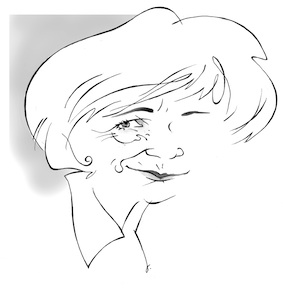
Like most Ontarians I have warm memories of many fine visits to Stratford, usually theatrical, but sometimes involving visits to friends like Geoff Hancock, Lynn Schellenberg, or Lucille Roch. I have even met Alice Munro for lunch there. But usually my meetings with Alice were at her home in Clinton or in Goderich. This meant that to follow the old Huron Line I would take a right turn at Stratford City Hall, and head west into Alice Munro Country. It’s appropriate that the building I used as my landmark for that turn to visit Alice will now house my show, with its tribute to Alice and her achievements . . . although the caricature of Alice bears the mischievous subtitle  “Not Bad Short Story Writer.”

Politics and the Pen

For many years now the Writers’ Development Trust has sponsored a very successful fundraising event in Ottawa. The March dinner at The Chateau Laurier is now a fixture on the Ottawa social scene, with guests promised that their table will feature both a politician and an author.

In the past I used to attend the dinner as a Publisher. In fact, my book tells the story that I first met Sheila and Paul Martin when I was placed at the Prime Minister’s table because an organizer had said, “Oh, Doug can talk to anyone.” And I always had a good time, especially when my authors (such as Max and Monique Nemni) were winning the evening’s big award, The Shaughnessy Cohen prize.

After my book came out, however, I was upgraded, and became An Author. This meant that I was invited to attend, free, flown to Ottawa, and very well cossetted at the dinner, where all authors are issued a medal and a colourful ribbon (green last year, red this year) to hang the medal around the neck like a Nobel Prizewinner. It’s all very good fun, and an excellent cause.

Before the dinner I had the perfect Ottawa afternoon. First I met with Sean Wilson, who runs the Ottawa Book Festival. It’s a very successful series that helped me a lot. In the Fall of 2011, when my book was just days old, and I had hardly started to tour my show, Sean took a chance on the stage show, and we were both relieved when it worked out well — and we sold out of every copy of my book. The future seems bright for his festival, although arts programming is never easy.

Next I spent a fascinating half hour at the office of my old friend Jeffrey Simpson, of the Globe and Mail. He’s always full of  interesting ideas (the man’s a columnist, after all!) but he’s also a fascinating witness to major changes in the Canadian Book business. He has produced non-fiction best-sellers about Canadian public issues in the 1980s, the 1990s, the 2000s, and right up until last year, when his book about our medical system hit the stands.

He tells me that everything has changed from the “magic carpet” days when your publisher would whisk you around the country from city to city, from one book talk show to the next. Now it’s up to the author to behave as his or her own publicist (he used the adjective “brazen”) and he estimated that of the 40 or so public appearances/speeches he made to promote his new book, he personally arranged 75% of them. He and I were excitedly confirming each other’s findings that the new world out there demands ever more active author involvement in promotion — although I can’t promise a one-man stage show from Jeff Simpson in the near future.

My final stop was at the CBC building, where my wife’s niece, Amy Castle, the Producer of the daily TV show, Power and Politics, invited me to sit in on the control room. Fascinating!

Everyone knows about the number of screens up there at the front of the room, and the constant directions to switch to this camera or this piece of film, but the instant typing of the links for the host  on the teleprompter, and the guy at the front choosing which tweets to add as crawlers to the screen were new to me. I was supposed to be quiet and anonymous – my desired state, of course – but when a Liberal backbencher was introduced and there was loud uncertainty in the room about the spelling of her first name, I was able to announce “Kirsty” very decisively; she’s a friend.

After that it was time to rush to the Chateau Laurier and don my 48-year-old dinner jacket, plus medal, and mingle. I suspect that few guests were able to range as widely on the political spectrum, chatting with old friends from Ed Broadbent to Preston Manning. Among the authors I enjoyed chatting with at the loud cocktail party were Lisa Moore (fresh from her victory in Canada Reads), Lawrence Martin, Paul Wells, and David Miller (who is a good enough friend that I have never raised the name Rob Ford in his presence). And I later was able to tell Justin Trudeau stories about his father that he had never heard, including my “Trivial Pursuit” moment, when he almost killed me. (It’s in the Trudeau chapter.)

At our table I had a very good time, but did not shine. In my role as Author, I went around the table to meet my companions. I found myself sitting beside a very pleasant woman named Diana, who spoke with an English accent. Because we had just established that our neighbours were Swiss diplomats, and since she had mentioned that she was moving back to England very soon, I asked her if she, too, was in the diplomatic service. Not exactly, she replied, she was moving to England because her husband had just been appointed the new Governor of the Bank of England.

Nice work, Doug.

Alice Munro Is Not Often Associated with Disappointment

As many of you will know, this year’s Toronto International Festival of Authors was supposed to feature an appearance by Alice Munro on October 19. To be more precise, it was supposed to be an on-stage conversation between Alice and me. All of the tickets were sold, the media were panting, the excitement was building . . . and then Alice’s health meant that we had to cancel it.

I tried very hard to make it possible.

But there were warnings. For example, Alice was unable to come, as planned, to my stage show at the Blyth Festival on September 28th.  And can you imagine my anticipated pleasure at presenting my section on “ALICE MUNRO: Not Bad Short Story Writer,” in Blyth, the heart of Alice Munro Country, with Alice herself in the audience?

Blyth, I should explain, played a major role in Alice’s life. Her father, Robert Laidlaw, was born on a Blyth farm, went to school there, and eventually set up his  trap-line along Blyth Creek, to augment his role as a young Huron County farm boy. He went after muskrats, weasels, mink and even foxes, which led him to his life raising foxes for their fur, in nearby Wingham, where Alice grew up.

Alice, too, has strong links with the Blyth Festival Theatre. In the 1990s (as Robert Thacker recounts in his classic biography, Alice Munro: Writing Her Lives) she acted in two theatrical fundraisers there. In her words, quoted by an interviewing journalist, “In one  play – both of them were murder mysteries – I was an aging but still sexually voracious professor of English . . . And in another I played a lady writer who comes into the library and demands to know if any of her books are available. I loved it.”

Thacker continues, “When the journalist asked her why she would do this since she was well known for avoiding publicity connected with her writing, Munro’s response was interesting. “Well, that’s because I have to be me,” she says to explain her dislike of such self-promotion. “With acting, I love the mask.”

It was at a Blyth Theatre fundraising chicken supper that Alice played the mischievous waitressing role recounted by Val Ross in my book, and repeated in my stage show . . . the one that Alice was unable to attend.

But our Alice Munro Country weekend didn’t end after the show, which later featured a very interesting and informative panel discussion of Alice’s work. After spending the night with friends in Stratford, we headed back west to attend an event in Alice’s honour at the Wingham Golf Club, where the winners of a local writing competition were celebrated. The former Bayfield bookseller, Mary Wolfe, gave a fine account of Alice and her work, and Jane and I returned to spend the night at the Ben Miller Inn, on the Maitland River (always a source of unearned pride to a man with my middle name).

Later that week, to leave no stone unturned, I headed back from Toronto to Huron County to chat with Alice, to see if there was any way to salvage the Harbourfront event. I drove west from Stratford, on Highway 8, the old Huron Line that the settlers followed. As usual I found myself contentedly ticking off the familiar towns . . . Sebringville, Mitchell, Dublin (celebrated in my book for the realism of the settlers who named the majestic local waterway, “the Liffey Drain”), Seaforth, Clinton (Alice’s town, though tourists seeking directions to her house will encounter a veil of protective ignorance) and Goderich, where we were to meet for lunch.

I had not seen Goderich since last summer’s tornado tore through, and was shocked by the damage. When Alice and Gerry met me for lunch at the restaurant at the top of the hill going down to the Goderich harbour, I noted that Baillie’s, the restaurant on the “square” where Alice usually liked to meet friends, and where her books were displayed, had been wiped out, almost as if it had been the target of the storm. Alice chose to consider the gloomy possibility that this was the sign of a jealous God at work.

So she was her usual amusing self, but it soon became clear that all of my plans to make her Toronto stage appearance as undemanding — and as untiring — as possible for this 81-year-old were simply not going to work. So we had a nice lunch, and both of her arms remained untwisted. When we hugged goodbye, she noted fondly that we had been through “some interesting times over the years.” I was able to reply that I didn’t regret a moment of those, let’s see, 35 years.

But I do regret the Harbourfront show that we never gave. Speaking selfishly, it would have been a type of pinnacle for me. Speaking for the audience, and for Alice Munro admirers everywhere, I’m convinced it would have been a very memorable evening.

From Shore to Shore

Waking up to a fine fall day at The Blomidon Inn in Wolfville is a perfect start. Roaming around the inn’s varied gardens is a very good way to ease into the day. But walking into the little town then drifting down to the dykes that created the Acadian settlement is another level of happiness.

In my book I talk about my fascination with the dyking system introduced by the early Acadian settlers. So you can imagine my delight in being able to walk along the top of the historic dykes that run very close to downtown Wolfville. A class of lucky young students from Acadia was being introduced to the natural wonders of the dykes, but I walked east, away from town, noticing that the fields walled off from the sea are still so rich that some of them are devoted to growing fine crops of corn. And the Fundy sands were still red, the waters of the Bay were still blue, and the great wedge of Blomidon still stretched into the bay, like a backdrop to an Alex Colville painting.

I had seen, but never visited, Cape Blomidon, but this was the day to fix that. I drove west, then turned right towards Blomidon and reached “The Look Off” (do locals shout warnings of “Look off!” rather than “Look out!”, I wonder?). From that height you can see much of the Annapolis Valley laid out before you with the “sleepy little town” of the Acadia school song in the middle distance, looking very fine.

I drove on to the Blomidon Park (although I was tempted to drop in on Ami McKay) and climbed down the steps to walk along the beach. I wasn’t exactly dancing on the shore, but it was a delight to get red Fundy sand on my shoes, and to dip a hand into the salt water. Then it was back to the idyllic town of Canning for a fine lunch, then ho, for Halifax, and my last event. Although I did load up on local apples, Gravensteins, at a roadside stand.

Alexander MacLeod is a well-established teacher at St. Mary’s University (as well as being my friend, and a fine fiction writer, with excellent bloodlines). He had kindly arranged for me to stay at The Waverley Hotel, east on Barrington Street in downtown Halifax. It was a revelation! A traditionally furnished old Victorian hotel, where Oscar Wilde once stayed (with no comments about his room’s wallpaper ever recorded). I warmly recommend it to all literary visitors.

As for St. Mary’s, Alexander drove me to the fine old campus and established me in the room where I performed my show to about 40 kindly people, including my old friend Harry Thurston, the notable writer about the natural world. Harry, I’m glad to say, later wrote that he found my show “entertaining and moving,” which was a pleasing combination.

The next day, after a pre-breakfast stroll down the hill to where early bird fishermen were hauling dozens ( “I’ve got about 40 in the bucket here, so far”) of mackerel out of the Atlantic-facing harbour, it was time to leave that particular shore, and fly back to Toronto. But I’ll be back.

Acadian Adventures of the Idle Rich

In Nova Scotia, all highways lead to Truro. Yet a Wolfville-bound traveller with time to spare and a love of the landscape can turn off the fast highway system at Truro and drift west along the Fundy shore, winding through little towns like the magically named Maitland. Gifted with that middle name (my mother was Jenny Maitland) I was excited to find that it is a little town laced with beautiful old houses, many now being restored.

I stopped at the local store to grab a sandwich, and casually asked how the place got its name. “It’s a native name,” I was told. My comment that this would be news to thousands of Scottish Maitlands made little impression. Could this be part of the weird intermingling of Scottish and Native history in Nova Scotia, where some believe that Glooscap was really a Scottish explorer named Sinclair? An enquiry for another time.

I drove happily on to Wolfville, pausing to notice that the incoming tide, off to the right, was racing in so fast that I could see sandbars disappearing every ten seconds.

Wolfville is a university town. Just as the ebb and flow of the Fundy tides rules the landscape, so the Acadia University year rules the town. During the academic year, when the 3,500 students transform the town, the movement of young people down from the slopes of the campus into the town is almost tidal. Driving along the main street I foolishly wondered what was causing the stop-and-go traffic. Then I realised that we were obviously between classes, and scores, even hundreds, of students were casually exerting their right to drift across the street, halting cars like mine. Not a bad traffic planning principle.

It is time to celebrate the Acadia school song. It goes:

Far above the dykes of Fundy
And its basin blue
Stands our glorious alma mater
Glorious to view.

Lift the chorus
Speed it onward
Sing it loud and clear
Hail to thee,
Acadia, hail to thee.

Far above the busy highway
And the sleepy town
Raised against the arch of heaven
Looks she proudly down.

They don’t write them like that today. I’d love to hear it sung.

I’m sorry to report that nobody serenaded me when I drove up the hill to the K.C. Irving Building to meet my gracious host, Andrea Schwenke Wyile. But before we went down to the basement theatre we paused to look in at the main hall, which is arguably the most welcoming space in any Canadian University I have seen. Almost worth going back to the world of classes and papers just to get to sit and read there, and think great thoughts.

Andrea (a specialist in books for children) was able to help me with the technical set-up, but the absence of security meant that we had to baby-sit the computer once it had been set up. Her gallant husband, Herb Wyile (author of the well-known book on Canadian historical fiction Speaking in the Past Tense, not to mention Anne of Tim Hortons) brought her food from home, and I was able to slip away to the Blomidon Inn to get into my “costume.”

As usual, before the start of the show I tried to greet my audience, mingling with them and welcoming them to what I hoped would be a good time. This evening before the show I was delighted to meet Terry Fallis’s in-laws, who live in Wolfville, and who were later pleased that I incorporated a tribute to Terry (“Saint, Little Red Hen, and Prizewinner”).

When the event started, things rapidly went downhill, because in introducing me Andrea laid great stress on the role of Jennifer Knoch, a recent and fondly remembered Acadia graduate, and the editor of my book.  I went on to repeat the tributes, so that many miles to the east Jen was blushing hotly for some reason unknown to her. The Acadia students, however, were visibly pleased by all this, as an inspiring example of good things happening to Acadia graduates just like them, and in the Q and A session I was able to reinforce this piece of inspiring news.

The show went well, the Q and A session was fun (including questions from some of Jen’s old teachers), and I signed a few books. Then I followed the line of least resistance down the hill and drove back through town to the grand old Blomidon Inn. It is such a traditional Victorian mansion that when I asked for a drink they directed me to a deserted drawing room, the Rose Room. There I sat sipping my colour-coordinated cranberry juice, and thinking that Wolfville is a fine place to be. Idle rich, indeed.

From the Sackville to Sackville

I gave my show at the theatre in the Art Gallery of Nova Scotia on a Saturday night, to an audience that included the veteran publisher Jim Lorimer and John Houston, the filmmaker son of my old igloo-dwelling friend James. Some old friends from my Speech at King’s College were there, too, and were polite about a sound system that had some problems. Books were sold, and signed.

The next day I went down to the Halifax waterfront, admiring the historic corvette, HMCS Sackville, that is tied up alongside as a floating museum. It’s a fine memorial to the Battle of the Atlantic that was largely fought out of Halifax and St. John’s, and the ship always draws me to it because in the 1970s I published the classic memoir of that war, The Corvette Navy, by James B. Lamb. These U-boat hunters were surprisingly small ships, and in mid-Atlantic they “rolled like pigs,”  but they won their part of the war.

Another reason for being on the waterfront is that it was the location for Halifax’s Word on the Street Festival. I roamed around the tented areas, visiting publishers’ booths and meeting old friends like Goose Lane’s Suzanne Alexander and Lesley Choyce of Pottersfield Press. But my main role was to be the host/interviewer for two author events. The first was with Ami McKay, author of The Birth House and, now, The Virgin Cure. Although the interview set-up had Ami and me arching like gospel singers at stand-up mikes at opposite sides of the stage, she is such an impressive performer that the interview/reading/Q & A went very well, and I was able at the end to escort her to a long signing queue.

Next it was Marina Endicott, talking about and reading from her new novel, The Little Shadows, which is terrific. In fact, I opened my interview with the words “Where have you been all my life?” She is precisely at that stage in a writer’s career when the prizes she has won and the nominations she has enjoyed are attracting readers to her work. For example, I admired The Little Shadows so much that I have since read her previous novel, Good to a Fault, with great pleasure. Both books are highly recommended.

Happily, Marina is as good a reader as she is a writer, and her time on stage flew by.

This was just as well, because I had to jump in my car and drive west all the way to Sackville, New Brunswick. I was to read at Mount Allison, at The Owens Gallery. Driving into Sackville, I encountered town and gown separation at its worst. Two young teenage girls at the town’s main crossroads had no idea where the Owens Gallery might be. It was perhaps four minutes walk along the very street we stood on.

The Marshlands Inn is the grand old Victorian hotel in town, where I had stayed on my previous visit (when, as my book describes, I became an Acadian), and it was there that I was picked up by Christl Verduyn, an old friend from her Trent university days, now on the Mount A. faculty. She and the student newspaper had done such a great job publicizing the Sunday evening event that we had 64 people in the audience, with some standing.

The show seemed to go down well, and I was especially pleased to meet long-range visitors from Moncton.

Afterwards, I was taken for dinner to Joey’s in downtown Sackville by  my friend Chris (of Sybertooth Inc., a gallant Sackville-based publisher that has picked up the Bandy Papers Series that I was proud to publish originally.) He and his wife drew me useful maps of how to explore the Tantramar marshes. The next morning, after wandering with my binoculars in town, I drove to High Marsh road, rambled across and through a covered bridge, then spotted a birdwatcher who confirmed that the dozens of little birds exploding into the air  around us were indeed migrating Savannah Sparrows.

It was time for me to migrate east to Wolfville, on the Bay of Fundy.

The Mills of Eden Grind Fine

I have attended the Eden Mills Writers’ Festival, just outside Guelph, on several occasions, but always as a supportive publisher, cheering on an author or two. This year, in my new role of Author, I got to attend the Saturday evening dinner held in the fine garden of a festival supporter.

As always, the literary festival magic took over, as I and other friends from the author circuit greeted each other with glad cries (“Hello, Angie!” “Don, I’ve got some great birding stories from the Prairies for you.” “Alistair, how are you?”) and enjoyed an outdoor meal warmed by heaters as night fell around us.

The next day, after parking my car with the help of solemn air cadets, I wandered around in the sunshine dropping in on various readings in the various sites around the little village. In the authors’ “Green Room” (actually in a blue house) I mingled with the likes of George Elliott Clarke and Donna Morrissey, although Richard Gwyn and Linden McIntyre tried to exclude me, on the grounds that I was really a publisher. I can reveal the exciting secret that the Green Room supplies authors with snacks (celery! carrots!) and soft drinks and wine. There is even a special washroom!

Alistair MacLeod and I walked to our show, which was in the little church nearby. The “little” proved to be a problem. We learned afterwards that disappointed fans of Alistair were to be seen pressing against the outside of the windows in the hope of hearing his reading, but the church proved to be soundproof. My own role, in what I described as “a Punch and Judy show” was to talk about my role in extracting No Great Mischief from him, and to set the urban legend straight I read the relevant passage from my book about the famous “home invasion.”

Alistair then read the tragic scene of the deaths on the spring ice from No Great Mischief, and the third part of our show consisted of me being mischievous, prodding the chuckling Alistair to tell stories like the famous midnight ride from Calgary to Banff that he took with W.O. Mitchell and a nervous cab driver not familiar with blizzards. The Question and Answer session went well, and on leaving I was pleased to meet the church’s minister who that day had preached from a text taken from my pal Trevor Herriot’s River in a Dry Land.

In the autographing session that followed I disobeyed my own rule for authors that you should never engage in a joint session with a famous and popular author. So I sat there beside Alistair while 50 eager fans lined up in front of him, and the kind people from the Book Shelf in Guelph engaged me in distracting conversation. I did, in fact, sign a few copies, but it was a tiny portion of Alistair’s, and the area in front of me was a still centre compared with the eager dozens lined up before him.

As he signed copy after copy I leaned over to whisper that he should sign the words, “Please buy my friend Doug Gibson’s book,” but I think he failed to do so.