The Zen of Authordom

I was pleased to see that this Sunday’s Toronto Star ran an excerpt from my Epilogue, which consists of Awful Warnings to new authors about the terrible things that will happen to them when their book is published. My piece is very cynical, and outsiders to the book world find it very funny, and totally unrealistic. Interestingly, the Star’s Insight Editor takes a different view. Under the title “Authors, be warned . . .” his subtitle runs “Book publisher covers a glorious CanLit career in a new memoir, including bang-on author advice.”

“Bang-on”? My cynical description of all of the possible review horrors seems to Dan Smith to be “bang-on”? And Dan was the Star’s Book Review editor for over a decade. Very interesting.

One of the good things in an author’s life is that, if you are very lucky, your book may produce fascinating new information from readers. For example, Ralph Hancox, who worked with Robertson Davies at the Peterborough Examiner, elaborates on my line about the great leap forward in Davies’ work to Fifth Business:

“I asked him,” writes Ralph from Victoria, “what had brought about the change . . . his study of the works of Freud, Jung?”
“No,” he said. “I could not have written such material before my mother and my father had died. I would have
been a sorry outcast to them both.”

We all shake our head at the thought of Davies, aged 57 when the book came out, until that point being constrained by what his parents would think.  And then I realize that at 67, I (as my W.O. Mitchell chapter reveals) am still subject to what my 98-year-old mother will say when she encounters “bad language” in my book.

So you’ll find me chickening out of a Bill Mitchell line by saying “. . . well, let’s just say the term Bill used resembled ‘sock-kickers.’” There’s room for a really useful Ph.D. Thesis here. And what, dear reader, would you do?

One of the bad things in an author’s life is that eagerly-awaited reviews don’t appear because book review editors plead that they don’t have enough space to run all the reviews they have. This produces unworthy thoughts in unworthy authors. Thus my first reaction, on hearing that the authorized biography of Steve Jobs has been rushed through to come out late in October, was to lament the fact that the line-up for review space had just got more crowded, dammit. I will have to try for a more zen-like approach to this author business.

— Doug Gibson

An excerpt on Pierre Trudeau on the Canadian Encyclopedia blog

It’s Friday, and with it comes another excerpt of Stories About Storytellers on the Canadian Encyclopedia blog. This week, find out how Doug was tested by Pierre Trudeau. To read the excerpt, head over to the Canadian Encyclopedia.

(Have you missed the previous excerpts? You can still read the selections on Alistair MacLeod, Stephen Leacock and Alice Munro.)

Being an Author Is Hard

For a new, first-time author sentences  like “I love you and want to bear your children” or “Congratulations, this is the Lotto Corporation calling to tell you that you have just won a million dollars!” pale into insignificance compared with the magic words “Hey, Doug, I’m really enjoying your book!”

That was the greeting I received from Ron Graham (the well-known author, and, obviously, highly intelligent and discerning reader) as I entered Massey College at the U of T yesterday.

Thrilled, I went on to confide to him my shy first steps as an author, doing things like trying my hand at autographing books in the store (which, by the way, I have now done by invitation). He told me of his first visit to a bookstore to see a pile of his just-published first book, lying there throbbing. He hung around, sensing that something was bound to happen.

Sure enough, a young man, browsing through the store, came to his book and picked it up. He leafed through it, read a couple of passages, and then, to Ron’s almost audible horror, put the book down and walked away.

A minute later he came back, and started to leaf through it again. Ron, quivering with excitement and unable to stand the suspense, was on the point of going up to him and offering to buy the book for him. Before he could do that, however, the young man looked around, slipped the book into his bag, and walked briskly out of the store.

Ron, left standing there with his mouth open, is still not sure what he should have done.

Being an author is hard.

— Douglas Gibson

Winnipeg Free Press praises the “Delighftul” Stories About Storytellers

Winnipeg Free Press Books reviewer Morley Walker praised Stories About Storytellers this past weekend, noting,

Here’s the thing about Douglas Gibson, Scottish immigrant and Toronto publisher extraordinaire. He has a greater appreciation of regional Canada than 99 per cent of those of us born here.

This genial memoir of his 40 years in the publishing racket, including 16 years at the helm of the country’s top literary house, McClelland & Stewart, takes readers from coast to coast and everywhere in between. . . .

Gibson joins such American giants as Michael Korda and Bennett Cerf in penning a gossipy memoir of his publishing life and times.

His delightful volume enriches the Canadian shelf beside Jack McClelland’s more selective letters, Imagining Canadian Literature (1998), and Roy MacSkimming’s stuffily comprehensive history, The Perilous Trade (2003). Anyone interested in CanLit will find much to enjoy here.

Read the full review here.

An excerpt on Alistair MacLeod on the Canadian Encyclopedia blog

Enjoy another taste of Stories About Storytellers this Friday courtesy of a weekly feature from the Canadian Encyclopedia. This week, find out why Alistair MacLeod accused his editor of “a home invasion” to retrieve the manuscript for No Great Mischief. To read the excerpt, head over to the Canadian Encyclopedia.

(Have you missed the previous excerpts? You can still read the selections on Stephen Leacock and Alice Munro.)

New frontiers not far from home . . .

Though this Dispatches section will have tales of the Adventures of Douglas Gibson all across our fine country, for a new author, there are adventures to be had at home as well as abroad. Our intrepid author headed to his local Book City, and after locating his book (defying the Murphy’s Law that governs such things), Doug signed a few, and afterward took the time to write a note to the manager about his new experience:

Greetings,

Although you don’t know it, you have just played a major role in the transformation of your friend Doug Gibson, editor and publisher, into Doug Gibson, typical author.

This morning my wife and I went into your Danforth store. We found 5 copies of my book and I carried one to Hanna at the front desk (in case I needed proof, I suppose, if challenged) and shyly confessed that I was . . . ahem . . . the author of this book, and . . . er . . . um . . . would she like me to sign the copies in the store?

She responded very kindly, and stood by with “Autographed” stickers, while I adorned the books with a signature that she generously described as “cool.”

Then, after buying another, different book, Jane and I exited. It was my very first in-store signing, and a frontier has definitely been crossed.

— Douglas Gibson

A few words on Word on the Street

Toronto’s Word on the Street. Great weather means an attendance ten times the rain-swept version. Queen’s Park looks perfect with crowds of adults and kids and dogs  and tents, prompting the question: why doesn’t the city make more frequent use of this fine, central park?

A series of “firsts” for me. The very first public  reading from my book, and it takes place in a tent labelled (are you ready?) “Vibrant Voices Of Ontario.” The tent is flatteringly full, and Stuart Woods of Quill & Quire introduces me efficiently. I explain that my book is a series of profiles of authors that I edited, but that I’ve chosen to read the book’s Epilogue, “What Happens After My Book Is Published?”, which consists of the Awful Warnings I used to give to first-time authors. As usual, most of the crowd laughs happily at the examples of Murphy’s Law in action – and authors and publishers shake their heads in  sad recognition.

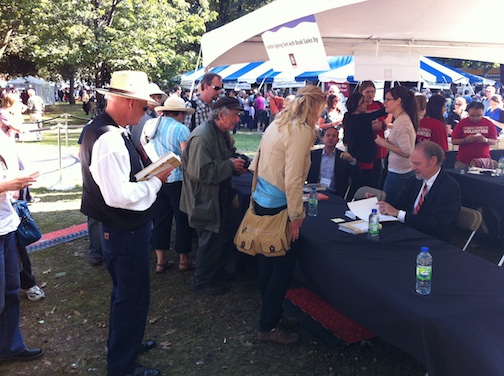
The second “first” is that, after a “Q and A session,” I am led to the “Authors Signing Tent.” There I shyly sign seven (maybe even eight!) copies, and find myself guiltily resenting the pals who stand at the front of the line to chat, not buy. As the line-up disappears I have time to notice that within twenty metres is the superb black  statue of my old friend Al Purdy, characteristically in a relaxed sitting pose, his hair drooping to the very life. I published him at M&S and, in addition to routine, in-office chats, we became friends after I went out to High Park to support him at a sweltering outdoor reading. Backstage, I remember, he was really glad to see me, and we both were bathed in sweat. I hope that the campaign run by Jean Baird to try to preserve his A-frame house in Prince Edward County is going well. I should have done more to help.

There’s still time though, and efforts to save the house continue. On November 23, Margaret Atwood is giving a special presentation at Picton’s Regent Theatre. Her provocatively titled presentation “Bulldozing the Mind: The Assault on Cultural and Rural Heritage” follows a reception with Ms. Atwood at Books & Company featuring County food and wine. More details can be found here.

— Douglas Gibson

Stories About Storytellers Companion Reading

Many early readers of Stories About Storytellers have remarked that they finish reading it only to rush to pick up one of the other books Doug has so lovingly described. So this recurring feature will be dedicated to highlighting Gibson-edited books you might have missed. First up . . .

Dickens of the Mounted: The Astounding Long-lost Letters of Inspector F. Dickens, NWMP, 1874-1886, Edited by Eric Nicol (1989)

It is true that Francis Dickens, son of Charles, was a long-serving Mountie in Western Canada. It is also true that he was a disaster in the role. The Canadian Encyclopedia  states: “Dickens can be blamed for worsening relations between the Blackfoot and the NWMP and for the growing antipathy of the officer cadre towards Englishmen.” What is not true is that Eric Nicol “edited” these letters home written by Frank.  Chuckling at his desk in Vancouver, Eric made them up, from the very first sentence “It was not the best of times, it was not the worst of times, it was Ottawa.” But he carried the joke off so brilliantly that the well-researched book appeared on both Fiction and Non-fiction best-seller lists in Canada, while I rubbed my hands with glee. It still makes for delightful reading.

For more on Dickens of the Mounted, see pages 76-78 of Stories About Storytellers.