The Canada Trip

This summer, Jane (my “techie”– though no tattoos so far) and I are going to be travelling widely to give my show in various parts of Canada. As usual, I’m preparing by consulting the 1997 classic, The Canada Trip, by Charles Gordon.  

  You may know him as a former writer for The Ottawa Citizen, or a witty columnist for Maclean’s. Even better, you may know him as the author of the classic At The Cottage and the follow-up Still At The Cottage. His other books include an affectionate satire on life in Ottawa (The Governor General’s Bunny Hop), The Grim Pig, a novel based on the newspaper world , and Canada’s answer to the wave of hyperbolic self-improvement books from the U.S.A., brilliantly entitled  How To Be Not Too Bad. All of them reveal Charles as a man with a finely understated style that is a delight to read, and a dry sense of humour so Canadian that  it deserves to occupy our seat at the United Nations.

   In the summer of 1996 he and his wife Nancy (known in the book, to her slight irritation, as “The Business Manager”) set out from Ottawa in the family car to drive across Canada and back. The result is a wonderful book that shows what typical travellers will find as they enjoy the trip. It is not an earnest “Whither Canada?” book, as much as a “Whither the moose?” or even a “Whither the washroom?” book, and we are all grateful for it. Check it out.

  I am especially grateful for what my old friend Charles wrote about me in his Acknowledgements:  “My publisher, editor, and fellow Scot, Doug Gibson, was as encouraging as always on this, our fourth project together. In his editing,  Doug consistently amazed me with his knowledge of what is where in Canada. Many times he was able to tell me that I could not have been looking at what I thought I was looking at from a given spot – a sunset, a mountain, an ocean – because I was facing the wrong way. This invariably sent me back to my map collection and invariably forced me to conclude he was right – except maybe for once in Saskatoon.” (Ah, Saskatoon, where the reliable old north-south Idylwyld Freeway treacherously turns east, south of the river.)

   Jane and I will have a chance to expand our knowledge of the country as we roam around with my show, this summer. Maybe we’ll meet you along the way. It should be fun.


STRATFORD, CLINTON, AND ALICE MUNRO

ALICE MUNRO 1931– Not Bad Short Story Writer

ALICE MUNRO 1931– Not Bad Short Story Writer

My two Stratford shows – in the grand old City Hall building, right downtown, near the Avon theatre – were inspiring for me. The school show on Friday afternoon drew a crowd of adult friends, including Geoff Hancock , the former editor of Canadian Fiction (and photographer of Mavis Gallant), who now runs a B&B in Stratford, and the Stratford Festival’s David Prosser. But the main audience was a large group of high-school kids brought in by bus.

I was able to speak briefly about their home town to the kids from Exeter – home of the unique breed of all-white squirrels, and of the famous family of my Toronto  friend John MacNaughton, who died a few months ago.

I was, however, able to speak at much greater length to the Grade 12 kids from Clinton. This, of course, is the town where Alice Munro lives, and I was able to suggest to them how amazingly lucky they were to live in the same place as a world-famous writer who was putting their town on the literary map of the world, an internationally famous figure they might meet on the way to the Post Office. I talked about how her stories were set among people like their neighbours, and explained how famous Alice (“the living writer most likely to be read in 100 years time”, according to The Atlantic magazine) really was.

The next day word filtered back from a teacher that conversation among the kids on the bus home included the comment that this was the first time they had “ever felt proud about coming from Clinton”.

The next night’s show (part of Stratford’s Springworks Festival ) was for adults, and went fine. The sound man, who had worked at The Banff Centre and fallen under W.O. Mitchell’s spell, was hit hard by my final story about the unforgettable W.O.. After the show, our hosts, Lucille Roch and Warren Holmes, held a reception for us, and as we entered they kindly led a round of applause. It was a pleasant surreal moment (“I’m being applauded as I walk into a friend’s house!”), but it was nothing compared to the news of the impact on the kids from Clinton.

Quebec City

Thanks to local friends like Neil Bissoondath I was lucky enough to be invited to the Quebec City InterNational authors event, an English-language event that takes place in the heart of the old city every spring. The organizer, Elizabeth Perreault, is so calm and efficient on e-mail that I was expecting a much older person than the fresh-faced young woman who greeted Jane and me.

She runs a top-class festival, too, with authors like Charles Foran, Emma Donoghue, and Guy Vanderhaeghe in attendance. We saw readings in two remarkable rooms in The Morrin Centre, in the heart of old Scottish Quebec. If you think I exaggerate there, The Morrin Centre (named after a Scottish doctor from the early 19th century) is on the Chaussée des Écossais, and is right opposite the old Scottish Church and the “Kirk Hall.”

Inside, the great hall of the Centre (housing The Literary and History Society)  is constructed on 19th century Scottish traditional lines, so that the electric light bulbs seem almost like an intrusion. The library is equally famous, with its wooden statue of Wolfe casting a dramatic arm from a corner of the two-story ranks of shelves. Louise Penny fans will be familiar with the setting, and after seeing Peter Dube talking about his books there, I learned that ancient authors from Charles Dickens to Mark Twain had given readings there.

After Guy Vanderhaeghe entertained us with tales of Western History in this Eastern city, I recalled for him that it was exactly 30 years earlier that he and I celebrated his Governor-General’s Award win for Man Descending in this city. The actual award was given in an ancient room in the Laval campus downtown, but Guy remembered that the evening dinner was held in the Royal 22 (the Van Doos) Regiment’s Mess room at the Citadelle, with the waiters in full red mess uniforms. I was in a daze of delight that evening because as the Publisher at Macmillan I was celebrating two Governor- General’s Awards that year, for Guy’s short stories and Christopher Moore’s superb history book, Louisbourg Portraits.

On the Sunday afternoon I gave my show in the grand old hall, introducing a Guy Vanderhaeghe anecdote from my book that doesn’t usually feature in my stage show. It’s the story of my edgy walk back into Saskatoon alongside a gigantic guy who had just exited a bar, running very fast, and who asked me, in a challenging way, “Are these women’s boots?”

The crowd seemed to like that story, and the rest, so that at the end they gave me a standing ovation. (Jane, I must report, far from leading this excellent development, said to Elizabeth Perreault, “Do I have to stand up?” If anyone wonders about my being a grounded sort of fellow, look no farther than this story for a reason.) But a standing ovation in Quebec City is something worth recording, if I can find a suitably capacious tombstone.

The rest of our visit was taken up with a wonderful dinner chez Bissoondath, and three days of strolling around old Quebec from our central base at the Hotel Clarendon.

One feature of the weekend involved a coincidence that no fiction writer would dare to attempt. In the appreciative crowd for Guy Vanderhaeghe was a nice fellow who proved to be the American consul-general, Peter O’Donohue. What led to his appointment here, we wondered. Well, he grew up in Connecticut and knew Quebec well. Where in Connecticut, Jane wondered, because she had an uncle and aunt in Norwalk. Norwalk! What were their names? The Finlaysons, my God, I practically grew up in their house!

It turned out that Jane and he had been at cousins’ weddings, and two of her cousins are going to stay with him at his amazing house overlooking the slide on Dufferin Terrace, near the Chateau Frontenac

The next day the coincidences continued, because our sight-seeing stroll took us past the magnificent Consulate just as his wife was in the doorway, greeting a friend. We ended up with a tour inside, and spent time gazing over the St. Lawrence from Levis to L’Ile D’Orleans. A magical view, and a magical weekend. And almost 20 more books sold!

Montreal

The Atwater Library is based in the former Mechanic’s Institute building, which means that it has an impressive background in social democratic movements that believe that education and advancement should not be restricted by class. Even today the building houses writers organisations and other fine, progressive but penny-pinched groups.

I enjoyed my tour around with the Newfoundland-born Librarian, Lynn Verge, then watched 60 or so literary types assemble for my talk/show, including authors like Mark Abley and George Tombs, and my old historian friend Desmond Morton. Also there was my fellow-publisher Simon Dardick (who confirmed sympathising with my attempt to cut Mavis Gallant’s speech short, which led to the famous jacket quote “I’ll kill him! — surely a first in the history of jacket blurbs). It was a show where I whizzed through all of the Tony Jenkins caricatures then asked the crowd who they’d like to hear stories about. The requests came thick and fast, including a tricky question from my hostess, Pat Webster, who asked if I edited political memoirs differently from other books. Very interesting. Good questions make you think hard.

What was special about this show was that I had lots of Montreal scenes to recall, and a remarkable new James Houston story to tell. In the train from Toronto I was near Cornwall when I was puzzling over  how best to talk about Jim’s Montreal connections. I happened to look out of the train window, and saw strings of geese heading north. At first there were just three or four v-shaped groups heading north, then ten then twenty, then fifty, sixty, then hundreds. Soon there were scores of thousands of geese filling the skies, all heading north to James Houston’s Arctic. I looked around the train, and nobody else seemed to be aware of the miracle that was filling the skies above us.

At the end of the show we sold about 20 books, which leaves a few potential readers in Montreal still to be tapped. I shall return.

In the evening I filled a major gap in my all-Canadian education by attending, with Norman Webster, my very first Habs’ home game. They won!

The skies above the train on the way back to Toronto were empty.

Stratford and Me

I’m getting more and more excited  about my show at the Stratford City Hall on Saturday, May 11, at 8 p.m.

It’s part of the famous SpringWorks festival, and I’ll also be giving a special show for schools on the Friday afternoon. This has set me wondering just how well a young audience will react to stories from behind the scenes in the world of books, a world that alarmists warn is increasingly remote from their own world. Maybe a Harry Potter comparison or two would be helpful . . . especially the story of idiot publishers turning down J.K. Rowling’s first Harry Potter manuscript!

I’m spending some time recalling my own Stratford connections. As a publisher I was proud to bring out the official  Festival history, Stratford: The First Thirty Years by John Pettigrew and Jamie Portman in 1985. That handsome two-volume edition was published by me at Macmillan of Canada, with a Foreword by Robertson Davies. I note with pleasure that he dated his Foreword “March 1, St. David’s Day,” and we, sparing no expense, ran his distinctive signature in blue ink. I forget why blue was regarded as the ideal colour for the signature of this avid supporter of the festival from its earliest years. Blue?

Later, the link between Robertson Davies and the festival was made clear, in the saddest of settings. Along with John Fraser, RD’s successor as the Master of Massey College, I was involved in arranging the Celebration of the Life of Robertson Davies at Convocation Hall in Toronto in 1995. I asked Richard Monette, then the Artistic Director of the Stratford Festival, to join the group of speakers paying tribute to the Master’s life, and Richard did a superb job, speaking of RD as a Stratford supporter, and as a man of the theatre. That memorable evening had two other speakers with Stratford links: Timothy Findley, a festival alumnus, and Jane Urquhart, for many years a Stratford resident.

Like most Ontarians I have warm memories of many fine visits to Stratford, usually theatrical, but sometimes involving visits to friends like Geoff Hancock, Lynn Schellenberg, or Lucille Roch. I have even met Alice Munro for lunch there. But usually my meetings with Alice were at her home in Clinton or in Goderich. This meant that to follow the old Huron Line I would take a right turn at Stratford City Hall, and head west into Alice Munro Country. It’s appropriate that the building I used as my landmark for that turn to visit Alice will now house my show, with its tribute to Alice and her achievements . . . although the caricature of Alice bears the mischievous subtitle  “Not Bad Short Story Writer.”

Gibson’s Stage Show Returns to Toronto

After around 50 performances, in places from Haida Gwaii to Halifax, Douglas Gibson’s Stories About Storytellers stage show is returning for a rare midtown Toronto performance. On Tuesday, May 7th at 7:30 p.m., Doug will be bringing his memoir to life at the Heliconian Club (35 Hazelton Ave.). For tickets, call 416-922-3618.

Update: This show is now sold out. Watch the events page for more Toronto shows.

Politics and the Pen

For many years now the Writers’ Development Trust has sponsored a very successful fundraising event in Ottawa. The March dinner at The Chateau Laurier is now a fixture on the Ottawa social scene, with guests promised that their table will feature both a politician and an author.

In the past I used to attend the dinner as a Publisher. In fact, my book tells the story that I first met Sheila and Paul Martin when I was placed at the Prime Minister’s table because an organizer had said, “Oh, Doug can talk to anyone.” And I always had a good time, especially when my authors (such as Max and Monique Nemni) were winning the evening’s big award, The Shaughnessy Cohen prize.

After my book came out, however, I was upgraded, and became An Author. This meant that I was invited to attend, free, flown to Ottawa, and very well cossetted at the dinner, where all authors are issued a medal and a colourful ribbon (green last year, red this year) to hang the medal around the neck like a Nobel Prizewinner. It’s all very good fun, and an excellent cause.

Before the dinner I had the perfect Ottawa afternoon. First I met with Sean Wilson, who runs the Ottawa Book Festival. It’s a very successful series that helped me a lot. In the Fall of 2011, when my book was just days old, and I had hardly started to tour my show, Sean took a chance on the stage show, and we were both relieved when it worked out well — and we sold out of every copy of my book. The future seems bright for his festival, although arts programming is never easy.

Next I spent a fascinating half hour at the office of my old friend Jeffrey Simpson, of the Globe and Mail. He’s always full of  interesting ideas (the man’s a columnist, after all!) but he’s also a fascinating witness to major changes in the Canadian Book business. He has produced non-fiction best-sellers about Canadian public issues in the 1980s, the 1990s, the 2000s, and right up until last year, when his book about our medical system hit the stands.

He tells me that everything has changed from the “magic carpet” days when your publisher would whisk you around the country from city to city, from one book talk show to the next. Now it’s up to the author to behave as his or her own publicist (he used the adjective “brazen”) and he estimated that of the 40 or so public appearances/speeches he made to promote his new book, he personally arranged 75% of them. He and I were excitedly confirming each other’s findings that the new world out there demands ever more active author involvement in promotion — although I can’t promise a one-man stage show from Jeff Simpson in the near future.

My final stop was at the CBC building, where my wife’s niece, Amy Castle, the Producer of the daily TV show, Power and Politics, invited me to sit in on the control room. Fascinating!

Everyone knows about the number of screens up there at the front of the room, and the constant directions to switch to this camera or this piece of film, but the instant typing of the links for the host  on the teleprompter, and the guy at the front choosing which tweets to add as crawlers to the screen were new to me. I was supposed to be quiet and anonymous – my desired state, of course – but when a Liberal backbencher was introduced and there was loud uncertainty in the room about the spelling of her first name, I was able to announce “Kirsty” very decisively; she’s a friend.

After that it was time to rush to the Chateau Laurier and don my 48-year-old dinner jacket, plus medal, and mingle. I suspect that few guests were able to range as widely on the political spectrum, chatting with old friends from Ed Broadbent to Preston Manning. Among the authors I enjoyed chatting with at the loud cocktail party were Lisa Moore (fresh from her victory in Canada Reads), Lawrence Martin, Paul Wells, and David Miller (who is a good enough friend that I have never raised the name Rob Ford in his presence). And I later was able to tell Justin Trudeau stories about his father that he had never heard, including my “Trivial Pursuit” moment, when he almost killed me. (It’s in the Trudeau chapter.)

At our table I had a very good time, but did not shine. In my role as Author, I went around the table to meet my companions. I found myself sitting beside a very pleasant woman named Diana, who spoke with an English accent. Because we had just established that our neighbours were Swiss diplomats, and since she had mentioned that she was moving back to England very soon, I asked her if she, too, was in the diplomatic service. Not exactly, she replied, she was moving to England because her husband had just been appointed the new Governor of the Bank of England.

Nice work, Doug.

Douglas Gibson on being Hugh MacLennan

The National Post books blog, The Afterword, featured a piece by Doug on his experience being Hugh MacLennan for Canada Reads this year.

It all began with a very tentative email from a nice woman at CBC Radio in November. She explained that the five books that would be finalists for Canada Reads had been selected. The publicity leading up to the week of on-air debates in February would begin soon, involving not only the advocate for the book on the jury, but also the author.

But they had a problem. One of the books was Two Solitudes, by Hugh MacLennan. And Hugh had passed away in 1990 (a sad fact that I knew all too well, since I had spoken at his funeral). Would I, just possibly, she wondered, be willing to step in to speak on Hugh’s behalf, if that wouldn’t be too much trouble?

Read the rest on The Afterword.

The Al Purdy Show (Part Three)

So we came to the night of the show, February 6 at 7:30.

As the whip-cracking Director of the show, Laura McLeod was tough on all of us who were going to appear onstage, insisting on everyone showing up for sound checks at 6:15. This allowed us lots of time to mingle in the Koerner Hall Green Room, where I got to meet  Alex Gagliano, from Upper Canada College, the young man who was going to be reciting a Purdy poem from memory, on behalf of Scott Griffin’s poetry-promoting project. The room was loud with poets renewing old acquaintance, and there was an air of pleasure as well as the usual backstage excitement. We were all very glad to be part of this.

purdy

Photos courtesy John Degen

In my dual role, performer and front-of-house-greeter, I was able to roam among the audience in the drinks area, where I saw lots of friends, thanking them for coming, and pointing out the amazing silent auction items that Valerie Jacobs and her crew had spent much of the afternoon laying out. Later the Random House blogger for Hazlitt was to report that in the cocktail party crowd somebody pointed me out as “the bearded guy,” kindly describing me as “Al Purdy’s first publisher.” (Wrong! In fact, Sandra Campbell’s forthcoming biography of Lorne Pierce of Ryerson Press, Both Hands, establishes that this grand old man, usually associated with poets like Bliss Carman, Charles G.D. Roberts, and Duncan Campbell Scott, was actually Al’s first publisher, with a 1945 chapbook!) I even met Josh Knelman, who kindly recalled my days as a soccer coach for youngsters like him. Then I was able to join my family group (including my second cousin, Claire Caldwell, who as a young poet made the ideal guest) and enjoy the first half of the show.

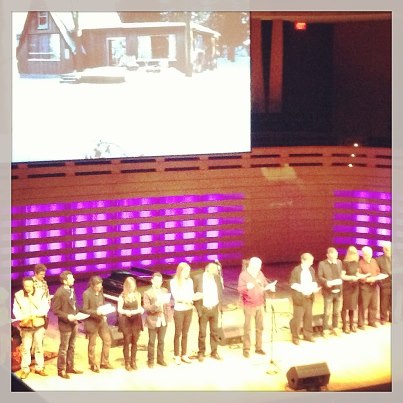
Because I had seen the script, I knew the opening was going to be spectacular. With a black and white photograph of the A-frame filling the screen onstage, the house lights went down and Al Purdy’s voice filled the hall, reading the opening lines of “The Country North of Belleville.” After a few lines, the house lights slowly rose and Gordon Pinsent walked onstage. As Al’s voice faded away, Gordon seamlessly took up the poem with the words:

“Yet this is the country of defeat
Where Sisyphus rolls a big stone
Year after year up the ancient hills . . .”

Gordon finished the poem, to enraptured applause, and introduced the rest of the evening  as a “ literary barn-raising.”
And we were off.

Marni Jackson’s brilliant script was based around two principles. Everything should centre around Al and his poetry; and there should be constant variety on the stage. So Gordon Pinsent was followed by Gord Downie, the lead singer of The Tragically Hip, who read “At the Quinte Hotel” then sang a song and played guitar.

Steve Heighton turned the event into a fashion show by wearing one of Al’s distinctive shirts (and recommending other items at the Silent Auction) before reading “Necropsy of Love.”

It was time for a Greek Chorus, with Gillian Savigny, Leigh Kotsilides (no typecasting there!), and Moez Surani, led by Robert Priest. They sang and then produced a choral version of “In Search of Owen Roblin.” Then Robert introduced young Alex Gagliano, who recited “Thank God I’m Normal” with its ringing final line, “ Why — why the sonsabitches!”

Michael Enright then brought his CBC gravitas to the proceedings, telling us the story of Al Purdy’s life. Then, in the role of M.C., which he was to adopt increasingly, he introduced more music in the form of author-musician Dave Bidini, of The Rheostatics, here appearing along with Bidiniband and The Billie Hollies. bidiniband

That rousing musical interlude led to the 35-minute intermission, where two of Patrick White’s friends, reluctant attendees, were exulting that this Al Purdy was clearly “the coolest guy ever!”

Here my account of the evening becomes scattered, because after the intermission I was backstage throughout (except for my moment in the sun, when I got to talk about my role as Al’s publisher, to pay tribute . . . very briefly . . .  to George Goodwin and the organising committee — “You’ll find their names in the programme” — before praising Eurithe, and Jean Baird “with us tonight from Vancouver.” Then it was “on with the show,” and an introduction for Ken Babstock).

But from my perch in the Green Room, watching the fuzzy screen, or from the wings, I enjoyed the video produced by Brian D. Johnson, then Phil Hall and Karen Solie doing their duet reading of “Shall We Gather at the River,” George Elliott Clarke, as Toronto’s Poet Laureate, reading “In Cabbagetown,” and then the Skydiggers (Andy Maize, Josh Finlayson and Michael Johnstone), who filed off, brushing shoulders with me as the applause from their music still rang around the hall.

After Ken Babstock, Michael Enright brought Margaret Atwood onstage for a sit-down interview (hey, we haven’t had an interview yet!), which was great fun (as listeners to The Sunday Edition were to learn). It ended with Margaret reading “Wilderness Gothic.” Dennis Lee then talked briefly about Al and read “In My Grandfather’s Country,” which sounded even better from the wings, where the cast was assembling for the Finale, where George Bowering led us in “Say the Names,” with chosen poets hollering out “Lillooet” or “Nahanni” on cue.

saythenames

For this finale, which turned into a curtain call, Michael Enright and I bracketed the poets ranged along the stage. Beside me was Gordon  Pinsent, whom I had telephoned so many months ago to ask if he would perhaps be interested in helping with this event we were planning. To be with him as the waves of applause . . . no, more than that, the waves of affection . . . came washing over us from the audience was unforgettable. Then in an unrehearsed way we waved to the audience and walked off, dazed and delighted.

Later, when I was able to leave all the happy handshaking backstage, the audience was still filing out, and were clearly delighted, saying very kind things.

And, after the nail-biting lead-up, we ended up selling over 700 tickets! In fact, we ran out of programmes, because we had to set the number of the print run a couple of days in advance, when printing 500 seemed sensible. And we made money, and Duncan Patterson’s plans to fix up the A-frame can now go forward.

And, yes, as I had predicted to the Metro Morning audience, it was the sort of once-in-a-lifetime event where others will say . . . “You were there?”

The Al Purdy Event (Part Two)

In the end, the fundraising event at Koerner Hall on February 6 was such a success that it’s worth celebrating the people who put it together. I’m reminded that a 19th century British Cabinet was once famously described as the Cabinet “of all the talents.” I think that the Al Purdy event organisers deserve the same description.

Let me say the names here: George Goodwin, our fearless (and tireless) Chair, a former McClelland & Stewart colleague now working for the Weston organization; his son Christopher Goodwin, a banker who knows a lot about fundraising and how to close a deal and how to represent a younger generation; Leslie Lester, the Executive Director & Managing Director of Soulpepper Theatre Company with many excellent contacts in the worlds of poetry and rock, and who knows how to go about putting on a good show; Don Oravec, who, before he was felled by ill health, as Executive Director of  The Writer’s Trust had learned all there was to know about fundraising for the literary world; Alexandra Manthorpe, a young lawyer, who could keep us all out of jail, and who stickhandled the purchase of the A-frame itself on just 10 days’ notice; Valerie Jacobs, the superhuman organiser who once ran my life at M&S, and who was now given the task of running the Silent Auction; Duncan Patterson, the young architect who had made detailed plans of exactly how the Purdy A-frame had to be repaired – and who had spent every summer of his life in Prince Edward County; Patrick White of the Globe and Mail, a son of Howard White, one of the founders of the movement to save the A-frame, along with Jean Baird (Jean and Howie were distant but very active members of our planning group); Marni Jackson, the author who can turn her hand to any writing task, including the creation of the script for this show that had such a marvellous flow that it was able to lull or startle the audience, as required, on the night. (Marni’s husband, Brian D. Johnson of Maclean’s fame, played a major role behind the scenes, acquiring amazing film footage and creating a tribute video to Al that appeared for the first time that night.)

Finally, this group of unpaid volunteers shrewdly hired Laura McLeod, a theatre professional, to make sure that the event happened, including such details as having tickets available at the box office, and having the cast show up on the night, knowing what was expected of them.

As those who were there know (and will happily tell you), we pulled it off. And it was indeed “all right on the night.”

But not before much nail-biting anguish. High drama, indeed. If you like a comfortable, predictable life, do not ever put on a one-night stand-alone show. Unless your show is an annual event, or part of a series, with a predictable – and contactable – audience, you are in for a testing time, a roller-coaster ride for your emotions.

To over-simplify:  if you can charge $200 for each ticket you will raise funds very fast, if you can sell them. By lowering the price of our tickets to $50.00 we were gambling that we could sell enough of them to cover our costs, plus . . . Although all of our artists, musicians and poets and actors alike, were generously donating their time, we found that renting a superb, central space like Koerner Hall (and heating it, not to mention having the stage lit, and having ushers etc., etc.) costs a lot of money, and we had to sell several hundred seats to break even. So for all of us, the two weeks up to the event were dominated by emails describing the Daily Ticket Sales, sent along by Laura McLeod.

They were terrifying. With roughly one week to go we had sold only about 200 tickets. We were going to lose lots of money on this fundraiser.

It was time for emergency action. Since people reacted well when they heard about the event (“That sounds great. When is it, again?”), the trick was to spread the word. Any way we could. Emails flew to surprised friends and professional contacts. Our committee worked their contacts in the media (“Hey, we’re in NOW!”). Eventually this led to fine things like an A-frame article in the Toronto Star (which neglected to mention the date and location of the fundraising event, requiring a sly Letter to the Editor, praising the piece and just happening to mention “Koerner Hall” and “Wednesday”).

Even better, CBC Radio came through, inviting me (an internal CBC document praised my ability to “yak”) to talk about the forthcoming show on Metro Morning on Tuesday. I stressed that I was just part of the organizing committee, but this message was embarrassingly elided at the end, so that it seemed that I was The Organising Principal.

The next morning I was on Ontario Today, urging people outside Toronto to come in for the show. I think some did come. Certainly as I mingled gratefully with the crowds I met lots of people who were Metro Morning listeners.

And we sold over 700 tickets! As for the show itself, watch for my next installment.