THE POINT OF WOODY POINT

For a Canadian author, being invited to attend the Writers at Woody Point event in August is the equivalent of winning the Nobel Prize. It has been running for 10 years now, and has attracted a galaxy of literary stars “from away,” like Michael Ondaatje, Richard Ford, Alexander McCall Smith, Linda Spalding, Elizabeth Hay and Will Ferguson, bolstered by major talents from Newfoundland such as Lisa Moore, Wayne Johnson, Michael Crummey, Michael Winter and many more.

It all started when Stephen Brunt, the well-known Toronto-based sportswriter, had the idea that outsiders would love to discover Woody Point, his idyllic summer home. The tiny community of about 700 lies half-way up the long west coast of Newfoundland, surrounded by Gros Morne National Park — a little like an east-coast Banff, without the fudge shops. The sort of sweeping views of fiords and mountains that you get in those clever ads from the Newfoundland Tourism folks lie all around the little town, and the open waters of the Gulf are just around the corner, as Jane and I found when we borrowed kayaks from our friends Peter and Robert early one morning.

Gros Morne, of course, is a World Heritage site. Its high, orange Tablelands (amazingly, derived from the ocean floor thrust upward) were what proved the revolutionary Continental Drift theories of Toronto’s Tuzo Wilson and Newfoundland’s own “Hank” Williams.

Two minor notes: Tuzo Wilson and I were once guests at a small dinner party given by Brenda and Robertson Davies; like most great scientists he had wide-ranging interests. Second, in the course of my five days at Woody Point I went on a guided hike at The Tablelands. Part of the attraction was a reading by the poet Don MacKay, a keen geologist, and also an outdoor performance by the energetic fiddler Kelly Russell; he amazed me by revealing that Hank Williams was a fine fiddler too.

A key moment in the history of the writers’ festival was when Stephen Brunt’s local crew (including his wife of undetermined ethnic heritage, Jeanie MacFarlane) persuaded the marvellous Shelagh Rogers to get involved. Now she is the voice of the Festival, introducing all of the main events at the grand old Heritage Theatre. She even conducts live, on-stage interviews for her CBC show, The Next Chapter. Her talk with Greg Malone, author of Don’t Tell The Newfoundlanders will make astonishing listening for anyone who, like me, believed that Newfoundland joined Canada gratefully, after an honest vote.

The writers’ events run morning, noon and night. My own show began at 11 at night, followed by some more music, by Pamela Morgan and Sandy Johnston. (Later, Shelagh announced Pamela as “Pamela Anderson,” which led to many jokes.) Often the first readings were at 9:30 in the morning, and the nature walks and other events through the day kept us hopping, and sometimes missing readings that clashed with our chosen event. Saturday morning started with a Church Hall fund-raising breakfast for the local firemen, and the Saturday and Sunday evenings ended with a big dance at the local Legion.

We were staying within earshot of all this, at a central B and B named “Aunt Jane’s”. How could we resist? Will Ferguson was there, too, and others came and went.

A key part of understanding the lure of Woody Point is realising that you are part of the community. People who elsewhere might be strangers come up to you on the street and chat. Fishermen and carpenters (I’ll try not to be too Biblical) reveal that they were at your show, and enjoyed it, but have a question about Brian Mulroney.  Going for dinner produces comments and questions from the staff, and paying your bill involves a long conversation. Village life! That’s what I grew up with in Scotland. I loved every minute of it. And the organizers like Gary Noel made everything easy for us.

At the start of my show I told the audience that my book contains the line “I never met a Newfoundlander I didn’t like.” I hoped that none of them would take that as a challenge, and none did. So the record is still unblemished.

The usual unbelievable coincidences occurred. After my show a woman from the Cypress Hills district in Saskatchewan came up to tell me that when she was growing up she knew my cowboy author, R.D. Symons. She was even able to tell me what happened to his son, Gerry, ranching on another frontier in Colombia.

And when we had dinner with the multi-talented Des Walsh and his lady, Ruth, he told me that he had known Harold Horwood well, even attending the rebel school called Animal Farm that Harold established, in the teeth of fierce St. John’s police pressure. He could even do a fine imitation (like all schoolboys) of his teacher, Harold, throwing back his long-haired head.

A final Newfoundland story. At the Legion bar I met a fine man who had enjoyed my show. When he told me his name was Young, I got excited, telling him about my father’s mother in Scotland, Jessie Young. He cut short my speculation about our being related by telling me that family research had showed that his family were pirates … and had stolen the law-abiding name of Young!

I never met a Newfoundlander I didn’t like.


BAYFIELD DAYS AND NIGHTS

Late in July we drove down to Bayfield, in Alice Munro’s Huron County.  

   After Stratford the car knows the way… through Sebringville (Ontario’s longest hamlet, I’m told) then Mitchell (former home of Orlo Miller, who wrote Death To the Donnellys for me) then Dublin (home of “The Liffey Drain”) then Seaforth. Here we took a turn south, wrenching the car wheel away from the traditional route on to Clinton and then Goderich,  to go straight to Bayfield. Along the way we saw the Bannockburn Bridge (worth a photo shoot, since I’m organising a Bannockburn reunion next June, the 700th anniversary of the 1314 battle, where Robert The Bruce defeated Edward The Second-Rate) with the next village, appropriately, named Brucefield.

Bayfield is a place well known to Alice. She once did a “Long Pen ” signing event there , as a favour to her friend the bookseller and her friend Margaret Atwood, the Long Pen’s inventor. We know it, too. In fact my wife Jane is a former resident. When she was based in London, working as a Speech Therapist at the old Victoria Hospital, she and her first husband had a summer place in Bayfield, so we’re always glad to have an excuse to head for “Ontario’s West Coast”.

After wandering around the busy Main Street (on a summer Sunday it’s as crowded with strollers as Yonge Street) we settled in at The Little Inn. In the evening we met Mary Brown, the brave bookseller who organised the event, at the Town Hall, an old church built in 1882. There were the usual technical difficulties before the show, but it all worked out well, with me performing my act at floor level, in front of the stage, and introducing my “lovely and talented assistant”, Jane, who would be changing the slides for me. We even had a Q. and A. session , which was fun, including a woman with memories of being hailed as a  fellow “stubblejumper” by W.O. Mitchell.

Among the audience were old friends of mine , lost for 30 years, and a number of Alice’s friends, from Goderich, Clinton, and even Blyth including one lady who once shared waitressing duties with her. There was a flash of Huron County understatement when one woman told me she was at the show because a friend had seen my show in Stratford and had reported that it was ( I swelled, expecting superlatives, although she was really  too old for “awesome”) it was … um …  “quite interesting.”

When we visited Alice at home in Clinton the next day, she liked that story, and matched it with a story from some years ago when she was visiting a bookstore and offered to sign the pile of copies of her latest book. The bookseller refused the offer…  “because then I couldn’t return them if they didn’t sell.”

GOOD CHEER AT BONNECHERE

 For 11 years the little Ottawa Valley town of Eganville has played host to the Bonnechere Literary Festival. The moving spirit (there is always a moving spirit for these things) is a Force of Nature called Doyne Ahearn. She contacts you, tells you just how remote her Festival is (about 5 hours from Toronto) and how they can’t really afford to pay anything, but you can stay with her and Frank in their big log house and get to know the Ottawa Valley, including nearby Foymount,  the highest inhabited town in Ontario.

 How can you say no?

  Well, I tried, just as others such as Nino Ricci before me had tried, but Doyne wore me down. Not the summer of 2012? OK, we’ll put you down for 2013.

   So Jane and I planned an anti-clockwise sweep, first up to Peterborough, then to Marmora and the gold-rush country near Madoc, then via Bannockburn (!) up to Bancroft , then sidling north and east to Cormac, near Eganville.

  Our arrival at the famous log cabin coincided with the descent of amazingly thick clouds of flies, but Doyne and Frank soon introduced us to the joys of “bug suits”, and we were able to go swimming off a raft moored in the bug-free middle of a lake, Lake Doyne. The raft, by the way, was reached by means of a circulating rope ferry system, the rope pulled by Jane or me as keen, bug-suited Charons.

   A fine dinner was followed by a tour of the Valley, far from the county seat of Renfrew, the boyhood home of Robertson Davies. In Eaganville we learned about “the Catholic side “ of town, as it was in the old days (and as late as the 1920s Orange-Catholic hostilities were so fierce that the military came in “with cannon”, we were told, to keep the opponents to their own side of the Bonnechere River that divides the town). In these saner times we saw the fine old Museum, and the Library, which the Literary Festival helps to maintain.

  Late in the day “extreme weather” took over. Rain fell in sheets, thunder rolled and lightning flashed. The pre-show dinner at the best restaurant in town was shaping up well, with our mouth-watering orders taken by the friendly waitress when everything went black . The power was off.

It stayed off, and dinner was cancelled. Show time approached. Since my show was due to take place in a windowless church basement, the lack of power was fatal.  For safety reasons we would not be allowed in the dark basement.

   With 30 minutes to the show, it was time for plan B. I suggested that with the thunderstorm rain now gone we could bring chairs out to the parking lot and I could do the show there, in the open air. We had started to bring the chairs out when the lights went on…and, after some heart-stopping flickers, they stayed on.
And the show went on!

  We all had fun, and a few books were sold. Doyne told me that we attracted the very first standing ovation the Festival had seen in its eleven years; I could get to like the experience, especially when Jane joins in. And I was very pleased to receive a fine original painting, entitled “The Storyteller”! Local delicacies made up a very welcome “gift pack”.

   When we got back to Doyne and Frank’s place, the power was off there, so we went quietly to bed. And the next day, after a lavish breakfast, we set off for the long ride through Algonquin Park, armed with Frank’s fascinating book on the subject. As my father’s son, who grew up around saw-mills, I found the Logging Museum a constant delight. And then, after Algonquin Park, via Huntsville, Rosseau and Foot’s Bay, we were back at beloved Loon Island, the cottage on Lake Joseph owned by our good friends, Hope and Phil, who live next door. After four days of swimming (why do they put the navigation buoy we swim around further out in the lake each year?), canoeing, rowing the skiff, cruising the lake admiring the moon and stars, and gathering buckets (oh, all right, cups) of the world’s best blueberries, it was time to head south to Barrie and Toronto, after almost 900 Ontario kilometres.

Not a bad way to spend a summer.

WORKING HARD AT LAKEFIELD

  Three years ago I was the Lakefield Festival’s host/interviewer at an evening celebrating Michael Crummey’s Galore and Linden MacIntyre’s The Bishop’s Man. With those two fine writers and performers crooning their readings at the entranced audience, how could it go any way other than very well indeed?

  But the Lakefield Festival organisers (this means you, Stephanie) remembered me with affection, and this year presented me with an offer I could not refuse. I would give my solo Stories About Storytellers Show at 2.30 on Saturday afternoon, then act as host/interviewer for the evening session at 8.00, with three authors — count them, three. Then, presumably, I would collapse off-stage, but the show would be over by then.

   Ruthless people, those Lakefield folks.

   On the Friday evening we had dinner with Orme Mitchell (W.O.’s son) , his wife Barb, and  Norman Jewison and his wife, our dinner enlivened by Norman’s tales of his Caledon neighbour , Robertson Davies, and his Hollywood friend Sean Connery, whom I can imitate shupremely well.

  Saturday was spent roaming around Lakefield, before we went to the superb theatre at Lakefield School. After many careful sound checks the lapel mike was working really well… until, after a kind introduction by Lewis MacLeod (son of you know who), I went on stage, to find that squeaking feedback was now, mysteriously, a constant enemy.

   In the end Jane (urged by the sound man) strode on to the stage, demanding the slide-changing “clicker”, which she handled off-stage, and we soldiered on, to good effect. There was even a standing ovation, which is a surprisingly humbling experience (“You really liked it that much?”). Then Lewis conducted a kindly Question and Answer session, and I went off to sign books.

  So many books were sold, and signed, that the local bookseller ran out, and we were able to replenish her supplies with extra copies from the car. Ah, the glamorous life of a touring author.

  The evening session featured three very fine novelists, reading from their recent books, then chatting about them with me. The final part of the evening allowed the audience to throw questions at any of the authors.

  The books in question were very different: Annabel  by Katherine Winter tells the story of a hermaphrodite baby raised as a boy in Labrador in the 1970s:  The Empty Room by Lauren B. Davis tells the modern story of a day in a middle-aged Toronto woman’s life when her alcoholism catches up with her: The Purchase by Linda Spalding is set on the violent Virgina frontier around 1800 when an abolitionist Quaker finds himself the owner of a slave.

  All very different, all very good. I recommend each one of them whole-heartedly, and am proud that our discussion centred exclusively on the books, as opposed to the prizes won, or the brothers or husbands (including Ron Davis, an excellent photographer) who might have earned a mention. Our main problem was that we ran out of time before all the audience’s questions could be answered. But the books are there to be read.

And I did not collapse, on-stage or off, and even attended a post-show party, before sleeping very soundly that night.

THE PIGGERY TAKES FLIGHT

 North Hatley is a very special place in Quebec’s  Eastern Townships, near Sherbrooke. If you don’t know it, try to arrange a visit. If you can afford to stay at Hovey Manor, take the chance. If, however, you’re invited to stay with Pat and Norman Webster at their house on Lake Massawippi just beyond Hovey Manor, cancel all appointments and head off there as fast as you can, because you’re in for a wonderful time.

  North Hatley played a large part in my life, since I married into a summer family, and Sally and I spent many happy summers in North Hatley (and winter visits to ski cross-country), and her family’s lakeside cottage is still there. As my readers know, that was where I first met another cottager named Hugh MacLennan.

  So when Pat Webster suggested that I contact the Piggery Theatre (and you’ll never guess what the building was before it became a theatre) to offer to give my show, I was delighted. After a few phone conversations with Ruth McKinven, representing the little theatre, we were all set.

  I stupidly failed to specify the sort of equipment that my show would require, but this is a rural community where everyone helps out in an emergency just before a show. Miraculously, a screen came from here, a projector was picked up from there, and we started just 20 minutes late. The old Piggery held about 100 people, in comfortable seats, and the show seemed to go well, with Alison Pick commenting that the contents had really changed since she saw it in Moose Jaw. I had made special local changes to deal with Hugh MacLennan and the North Hatley book, I’ll Tell You A Secret by Anne Coleman about her teenage infatuation with “Mr. MacLennan”. I even produced a literary reason why Hugh, immersed in writing The Watch That Ends The Night, might be eager to spend so much time with this teenaged girl.

   After the show I received a remarkable email from an old friend, Michael Ogilvie, who had been in the audience. He had been struck by my story about Hugh’s funeral at the McGill Chapel, and wanted me to know how that had come about. My book records how McGill stupidly removed from his office this iconic teacher who had been with them since 1951. Hugh left feeling hurt, and relations between him  and his wife Tota and McGill were badly strained.

  When Hugh died in 1990, however, Michael Ogilvie realised that his aged aunt, Tota, was in no condition to organise a funeral for her late husband. He himself was flying off to the Maritimes, but he knew that this was a crisis. So although he had never met David Johnstone, the Principal of McGill… and now Canada’s very popular Governor General… at Dorval Airport he looked up his home phone number and called him at 6.30 in the morning, introducing himself to the surprised female family member who answered the phone as “Hugh MacLennan’s nephew.”

  David Johnstone came to the phone (think pyjamas, and a bathrobe) and cut short a possibly complicated conversation with the breathtakingly wise and generous words “I assume you’re calling, Michael,  to give us a chance to bring Hugh home….”

  Michael was very grateful, and McGill proceeded to organise the whole fine event in the Birks Chapel, from the string quartet playing Hugh’s favourite music, to the four speakers honoured to be asked to talk about his life, including the most grateful of all, his Publisher.

   We are very lucky to have a Governor General like David Johnstone.

A Montreal Coincidence

In July I gave my show at a Westmount residence for seniors named Place Kensington. It’s a fine, lively place (or Place) and the residents include two authors of mine, the charming Ted Phillips and my friend William Weintraub, the author of City Unique. Bill Weintraub is also famous for the  classic novel Why Rock The Boat?  and I proudly edited his last novel , Crazy about Lili,  providing  it with a very funny cover illustration by the wonderful Anthony Jenkins, whose path was later to cross mine, as my readers know.

In the course of my show, when I was talking  about James Houston going into the North, an older man in the audience asked me, “When was this?”

“In 1948,” I replied.

“Yes, that sounds about right.”

He went on to explain that he was setting up his medical practice around then, and had wandered into the Canadian Handicrafts Guild shop, and had come across a very fine portrait of a young woman (in those days a young “Eskimo” woman) in full sealskin traditional outfit. He stood there admiring this piece of finely drawn art that revealed another world, far from Montreal. Then another customer, a young dark-haired man, came and stood beside him, looking over his shoulder at the drawing.

“Do you like it?” the stranger asked.

“Yes, I do,” said the young doctor, “but I’m just setting up my medical practice, and I’m sure I can’t afford it.”

“Can you afford $50?” asked the man.

“Yes,” said the surprised doctor, and James Houston made the deal with him right there and then, remarking that this was the first of his Northern drawings that he had ever sold.

The doctor told us that he still had James Houston’s drawing, after all these years. And I told the audience that we had all been part of the sort of coincidence that weaves its web around us every day, in unexpected ways.

Later that evening Jane and I had dinner in Old Montreal, celebrating the coincidence that had brought us together at The Couchiching Conference, so that exactly 11 years earlier we had got married.

ALICE MUNRO SAYS GOODBYE TO THE WRITING LIFE.

 In 2006, Alice Munro said that she was not going to write any more. Many journalists seized on this terrible news and reported it as fact, and it flashed around the Canadian literary world like summer lightning

 Wiser heads, however, checked with me, her long-time editor, and found me dismissing the idea, with the words that “Alice is a born writer, and she’s not going to stop writing.”

   Fortunately for the world, I was right, and she has produced two collections of stories since then.

  Sadly, I’m not saying that this time.

   In fact, when she came to Toronto in June, to accept the Trillium Prize for Dear Life, I was with her in a private room at the Toronto Reference Library when the enterprising Mark Medley interviewed her and asked her about her future writing plans. When she told him that she had no such plans, and had stopped writing, (“I’m probably not going to write anymore”), I stayed silent.

  Recently Charles McGrath, of the New York Times, visited her in Clinton and returned with the same story. His fine July 1 article, “Alice Munro Puts Down Her Pen To Let The World In” reflects the fact that he is an old friend and editor of Alice’s work, and a great admirer. It’s a superb account of Alice’s life and work, and I recommend it highly.

  So what has changed? For a start, Alice is now 82. In April she lost her beloved husband, Gerry Fremlin, and life is harder now. On the subject of growing old, which Charles McGrath rightly notes is “a subject that preoccupies some of her best stories”, she says “I worry less than I did. There’s nothing you can do about it, and it’s better than being dead. I feel that I’ve done what I wanted to do, and that makes me fairly content.”

   “Fairly content”…now there’s an Alice Munro expression, (just like “better than being dead”). I suppose I can say that the millions of readers around the world who know her work can be “fairly content” that she wrote a lifetime’s worth of wonderful short stories that can be read and re-read for ever. My own recommendation, by the way, is The Progress Of Love, which I discuss on my Book Club website, complete with 20 Discussion Points.

   I accompanied Alice to two award sessions in Toronto in June, in both cases whisked by limo to the event, then escorted (with me hovering at Alice’s elbow, the escort escorted) to the reception and the dinner. At both the Libris Awards session, where I spoke to introduce Alice to the nation’s booksellers, who were giving her a Lifetime Achievement Award, and at the later Trillium Prize event, there was a strong sense that people in the audience knew that this was a special moment towards the end of a long , unmatched career. The affection and respect in the sustained, standing ovations were very obvious, almost tangible. And the people who took the opportunity to come to our table to greet Alice (“Yes, I once met Alice Munro!”), sometimes were literally kneeling to greet her , and were always visibly affected when they staggered away, dazed by the experience of meeting her, although she was always friendly and unaffected (“Who do you think you are?”)
It was wonderful to be so close to such powerful experiences, although my role was to watch for signs of strain, then to swoop Alice back to her limo, and back to the family waiting for her at the hotel.

Stories About Storytellers Audiobook

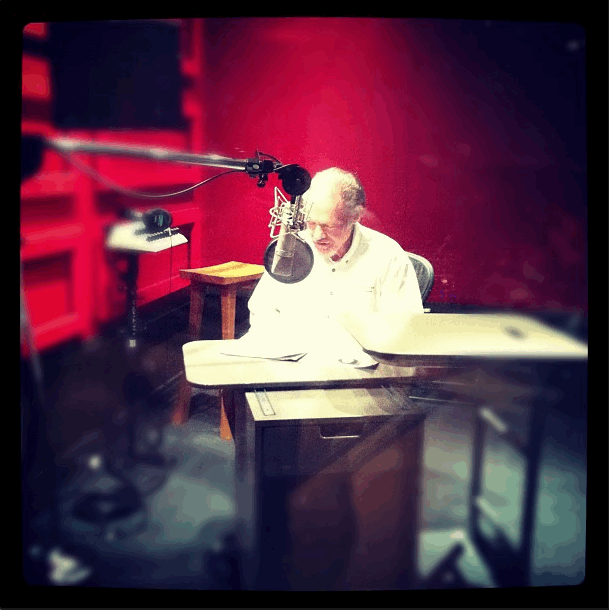
dougstudioSummer has arrived, and with it long drives for much-needed vacations. If you’d like the companionship of this author, and the multitudes within Stories About Storytellers, the audiobook is available for order from Audible, and provides over 17 hours of company on the road.

Points of interest about this particular incarnation of the book include that (a) the Introduction by Alice Munro is read by my multi-talented editor, Jen Knoch [ed. note: a daunting task!] and (b) that although I have read more than 100 movie reviews for CBC microphones over the years, it was a shock for me to find out how reading a book aloud is very, very hard work. To be precise, with gulps of air and gulps of hot soup to keep the Scottish-accented voice healthy, day after day, it took me over 20 hours of reading over 5 days to get the whole book on tape.

The good news, of course, is that when the book (as in this case) is written in the first person, and read by the writer, the listener knows that this is the way the author meant it to sound. It does add to the listening experience, which is why I did it.

And, of course, being a professional reader in the studio day after day, accompanied by the patient Kevin at the controls, was a fascinating new experience for me. I’m still working  at expanding my resume. You never know.

My New Book Club

We all know how important the avid readers who belong to informal book clubs are to the world of books.

I’m doing something new for them. I’ve produced a Storyteller’s Book Club where I deal with five classic Canadian books, and provide 20 Discussion Points about each one of them for the club members.

What’s special here is the I edited all the books I discuss. Well, with one exception. I didn’t edit Hugh MacLennan’s great novel The Watch That Ends the Night, but I did edit books by my friend Hugh, which allows me to talk about how I might have edited the book. As for the others, I can take the club members behind the scenes with Alice Munro, Mavis Gallant, Robertson Davies and Alistair MacLeod.

Check it out at on the Storytellers Book Club page.

DOUG GIBSON’S TRIBUTE TO ANTHONY JENKINS AND HIS CARICATURES

If you like the caricatures that begin each chapter of my book, I have very good news for you. A new book has just appeared entitled A Fine Line: The Caricatures of Anthony Jenkins. It’s published by the small independent Nestlings Press, and the ISBN is 978-0-9691456. It contains over 100 of the best caricatures ever produced by my friend Tony Jenkins; you may even recognise a few of them from my book.

I had the chance to talk about just how much I admire his work in The Foreword.

Here is what I wrote:–

Anthony Jenkins is a dangerous man. I alarm the good people who come to see my stage show, Stories About Storytellers, by warning them that I am going to whisk them through a list of interesting authors by showing them Tony Jenkins’ caricatures of each writer. I stress, however, that this is a perilous business, because he is clearly in touch with devilish powers that would frighten off a sensible Faust. Or perhaps he drinks potions that endow him with the same sort of magical powers that Oscar Wilde revealed in The Picture Of Dorian Gray, where the flesh-and-blood Dorian remains eternally youthful while the portrait at home does all of his aging for him.

Tony Jenkins, I explain, is clearly in touch with the same dark powers. “When he produces a not-altogether-flattering portrait of you” (and here I put on the screen the Spring 2011 portrait of me that appears on this page) “day by day, week by week, month by month, you will come to look more and more like that portrait!”

The terrifying process continues to this day. So I am very keen to do everything I can to stay in his good books.

This book is one of them. When the publisher, my old friend Warren Clements, invited me to contribute a Foreword, I instantly agreed to do so, out of fear. But there was something else, too—admiration. Not to mention regret that in my publishing days I was never smart enough to think up this book.

In those days (and I was the publisher of McClelland & Stewart from 1988 till 2004, so I can’t plead lack of time), I was keenly aware of Tony’s excellent work in The Globe & Mail. On occasion I would suggest to our Art Department that he would be perfect for this or that book cover. One example that still gives me pleasure is William Weintraub’s 2005 comic novel, Crazy About Lili, in which an earnest young McGill student meets and falls for a famous Montreal stripper. Tony’s cover art, involving a dangling McGill pennant and a dangling scarlet bra, is perfect. And I once, as a private citizen, made a pilgrimage to Tony’s office to buy a wonderful portrait of Alice Munro, which now hangs in our front room.

But I, like other Canadian book publishers, simply didn’t wake up to see, and develop, this amazing talent in our midst.

In 2011, however, when I was writing my own book I finally saw the light. I realized that Stories About Storytellers, its 21 chapters devoted to descriptions of 21 authors, needed to show the authors. A book with no illustrations would seem dull, possibly even (shudder) earnestly academic. A book that used photographs of the authors would seem overly serious. Witty caricatures of the authors at the opening of each chapter was clearly the way to go. And for these caricatures, Tony Jenkins was the man, without question.

So, defying the usual publishing practice where the Publisher chooses the Illustrator, I approached Tony directly, long before I had a Publisher. I gave him a list of the authors in the book, and we made a private arrangement whereby I acquired the rights to use his portraits in the book, and in promoting the book on stage and screen (I was already thinking strange promotional thoughts). In most cases, when the author was Robertson Davies or Brian Mulroney, he already knew the look of the authors very well. In other cases, such as the cowboy author R.D. Symons, I sent along photographs to guide him. In a surprisingly short time, and after very few revisions, I had my 21 superb caricatures, which I thought caught the spirit of my book so well.

When I approached interested publishers, I stressed that these caricatures were part of the deal, thanks to a private arrangement between us. And the wise people at ECW Press recognized what an asset we had, and contributed to the cost, and made good use of his artwork. Tony’s caricatures attracted widespread admiration, both in book reviews and in general comments from readers. After my stage show, despite my opening warning, the most frequently asked question is: “Who did you say did the wonderful portraits?”

Let me step aside here, away from my own experience, to discuss what I think Tony Jenkins is doing. I believe that he is trying to scale the same mountain that has challenged artists from the dawn of art: to catch, in two dimensions, the essence of another person.

People have been trying to do this from the days when cavemen drawing on the wall ranged from showing deer and other prey worth hunting to portraying the faces around the fire. Children still do it every day with crayoned portraits of Mommy. And we all know how hard it is to create a straightforward, “realistic” portrait. Graham Sutherland, a veteran portrait painter of great skill, once bitterly described a portrait as a painting “with something not quite right about the mouth.”

Some cultures and religions even frown on the whole concept of portrait-painting, recognizing that these attempts to catch the essence—perhaps we might daringly use the expression “the soul”—of another person represent very dangerous territory. I think most thoughtful Westerners respect the alarm felt by distant peoples that a photographer catching their image is perhaps stealing something from them.

Western art, of course, has produced many superb specialists in portraiture, too many to name here. In the case of Rembrandt, scholars estimate that at least two-thirds of his work consisted of portraits. And while the Old Master was frequently hired to produce portraits that would look good on the preening Amsterdam merchant’s wall, he took the art much further. One biographer, Jakob Rosenberg, in his Rembrandt: Life and Work goes so far as to claim that by the end of his life, his “mature” portraiture was more than a caught moment in time: “[W]e feel, to a certain degree, the sitter’s past coming into the present, and even some premonition of the future.”

Another dangerous man.

We are clearly in the realm of great imagination here, far beyond mere “photographic” representation. Yet to complicate matters, here is the famous photographer, Yousuf Karsh, writing about what he tries to do in his portraits. He begins his first book, Portraits of Greatness, with this paragraph (and liked it so much that he opened his next book, Karsh Portraits, with precisely the same words): “The aim and art of the portraitist who works with a camera are not merely to produce a likeness but to reveal the mind and the soul behind the human face.”

“Mind” and “soul” revealed by the camera. Consider, then, the challenge facing the brave artist armed only with brushes and paint, and pens and ink, who hopes with a skillful eye and a steady hand to catch that same “mind” and “soul” in a piece of art that the Oxford English Dictionary defines as a “caricature; grotesque usu. comic representation of a person by exaggeration of characteristic traits, in a picture, writing or mime.” Interestingly, the word derives from the Italian caricare, which means “load, exaggerate.”

A “cartoon” is defined by the same source as “a humorous drawing in a newspaper, magazine esp. as a topical comment.” We are on familiar ground here. Every reader knows, and to a greater or lesser extent enjoys, editorial-page cartoons where recognizable (possibly even labelled) figures act out embarrassing scenarios, or spout amusing, often incriminating words. Tony Jenkins can play that game very well, too, as Globe and Mail readers in the past were reminded by the occasional appearance of his fine political cartoons.

Canadians, I think, are reluctant to place living cartoonists in the highest ranks of the art. (Someone more cynical than your humble servant might expand that to “living artists of any sort”.) Many were startled when the American critic Edmund Wilson, in his survey of Canadian culture, O Canada, devoted a section to the Toronto Star’s political cartoonist, Duncan Macpherson, boldly putting him in the august company of the greats like Gilray and Cruikshank. Today, kind words about our leading exponents like Aislin (Terry Mosher) might produce the same reaction; the everyday is rarely associated with the eternal.

Yet when you, dear reader, roam through the pages of this book, I think that you will start to conjure up names of the great caricaturists of the past. Tony Jenkins may have a very different style from Hogarth, Daumier and Grosz, or the more modern masters Ronald Searle, David Levine, Gerald Scarfe and Ralph Steadman. But there is a very definite style here, one that is notably spare, using one line where others might use ten. Unused space—it would be wrong to call it “blank space”—is put to remarkable use.

Famously, defying the old proverb that “the eyes are the window of the soul”, Tony Jenkins has often seen fit to dispense with one of these valuable windows, preferring to let one eye speak for two. Again and again in these portraits, also, we see a tiny detail apparently catching the essence of the character, what in bolder times would have been called “the soul”. See for yourself.

As for me, I admire the art in this book immensely. These excitingly varied portraits constitute almost the work of a lifetime. They give us all a book to cherish by a superb artist—and a dangerous man.

Douglas Gibson

Toronto, February 2013