Barnstorming, Day 1 & 2, Sarnia & London

Day One, Sarnia:

The day starts with a fine interview with Allan Gregg at TVO. The make-up woman tells me that high-definition has altered the rules for TV make-up. No more pancake trowelled on to conceal wrinkles, since every trowel mark shows up. So instead of trying soft-focus tricks, you blast maximum light at the face, with the fierce reflection preventing detail from showing up. Who knew? Now I do, and so do you.

Jane picks me up from the studio around noon, and we set off for Sarnia. After sharing the driving, as always, we make it to The Book Keeper, impressively run by my old M&S sales colleague friend, Susan Chamberlin. Chatting at the front of the store we meet a man coming in, clutching a newspaper clipping about me. He can’t make it to the theatre that night, but I sign a book for him, clinching the sale. Two more in-store sales happen, by happy chance.

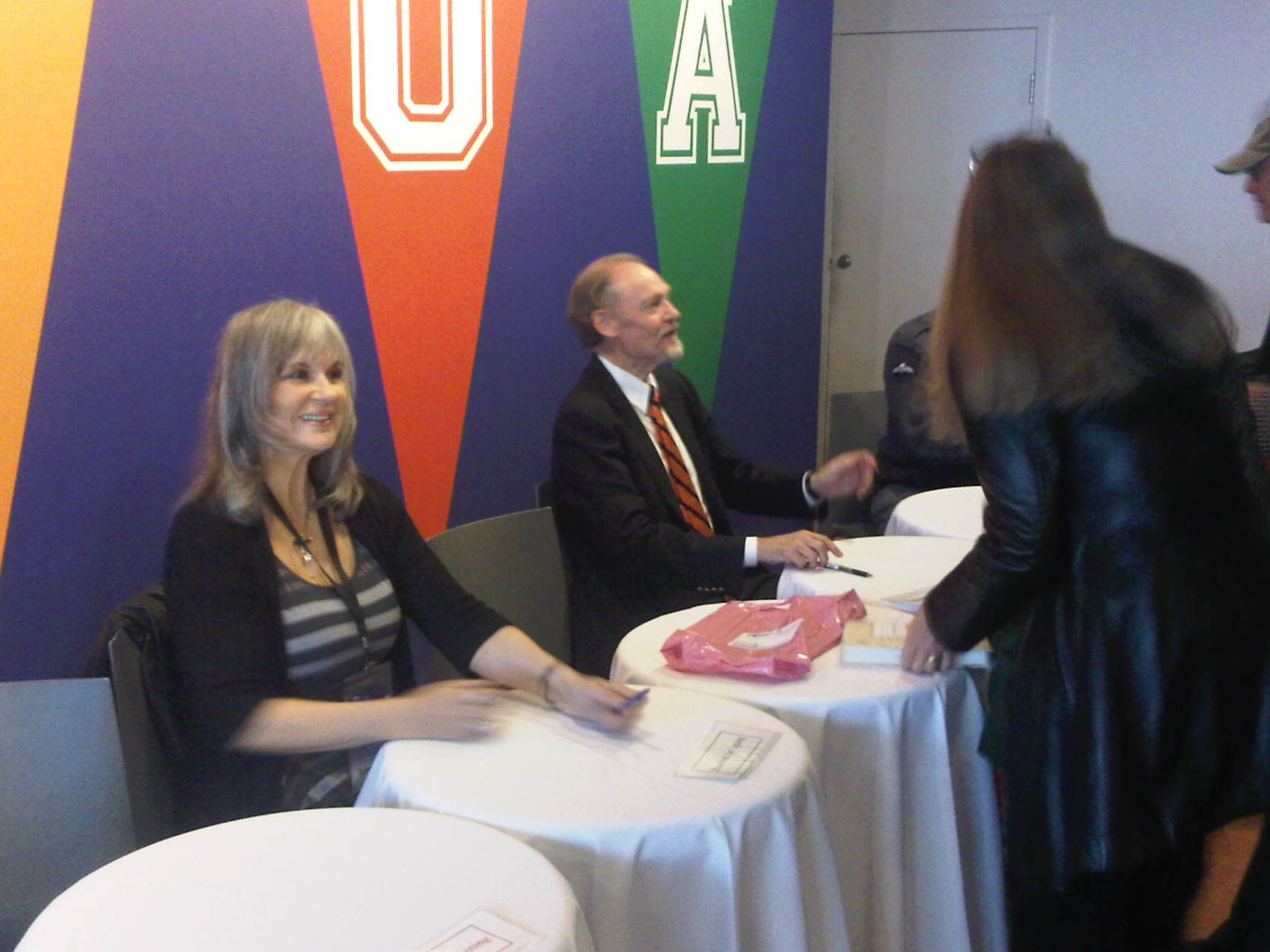
After a desktop take-out meal with Susan, we made it to the downtown Library Theatre. All goes well, and 29 books are sold and signed. It’s great to sell my book and to help out worthy independents  like Susan, who did a remarkable job in producing posters to promote my event. I see a framed one in my future.

We stayed overnight with our Sarnia friends Sue Brighton and Chris Curran. Morning dawned to show that we were right beside Lake Huron, and we had a stroll along the beach.

Day Two, London:

Arrived  in time to visit the Oxford Bookshop, en route to lunch with one of Jane’s cousins. Then on to our friends’ home where we’ll spend the night. (Hey, this is a book tour, where every penny counts!) We leave Nick and Anne’s downtown place after dinner, and find the Wolf Hall Theatre in the main library. The stage is enormous, with the screen very close to the front of the stage, but by now the old pro can adapt to almost anything.

The performance goes well, with the help of a very sound sound man, and Mark, the bookseller, is pleased to sell around 25 copies. Sheila Li, of the London Library System, does a fine job of introducing me, and arranging a Q&A  session. Afterwards, I sign for some people I know, and a friend of Alice Munro’s. Alice is well-known here, where she studied for two years.
To Montreal, Still Asleep

To get from Ottawa to Montreal on a  Sunday morning for brunch (after an evening event) requires you to catch a 5:45 a.m. flight. No comment.

Fortunately the Paragraphe Books and Brunch event at the Sheraton was well worth a little lost sleep. I spoke last, after David Gilmour (who was mysteriously unable to join the rest of us at the Authors’ Table), then David A. Wilson (who ended his talk about his book on D’Arcy McGee with a penny-whistle rendering of a lament for his death) then Kathy Dobson, the author of With a Closed Fist (about growing up tough in “the Point”). I talked about three Montreal authors in my book, Hugh MacLennan, Mavis Gallant, and Pierre Trudeau, who almost killed me right outside the doors of the Sheraton. The audience liked that idea.

After a chat with my friend Simon Dardick, who runs Véhicule Press, I went off to Le Salon du Livre. This extraordinary exhibition of Quebec literary culture attracts hundreds of thousands over a long November weekend. They line up, pay an entrance fee, then roam around to look at publisher’s booths, where they pay full price for any book that catches their eye. There may, or may not, be an author on hand to sign their copy, but the sense of literary excitement is palpable.

Attendance should be compulsory for all Toronto publishers. I used to attend as often as possible, and this year I was hosted by my old friend, Rene Bonenfant, who chairs the event. I also saw my one of my favourite authors, Yves Beauchemin, who signed a copy of his new novel to me, telling me to “keep on going!” And I met a number of publishing friends, including  Erwan Leseul, who had just launched the French edition of Trudeau Transformed, the book by Max and Monique Nemni that I published in English. I was delighted to find that the authors, in the French edition, had described me as “un editeur chevronné.”

I had a drink with Linda Leith (whose friendly Globe review of my book noted that we had never even had a drink together, which I was glad to fix) then took off for the West island to spend the night with Mark and Annie Abley. The next day Mark kindly took me to my radio interview with Tommy Schnurmacher at CJAD, a force in English-speaking Montreal. Storytelling works well on radio.

Then it was time for a nostalgic visit to the Chateau Versailles, where Hugh MacLennan delivered his last manuscript to me. I traced his path back to the apartment on Summerhill where he lived for so many years, then followed the walk he loved, along Sherbrooke Street to the McGill Gates. After a fine lunch with Pat and Norman Webster, it was time to take the fancy new airport bus and return to the bosom of my family.

— Douglas Gibson

To Ottawa, Once Again

A very different trip, this time, from the literary pleasures of the Writers’ Festival. Here I had two missions. First, to deliver a (very speculative) speech to a group assembled at the U. of Ottawa by the Canadian Conference of The Arts (a pro-arts lobby group that I volunteered for in the mid-’80s). The Exec. Director, Alain Pineau, spoke about the situation for Quebec publishers, and I talked about the scene in English Canada, for publishers and writers, and the dangers of prediction. To stress the uncertain climate I quoted both the Book of Proverbs (“the movement of a lizard on a rock”) and October’s Vanity Fair (“half of New York’s publishing companies will be out of business within five years.”) About a dozen of my books were sold, perhaps as a result of panic buying.

The second speech wrapped up the ACSUS Conference, of teachers of Canadian Studies at U.S. universities, with over 500 people in attendance. I roamed around the sessions for a couple of days (intervening once to say that, no, I didn’t believe that Canadian newspapers would systematically decide not to review a novel because it was critical of the oil industry). I then learned that, plenary or no plenary, it is not good to be the final Saturday speaker at a four-day conference. So my host-interviewer Robert Thacker and I simply moved down from the remote speaker’s platform onstage and produced a very informal session at floor-level for the die-hards remaining, some of whom had found copies in Ottawa bookstores for me to sign. Best of all, the session allowed me to spend time with Bob Thacker, the world’s greatest authority on Alice Munro, and her biographer, and a man very complimentary about my book – which benefits greatly from his work on the amazing Alice.

— Douglas Gibson

The Launch Party

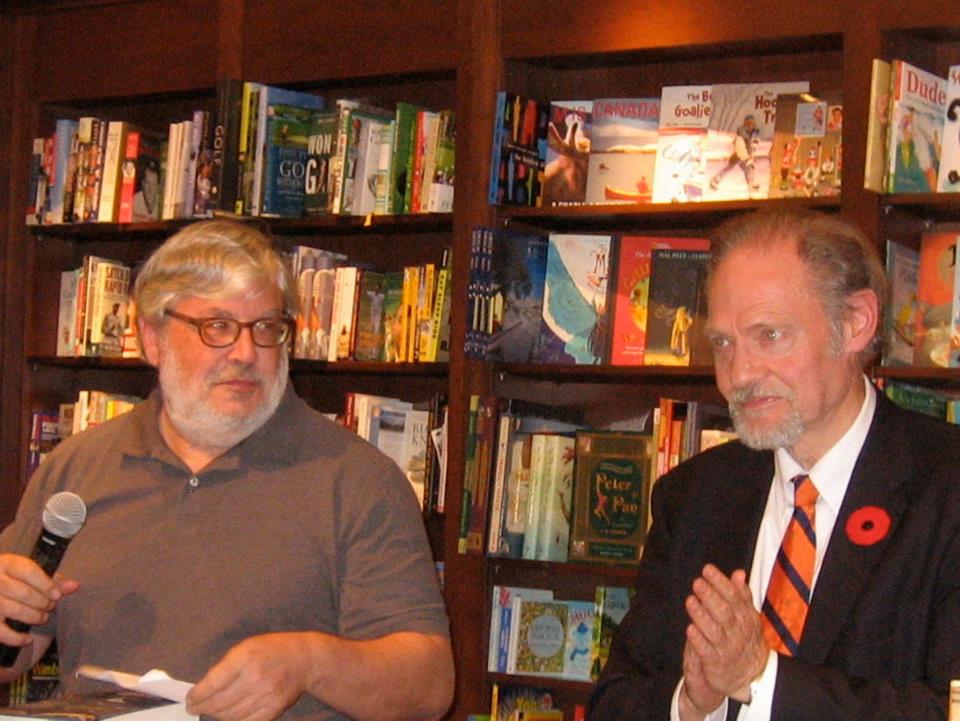
Doug being introduced by ECW Publisher Jack David

During my days as publisher at M&S I took a jaundiced view of launch parties for individual books. It turned our hard-working publicity department  people into almost full-time cocktail party organisers, and provided expensive free drinks for thirsty media types who couldn’t remember the name of the book they were supposedly celebrating, and writing or broadcasting about. To get away from this pattern, we held one big celebration, at the AGO (with all of our authors distinguished by a rose or corsage). It became a major attraction of the fall season, year after year, with a huge turn-out. It was so successful that Quill & Quire complained mildly about the company’s “Imperial style.”

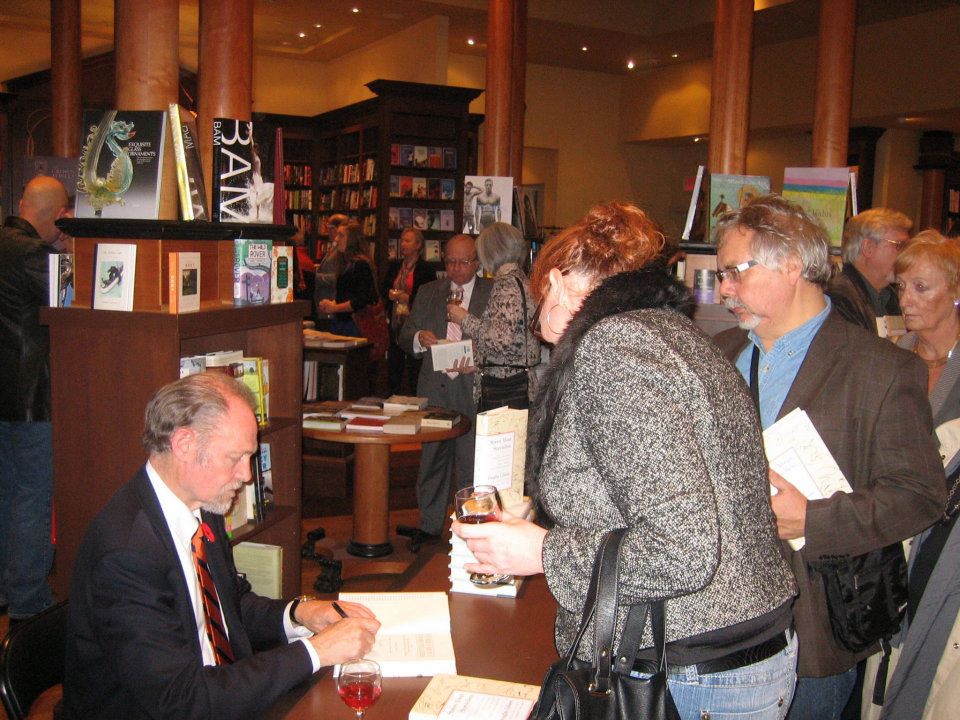
Now that I’ve had the experience of attending a launch party for one single book, and one single author  — me – it occurs to me that I underestimated the sheer selfish pleasure that an author experiences in that brief spell in the sun, as congratulations beam around. Certainly, the event at Ben McNally’s store (which in my brief speech of thanks I called “a beacon of enlightenment in the dark canyons of Bay Street”) was a very pleasant one, with friends popping up from all over. I was tied down at the signing desk from the start, and so wasn’t really at the party. But my friends played their part so nobly that we ran out of books to sign (with over 120 gone) and the ECW gang was pleased.

The next morning, like a sitcom character I was swinging my right arm and wondering aloud what was wrong with it. Jane pointed out that I’d just signed over 120 copies of my book. This is an occupational hazard I could learn to enjoy.

— Douglas Gibson

Doug's permanent position for almost three hours.

South to Windsor

Jane and I drove to Windsor for a double-billed event: a publishing panel at 2:00 p.m., followed by the one-man show (60-minute version) at 4:00. So after a long drive we were proud of our timing when we checked in at our hotel at 12:00. Only to learn that the Writers Festival folks had been calling the hotel in a panic. Didn’t I know that the show had been moved forward . . . to 11:30?

Well, no. So in horror I learned that 60 people had sat there eagerly awaiting me, to go away disappointed, with the news that my event would run later (against a popular already scheduled 4 o’clock event). We got about half of them back, but it was an embarrassing case of broken telephone.

The publishing panel, with Jack David (my publisher, and thus a model of wisdom in all things), Alana Wilcox from Coach House, and Jack Illingworth from the Literary Press Group, and me, was led by local publisher Dan Wells. I’m not sure that we left our audience feeling joyful optimism about where publishing is headed, but we spoke truth to lack of power.

My show was notable for being conducted in a fine Group of Seven Gallery. I had to apologize to a gallery visitor as we put up the screen in front of an especially fine MacDonald landscape, while he peered around it. And we filled the seats available, with Alistair MacLeod arriving late (he was involved with the rival event) just in time to miss my properly admiring account of his work. But as he came in, I said, “Oh, I’m going to have to stop saying rude things about Alistair . . . he’s just come into the room.”

Martin Deck, who runs the university bookstore, gave me a fine introduction, and vote of thanks, and I rushed off to sign lots of books (“Best Windsor wishes”).

On the way back the next day we took a side trip to Point Pelee. The birds were otherwise engaged, but I got to dip my toe in the water at the very southernmost inch of Canada’s mainland. Nearby teenagers were amused by this Tip Dip.

— Douglas Gibson

Friends new and old in Waterloo

Outside Words Worth bookstore I learned that my book contained a lie. The Epilogue tells authors flatly, “You will never see your book in a bookstore window.” Yet there were four copies of my book (not “sun-bleached, warped, and topped by dead flies”) in a window that advertised my appearance in the store that night. This amazing sight had to be captured for posterity, and Jane took a photo of me standing shyly beside the window display. At this a passer-by, a man of around 60, came up and said, “Are you Doug Gibson?” I had barely admitted the fact, when I saw that my wife was throwing herself into the arms of this stranger, emitting glad cries. They had gone to high school together.

The coincidences continued with my audience including a former M&S colleague, a man I met at Alice Munro’s 80th birthday party in Wingham, and Erica, a bookstore employee who once interned at M&S.

The best coincidence of all took place at the Giller Prize the previous evening. Jane and I were chatting with Andrew O’Hagan (a Scot who comes about 12 miles away from my home village), when he broke off to talk with a couple who were waiting politely beside us. In due course he directed their attention to me, saying, “And do you know Doug Gibson?”

Amazement all round because as they, David and Mandy, put it, “Know him? No, but he’s coming to our store in Waterloo tomorrow!” So I was among friends, and after a generous introduction from David (I asked Jane if she was taking notes) we had an interview, then I told stories about authors requested by the full-house audience. It was great fun for me, and at the end David gave a highly memorable quote to the crowd, describing my work as “a damn near perfect book.”

Would I make this up?

Talking of that, I’m so impressed by the attention and publicity produced by the Giller Prize that I’m starting to hope that some readers will accuse me of inventing stories. Then . . . Ta Da! . . . I can classify my book as fiction, and enter it for next year’s Giller Prize.

— Douglas Gibson

A fine place, Ottawa

A Sunday afternoon in a Presbyterian church is not normally my idea of a time and place for fun, but Sean Wilson’s successful Ottawa festival has made the church hall at Lisgar and Elgin a fine centre for literary events.

I followed a lively debate about Israel between two authors with widely differing views, and was delighted to see that my audience included authors like Charles Gordon and Denise Chong, political actors whom I published like Eddie Goldenberg, political columnists/friends like John Ivison and Jeffrey Simpson, and many old friends.

Although the podium could not be moved onstage (which left me strolling about at audience level, in front of the stage) the show seemed to go well, and my old bookselling friend David Dolan proceeded to sell out of all 25 copies he had ordered for the signing. Signed copies are a verifiable measure of success, very welcome in a world of vague compliments.

Much better than vague compliments were the comments on the blog of Ottawa’s Nigel Beale, who tells people to “run” to see my show, going on to compare it to performances by “Stephen Leacock. Charles Dickens even.” If you don’t believe it, see for yourself. I think I can state that this is the first and last time that I‘ll be compared to Charles Dickens, but I’m enjoying the moment.

The perceptive Nigel, who interviewed me later, liked the book, too. A fine place, Ottawa.

— Douglas Gibson

On IFOA and “The Floating World” of Authors

For many writers, the Toronto IFOA has such a pedigree that it marks a high point in their promotional lives. If, however, you’re on the tour, it’s just another meeting of the “Floating World” of authors. So the hospitality suite is a place of festival reunions (“Hey, I missed you after Banff. How was Vancouver?”), and I was glad to catch up with many friends from earlier festivals, and with old friends like Elizabeth Hay, who once graced the delightful Tepoztlan Canadian festival in Mexico, and whom I’m proud to have published.

I ran into David Adams Richards, and learned that one chapter in my book is out of date. Talking about Jack Hodgins, I lament the fact that perhaps I gave him bad advice by urging him to stay far away from Toronto. To make my point I note how well my friend David’s career has developed since he abandoned New Brunswick and moved to Toronto. David gently reminded me that after many years in Toronto, he moved back east, to Fredericton, two years ago.

Signing after their IFOA event, Sylvia Tyson and Douglas Gibson.

As for the show, I had the surprising honour of having Sylvia Tyson precede me (“I once had Sylvia Tyson open for me” is a good boast for posterity. ) Her reading from her novel was punctuated by occasional songs. When I followed her, in the course of my one-hour show, I sang one line, which gives me room for a tiny singing boast. I’m still working on it.

— Douglas Gibson

A Stop at Brock

I was delighted to be a keynote speaker at Brock’s Annual Two Days of Canada conference. I gave the full 90-minute show, punctuated by my ripping off a malfunctioning lapel mic and shouting my way through whenever I strayed from the mic behind the podium. There is a rule that no mic works immediately when you’re setting up, or consistently, when you are set up. So adaptability is not just a virtue, but a necessity. But a stage show with the performer tethered behind a podium is a reduced version of the real thing.

I was kindly looked after by my faculty hosts, Scott and Marian, and stunned by a case of extraordinary academic memory retention. One fine man kindly remembered a talk on Hugh MacLennan that I gave nineteen years ago!
A high point for me came from the name of the room where I performed: Pond Inlet. There I was, recreating a polar bear attack in a room (almost as far south as Niagara Falls) entitled Pond Inlet, with the room’s nameplate using English, French, and Inuktitut.

Signing books afterwards allowed me to chat with Shelley Martin, of the Brock bookstore, who is a veteran who has worked with most of the authors in my book. My book signing is getting better. When in doubt, I  write “Best wishes.” The encouraging slogan “Good reading!” can sound awfully close to boasting, a description rather than an exhortation.

— Douglas Gibson

Tales from Edmonton

Photo by Kim Fong

My first encounter with the “magic carpet” treatment that authors receive from Literary Festivals came at the Edmonton airport when we were met by the friendly volunteer Jean Crozier, who whisked us in her car to our downtown hotel. In less than an hour I was perched on one of those bar stools reserved for TV talk shows, and trying to interest the passing crowd of shoppers in the possibility of coming along to my show that evening. The amiable CBC host/interviewer got the name of my book wrong, but recovered swiftly after I happened to mention it in the course of my reply. Another of my Awful Warningscomes true in real life. Lunch with the energetic David Cheoros, who runs the festival, resplendent in characteristic suspenders. Then we moved to the Milner Library Theatre for technical preparation — stage setting, lights, screen, sound, with my “Techie,” Jane, handling the computer power point show link-up. I ran through 10 minutes, almost like a real professional actor, then we called it a day . . . or a rehearsal. It’s remarkable fun to work with real professionals in an unfamiliar world.

Photo by Kim Fong

That evening the show went fine, with the attendant photos by the excellent Kim Fong showing what it was like. Afterwards I got to sit there smiling at a table and signing books, some of them to Alberta relatives, but others to apparently sober civilians. There are book-signing tricks, as I am learning. When an old acquaintance whose name you have forgotten asks you to sign, the stand-by “And how would you like me to sign it?” does not always work. “Oh, just to me” is not the reply you want. And the feeble,  “Let me be certain about how you spell your name” can lead to the barked reply,”Mary!” I’m sure there are ways out of this. Time will tell.

— Douglas Gibson

Photo by Kim Fong