Jane Austen Comes to My Show in Haida Gwaii

Haida Gwaii is the sort of place where unusual things happen sooner or later. I made my third visit to the island right after the Sunshine Coast events, flying from Vancouver to the magnificently named Sandspit airport. The bus took us to the ferry, then on to Graham Island, and to Queen Charlotte City, where we were dropped off right at the door of the auto shop that was fixing the car we were to use. No problem. Within minutes we had taken the island’s main road north to Tlell, and settled in to Bridge Cottage, right beside the famous fishing river.

The plan was to spend our days trying to outwit salmon, with the help of cunningly tied fishing flies and barbless hooks. Every morning our friend Noel Wotten would appear at the door (at 8 a.m., then 7:30, then 7:00) and would lead us to places where we stood thigh-deep in water and cast our flies for fish. Our casting was highly satisfactory in every respect, except that of actually catching fish that we could retain. Coho, our desired targets, were leaping around us, but we caught only cutthroat-trout or sculpin. But Jane and I had mastered the key to fly fishing, which is the zen-like point that catching fish doesn’t really matter. That’s just an agreeable by-product of a wonderful time spent as part of the river, absorbing the sounds and sights. Twice a shadow on the water made me look up, to see a giant bald eagle flying low overhead, using the river as a highway through the tall cedar, and spruce, and hemlock trees that Emily Carr knew so well.

Thanks to smart work by some local friends, a show was arranged for me in Queen Charlotte City on Wednesday evening. We went with our friend Noel (who brought his mouth organ along for the drive back . . . “Four Strong Winds,” “Summer Wages,” and much else) and found the Legion Hall, which doubles as the Anglican Church. Presumably “Onward Christian Soldiers” is a popular hymn there.

The show drew 42 interested people. The best moment came when I was walking around, greeting people as they came in and found a seat. I shook hands with one lady in her 60s and introduced myself. “Hello,” she responded “I’m Jane Austen.”

“I’m very pleased to meet you, thank you for co–” I said, then gaped at her. She confirmed that, yes, that was her name, and told me that an over-awed teenage girl once asked her to sign a copy of Pride and Prejudice.

It was a very literary evening. When my hosts presented me with a gift book with a title in the Haida language I asked for someone who could translate it and teach me how to pronounce it. They called over a nice man in the crowd called Angus Wilson.
Hugh MacLennan and the Women’s Soccer Bronze Medal

On Saturday, August 11, I performed my show at the annual Couchiching Conference. Jane and I met there 11 years ago when I was a visiting speaker (pronouncing great truths on globalization and publishing, I recall) and Jane was a hospitable member of the board, tasked with making visiting speakers feel welcome. We were married within the year.

The conference theme this year was The Arab Spring, and the implications for Canada. My Stories About Storytellers show was labelled as “And Now For Something Completely Different,” which was very accurate billing. But much of the Conference had dealt with the worrying situation facing the minority groups in many nations in the Arab world, and Hugh MacLennan provided an interesting link there.

I recalled for the audience that it was Hugh who made the point that Canada was formed from “defeated peoples.” Hugh listed The Loyalists, driven north after losing the American War of Independence, the French-Canadians after 1759, the waves of Highland Scots ejected after The Clearances, the Potato Famine Irish. Thereafter there were waves of defeated people from Europe, followed by more recent examples like Vietnamese Boat People, Ugandan Asians, victims of the Yugoslavian troubles, Tamil refugees, and on and on, not to mention our invaded aboriginal people.

I went on to suggest that if you were trying to create a society that was concerned about minorities, not just the triumphant majority, you couldn’t devise a more promising background than Canada’s.

As a punch line, to show how long-lasting this cultural heritage of support for gallant losers really is, I asked what other nation would be so proud of an Olympic bronze medal? Think about it. It was no accident that Christine Sinclair was selected as our flag-bearer. That bronze medal was the great event of the Olympics for most Canadians.

Hugh MacLennan would have been very pleased.

Sunshine Sketches of a Little Coast

For 30 years they have held a literary festival at Sechelt. That very first year I was glad to send Jack Hodgins (from his Lantzville home on Vancouver Island, right across the Strait of Georgia from the Sunshine Coast ) as one of the five authors attending. He had a wonderful time, and reported back with great enthusiasm.

Over the years, as the little festival grew into the established “Sunshine Coast Festival of the Written Arts,” in my role as Publisher I was pleased to send a steady stream of authors to this festival, assuring them that they would “have a great time.” They always did.

This year, in my new role of author, I got to see for myself. The hard-working Jane Davidson had secretly attended my performance at the Vancouver Writers’ Festival last October, and followed up with an invitation to attend the Sunshine Coast Festival that she runs.

So August saw Jane and me flying in to Vancouver, then dashing off to catch a seaplane that skimmed up the coast to land us at Sechelt. There we were met by Sally Quinn, a welcoming volunteer who identified herself brilliantly by displaying a copy of my book . . . always visible to an author’s eye at 100 paces. A quick tour of Sechelt took us to the Festival site, where we met Jane D. (astonishingly calm, given that over the next three days she would be receiving more than 20 performing authors from across the country, yea, even unto Michael Crummey’s Newfoundland, and Linden MacIntyre, fresh from Edinburgh). I also got to see the hall where all of the readings/performances take place. It is an all-wood open structure, the ceiling held up with tall pine poles, lending the air of a West-coast longhouse (crossed with a Cathedral, as one admirer put it). Ten seconds on the empty stage were enough to show me that this was a very special space, open yet intimate.

Since one of the strengths of this fine festival is that all events take place there, with no competing events at different venues, Jane and I were to spend many happy hours in the audience at that theatre over the weekend, enjoying the varied readings, Q and As., conversations, and performances. I’m happy to report that my own tightly scripted but apparently informal Stories About Storytellers show was reviewed by the local paper as “polished ramblings.” Aha!

Most of the time we sat with our host and hostess, the authors Sharon Brown and Andreas Schroeder, who live just outside Sechelt as “Roberts Creekers.” (Over time, we warned them, “Roberts Creakies” may apply.) We had the great good fortune to stay at the cabin down by the shore that Sharon and Andreas (whom I have published with great pleasure over the years) provide for lucky friends. And the blackberries! Words fail.

One of the high points of the festival is that at the end of each session, the great Hall is cleared, and everyone files out to drink, chat, or (usually) line up for the next session starting in 30 minutes. As a result, the placid queues along the Rhododendron-lined paths are a great place to meet old and new friends, and to chat about books and authors.

The local support for the festival is all you would hope for, and people are proud of what they have built up over the years. One retired man who sought me out to sign his copy of my book said it best. When I commented on what a great thing for the community this festival must be, he said, “This is why we moved here.”

A footnote: on Sunday Andreas took us for a quick tour of Gibsons, just to the south. For someone with my name, the place is a goldmine for delusions of grandeur. A quick tour reveals “Gibson’s Cinema,” “Gibson’s Curling Club,” “Gibson’s Swimming Pool” and so on and on. At the waterfront (near where The Beachcombers was filmed) is a statue of Captain George Gibson, who founded the town in the 1880s, rowing his produce down the coast to Vancouver. I posed proudly with my arm around his oilskin-clad shoulders, and felt right at home.

Saskatchewan Birding with Trevor Herriot

I once was given a private tour behind the scenes in Parliament by Erik Spicer, the Parliamentary Librarian. On another occasion James Houston took me and some others through a special exhibition of Inuit art, recalling when he watched this piece being sculpted, and what his sculptor friend was chatting about as he worked on that other piece over there.

You have the same “behind the scenes” feeling when you set out with Trevor Herriot to look at birds in Saskatchewan. Trevor is not only a wonderful writer about nature, as well as many other things, as readers of his books know well. He is also an expert bird-watcher, so good that he has run a Regina radio show that helps callers to identify birds that they have stumbled across “with a yellow neck at the back.”

His own keen ears can identify different types of sparrow calls at a hundred paces, and his long-range camera skills are remarkable. I knew this because a couple of years ago he took me out from Regina to do some birding near Last Mountain Lake, and it was a very memorable morning.

So when Trevor suggested that Jane and I (who were staying in Regina with him and Karen and the family) head south with him and his birding friend Bob Luterbach to see what we could find en route to Weyburn, we were delighted.

It is as if the word spreads through the bird community that “Hey, Trevor Herriot’s here!” and they flock (so to speak) to see and be seen by this great celebrity birdwatcher. If you think that’s unlikely, look at the list birds we saw that morning, aided by the fact that a lush Prairie summer has lured uncommon visitors north from the parched American Plains states.

We saw White-faced Ibis (as in Egyptian pyramid art), Burrowing Owls (now endangered), Black Terns at the sloughs (and one angry Forster’s Tern), Baird’s Sparrow, Grasshopper Sparrow, Lark Bunting, Bobolink (with a yellow neck at the back), Chestnut-collared Longspur, and an amazing range of exhibitionist Bitterns, normally heard but never seen. All of these were first-time sightings for me and Jane.

Of course we also enjoyed watching Swainson’s and Red-tailed Hawks, not to mention the usual Mallards and Eared Grebes on the sloughs, the usual gangs of Redwinged Blackbirds and Cedar Waxwings, and a lone Upland Sandpiper. Wonderful!

Gibson Does a Striptease on Stage

When I found myself paired with Vancouver’s John Vaillant (author of The Golden Spruce and The Tiger) I chose to read from my chapter devoted to James Houston. After Jim’s great deeds in the North, he fell in love with a cottage in Haida Gwaii, where I visited him. My book goes on to talk about the Haida people, and mentions the appalling story of the golden spruce, their magical tree that was felled by a crazed logger-crusader. I then praise The Golden Spruce, wishing that I had had the chance to publish it, and calling it “One That Got Away.”

Reading that passage, of course, made a fine segue into John’s reading  Then he revealed that, although he never met James Houston, while he worked on The Golden Spruce (set on the West Coast), for some reason he became fascinated by the distant Inuit art of the far North, and immersed himself in it.

Earlier, when I was talking about James’s key role in spreading Inuit art (“No James Houston, no Inuit art!” as one museum director put it) I was able to demonstrate how Inuit art is now everywhere. As I read, I slyly unbuttoned my long-sleeved white shirt, and opened it wide to reveal – ta-da! – that I was wearing a T-shirt devoted to the The Enchanted Owl, the 1960 print by Kenojuak that became a Canadian postage stamp ten years later.

“And now,” I said, pulling my shirt apart and thrusting out my owl-covered chest, “Inuit art is everywhere!”

I’ve never had such applause for a striptease act before. Something to work on?

The Mae Wilson Theatre in Moose Jaw

Saturday was a busy day for me, with two readings (James Houston, then W.O. Mitchell) in the morning, then the show at the Mae Wilson Theatre on Main Street. This is a grand old Edwardian Theatre, with all the elaborate plaster trimmings, where touring performers like Sir Harry Lauder have appeared down through the ages.

I did my show (with the help of Eric the soundman, and Shane looking after the lights — and Jane up there in the booth) against a truly massive screen, perhaps 15 feet by 30 feet, which meant that the author caricatures were clear to everyone in the 300 person audience.

The audience was set up by a very generous introduction by the local author Bob Currie, and was notable for the fact that the gallant Jane, who knows the show very well, managed to handle the slide changes perfectly, so that the audience thought that my casual hand gestures automatically changed the screen.

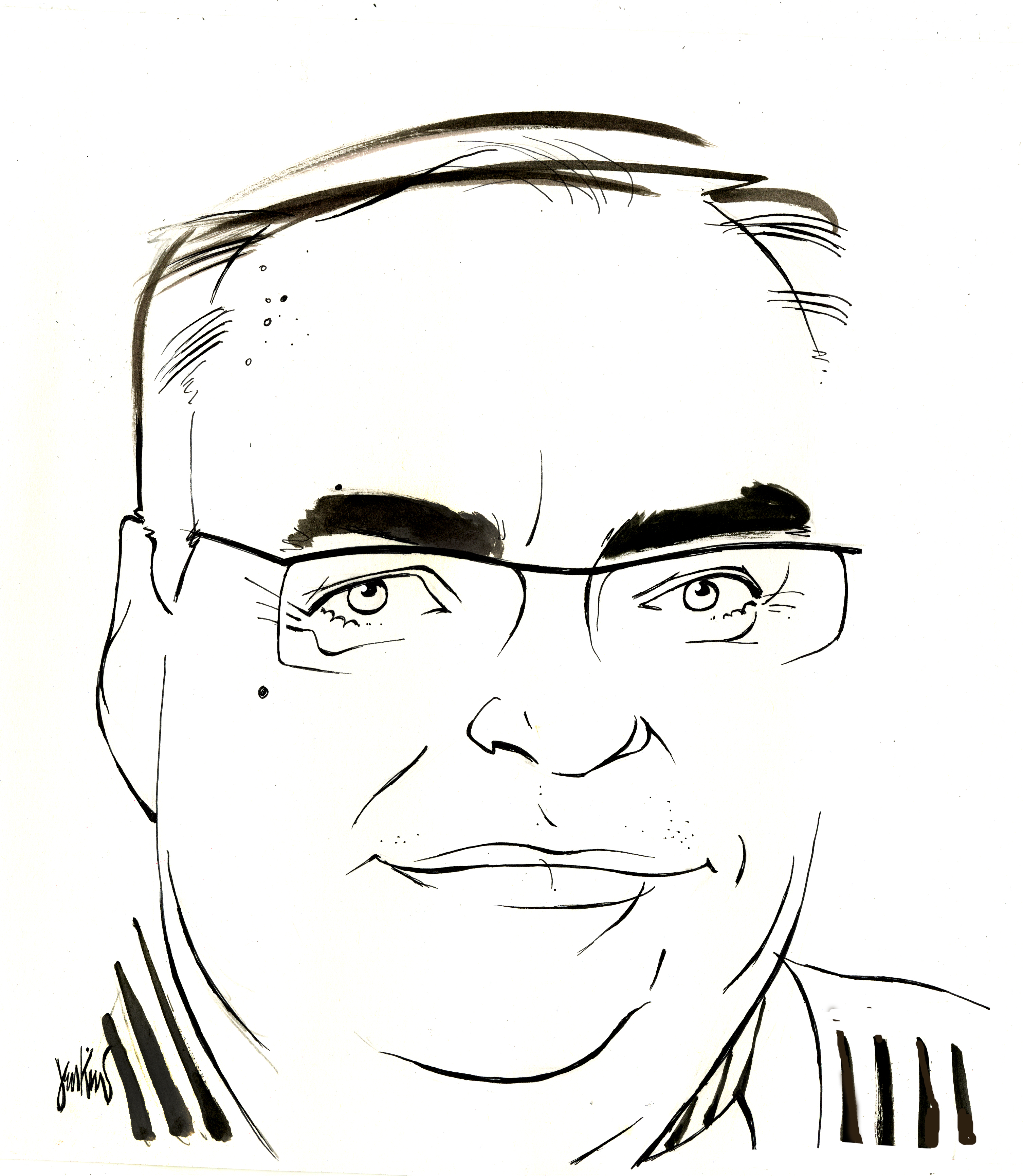
One new part of the show was a special surprise for my good friend Terry Fallis, author of The Best-Laid Plans. I had got the splendid Tony Jenkins to do a caricature of Terry, knowing that he would be at Moose Jaw, although he had seen my show before.  (Terry is that kind of friend). I gave his picture the sub-title “Saint, Little Red Hen, and Prizewinner” and explained each part of the sub-title as Terry gurgled and blushed in the audience at his unexpected appearance in mid-show.

The audience seemed to like the show, and gave me a standing ovation. Later we had a Q and A session (“Did you have any authors you really didn’t like working with?” “They’re not in the book.”) A good day’s work, worth a relaxing spell in the Spa pool.

In Praise of W.O.

For my third reading in Moose Jaw, I saw no obvious link to my fellow reader. This was a very good thing. Jalal Barzanji’s book, The Man in Blue Pajamas, is a prison memoir of his days in Saddam Hussein’s Baghdad, before he and his family finally managed to make it to Canada. Happily, I had no similar stories to write about. So after praising the PEN Canada help that brought Jamal to Edmonton, I simply chose to honour Saskatchewan’s own W.O. Mitchell, from Weyburn, just east of Moose Jaw. Any reading that includes a selection of stories about the unforgettable W.O. is bound to be popular. This selection from my chapter on “W.O.Mitchell: Character and Creator of Characters 1914-1997” was no exception.  People love to hear about this guy.

Later, after a Regina visit with our friends Karen and Trevor Herriot (the subject of a separate birding blog) Jane and I made a pilgrimage to Weyburn. Armed with information provided by Kam and Megan at the library, we walked the streets of the little town, which now has roughly 10,000 people. As everyone who has read Who Has Seen the Wind knows, when W.O. was a boy the open prairie lay just a couple of blocks north of his house, now close to the centre of town.

Thanks to the library’s leaflet we found the Mitchell residence at 319 Sixth Street. Nobody was at home, so we took photos and were giving up and leaving when a car drew up outside. It was Jamieson, the son of the household, who kindly invited us in and showed us around the ground floor. It was just as we had hoped — all maroon furniture against a base of old oak panels — befitting a grand 1903 house that was the best in town. Even the bevelled glass windows and doors in the book cases and the Art Nouveau metal light fixtures spoke to the deliberate standard of excellence from that time.

We also saw the Knox Presbyterian Church that the Mitchells attended, but we did not get to see the inside stained glass, “all grapes and bloody.” We peeked in at the ancient Royal Hotel (once opposite the now-gone Railway Station, although Railway Avenue remains), and visited his father’s grave in the cemetery just south of town.

I must confess that there was no sign of the cheeky gopher at the edge of the tombstone (“O.S. Mitchell. Loved by all who knew him”) that so offended young Brian/Bill when the family solemnly visited the grave.

The Weyburn Museum (the “Soo Line Museum”) contained many photos of the town from W.O.’s boyhood days (“the litmus years”) and one of his father, and of his pharmacy. We roamed the banks of the Little Souris River, in search of the famous swimming hole where W.O. and the other boys swam naked. We even saw some descendants of the cat-tails that provoked such naughty behaviour from some of Sadie Rossdance’s girls.

In the evening, having walked the streets to absorb W.O.’s Weyburn, I gave my show in the Weyburn Public Library to about 15 appreciative local people, including the local author, my friend, Joanne Bannatyne-Cugnet (A Prairie Alphabet). As usual the show ended with a tribute to W.O., and in Weyburn that seemed only right.

Moose Jaw Encounters

The Saskatchewan Festival of Words has been held in Moose Jaw for 16 years now, but this was the first year that I was able to attend. Right away I saw why my authors had always enjoyed it so much.

Invited authors/performers are housed at the downtown Spa hotel, built around some natural hot springs full of healing waters. We found that every day had to involve at least one wallow in the soothingly warm pool on the top floor, where people sunbathe then swim, drink cool water, then repeat the dose. I was right at home because the little café beside the pool was named the Morningside Room, recognising the fact that Peter Gzowski (a sentimental graduate of the Moose Jaw Times-Herald) chose to stage his last Morningside broadcast from the hotel, and a photo of my friend Peter hangs on the café wall.

The festival itself is set a short walk away, in the library and the at gallery on the edge of Crescent Park. This is Moose Jaw’s central park (and indeed its Central Park) and is a fine blend of beauty and endless, active variety, which we explored every day.

I gave three readings, adapting my chosen excerpt to fit in with my co-reader. For example, matched with Harold Johnson, a truly impressive Cree-speaker who is a Crown Prosecutor in Laronge and has a Master’s Law Degree from Harvard, I chose to read about Saskatchewan’s own R.D. Symons, my very first author.

I was so impressed by Harold that I bought a copy of his novel, Charlie Muskrat. The trouble with literary festivals is that you hear so many fine readings that you end up buying lots of books. An occupational hazard.

Just Glad to Be Nominated – No, Honestly

On Saturday, July 28, I went to Orillia for the exciting announcement about this year’s winners of the Canadian Authors’ Association prizes. I and Jonathan Vance and Richard Gwyn had been nominated (from among, they told us, countless authors of Canadian non-fiction books) for the Lela Common Prize in Canadian History.

I was, of course, very pleased to have my book nominated for an award, and in such good company. But the “history” designation worried me. So when the local TV station asked me what I planned to do if I won, I said, “Demand a recount!”  My objection was that while Richard and Jonathan are real historians (who wear gloves in archives, and get ancient dust up their noses as they research Sir John A, or Canadians in Britain during the First World War) my book was a cheerful personal memoir of working with 20 famous Canadian authors, many of whom are still with us.

I argued, in fact, that while I am certainly a “mature” individual, I am not yet “history,” and I want no part of it. Yet.

As the day wore on, however, and Jonathan and I read from our books, and smiled continuously and were relentlessly charming, my objections to receiving the award weakened. At the evening dinner I was the keynote speaker, and the stars seemed to be aligned for a triumph for Stories About Storytellers. It was not to be. The absent Richard Gwyn received the award, and Jonathan and I consoled ourselves by saying, truthfully, that this was the result that we had expected.

And as the announcement was made, sitting with my game face on, I had just enough of a sniff of the smell of success to realise that while it is very pleasing to be nominated for a book prize, it must be much more pleasing to win one.

Is anybody listening?

A Triumph at Ridgeway

On June 1, I had the honour of appearing at the very first Ridgeway Reads Literary Festival, held in the delightful little town just west of Fort Erie. It’s so attractive that it just might prove to be a southern bookend matching Niagara on the Lake at the other end of the Niagara Parkway. (And the Farmers’ Market offers great pies!)

For this inaugural event Mary Friesen and her Ridgeway team had put together a sparkling series of authors, including Charles Foran (Mordecai: The Life and Times), Andrew Westoll (of Taylor Prize-winning fame), Olive Senior (Dancing Lessons), Richard Wright (Clara Callan, etc.) David (D’Arcy McGee) Wilson, and Phil Hall, whose book Killdeer was up for this year’s Griffin Poetry Prize.

I had the pleasure of giving my show on the opening Friday night, introduced by Rhyming Barb, who concluded her vote of thanks by asking me for another “chapter,” because to provide it no one would be “apter.” Ogden Nash clearly did not live in vain.

We had to leave after Charlie Foran’s marvellous Saturday morning talk on my old sparring partner Mordecai (his letters to me would continue our duel more in sorrow than in anger, wearily beginning, “Gibson, Gibson”) because Jane had a high school reunion to attend in Cambridge. This meant that we missed the following wonderful event in Ridgeway, closely described by an anonymous observer very similar to my friend David Wilson.

Later on Saturday there was a formal unveiling of a mural celebrating the 1866 Battle of Ridgeway, against Fenian invaders from the south. A high point of the official speech (by, I believe, the Minister of Justice, Rob Nicholson) was when he praised the literary festival: “This is a wonderful event, with some of Canada’s best-known writers. One of them, who gave a most enjoyable talk last night on stories about storytellers, was [short pause] none other than [slightly longer pause] Doug Wilson.”

Several people in the crowd shouted out, “No, no, Doug Gibson.” But my triumphant role (as in “Fred Gibson”) was established once again.

Stephen Leacock was apparently directing the events around the formal unveiling of the mural. First, the procession to the mural was delayed because the two regiments involved in the original battle (or, more correctly, the original headlong retreat) were unable to agree on which of them should lead the way. The gallant men of the Queen’s Own Rifles stood firm against the equally determined soldiers from the 13th Hamilton Regiment. After a long stand-off (possibly longer than their appearance in the actual battle, before both regiments ran away) the Hamilton men picked up their marbles and went home.

My anonymous observer’s account continues: “Second, the Town Crier immediately led the parade through the back alleys of Ridgeway, without waiting for the dignitaries to arrive, and without paying any attention to the prescribed route along the main street; deaf to all cries to wait, he pressed on fearlessly and relentlessly.”

“Third, when the Queen’s Own and the dignitaries finally made it to the mural, it turned out that the cover over the mural had been tied down so tightly that it couldn’t be removed. Eventually, the ropes were cut,  and someone leaned out from the window above the mural to catch the cover as it billowed in the wind, and to haul it in like a ship’s sail.”

Where, I want to know, were the Knights of Pythias in all this?