The Vancouver High Wire

The Granville Island Hotel is the centre of the Vancouver International Writers’ Festival, run by a dedicated staff under Hal Wake. The usual suspects assembled there although Jane and I were also lucky enough to attend the opening night Gala Dinner. This was a Bollywood-themed extravaganza, with much merriment, where I was delighted to meet the splendid non-fiction writer John Vaillant. I told him that he was mentioned in my book, where I bitterly regretted that despite my Haida Gwaii knowledge, I never had the chance to publish his superb book The Golden Spruce. (I have now read his latest book, The Tiger, which I recommend – but not for bedtime reading.)

The MC of the dinner was the admirable Bill Richardson, who met up with me to recall a publishing prize-giving ceremony in Toronto where I accepted his challenge to accept a prize using “interpretive dance.” He claimed at the time that generations of my ancestors were spinning in their graves.

The prize, by the way, was for doing good environmental work. The truth of the matter is that Alice Munro twisted my arm to have Hateship, Courtship, Loveship, Marriage printed on recycled paper, which at the time was both eccentric and expensive. By doing it with this major bestseller, M&S broke the log-jam, and now it is usual, sensible publishing practice. But the credit all goes to Alice.

On the Tuesday evening I was thrown to the lions (and tigers), doing a one-man show at the Improv Theatre, where I told the audience from the empty stage that my book consisted of stories about these 20 authors, then asked for the names they’d like me to tell stories about.  It was an exciting high-wire act, and it seemed to work, right down to my friend, Paul Whitney, calling the event to a halt with a request for “one last story.” It must have worked, since the head of the Sunshine Coast Festival was in the audience, and later invited me to their Festival next August.

A new life beckons.

One behind the scenes story: I was in the Green Room backstage with seven minutes to go, when I thought it prudent to visit the washroom. “Not that one,” I was told,  “the one in the corridor.” Nobody added the words. “But don’t close the door, or you’ll be trapped inside.” You can imagine the rest, including the thunderous beating on the door until I was released just in time. You will understand why Jane was appalled for the next 75 minutes as I strode around at the very front of the stage with my zipper at half mast. All part of the excitement of the unscripted show.

Afterwards I signed copies for a crowd including the woman I first met as a seven-year-old next door in Toronto, and a downstairs neighbour from a later apartment. My life flashed across my eyes. The best surprise of all occurred in Banff when Robin Spano, the fine novelist published by ECW, greeted me with the words,  “Hi, you once came to talk to my high-school class.” And so I did, at Jarvis Collegiate twenty years ago.

Everything connects.

— Douglas Gibson
The Pleasures and Perils of the Festival Tour: Banff

In Banff, where I taught at the Banff Publishing Workshop from 1981 to 1988, I ran into the usual elk stories. The drifting herds of elk were  a prominent part of the campus , and in rutting season (October, and thus Writers’ Festival season) there were so many problems that I remember Roddy Doyle complaining that he had experienced a lot,  touring the world to promote his books but, as he put it in his worried North Dublin accent, this was the first time he had been in danger “of being focked by an elk.”

One of the things I’ve learned about being on the writers’ festival tour is that you’re on a magic carpet, whisked by kindly drivers from the airport to your hotel, which comes complete with a hospitality suite. Even better, the suite comes complete with an interesting group of other writers, who tend to be on the same circuit. So in Banff, and then Vancouver, and so on, I found myself running into the same people, in very convivial circumstances. Sometimes they share a programme with you (in Banff, after my own event, I had fun chairing the final session, featuring the fiction quintet of  Germany’s Thomas Pletzinger, my old friend Madeleine Thien, Scotland’s Stuart McBride, Helen Humphreys, and David Bezmozgis). And sometimes they are old, close friends like Guy Vanderhaeghe, whom I’ve published right from the start, until his current fine book, A Good Man.

Guy’s  Saturday night reading was the high point at Banff, where he alluded to an elk story, without elaborating. I know the story, and can reveal it here. Some years ago (possibly even before Roddy Doyle’s complaint) Guy was staying at the Centre, in rutting season. Coming out after breakfast he noticed that the herd had drifted across to block his path up to his residence, and that the male was looking aggressive. So he prudently waited at the foot of the stairs, a barrier to the elk. A confident young woman came out from breakfast, and Guy politely suggested that it might be best to wait for ten minutes until the elk moved on. She took this suggestion badly.

“I will walk wherever I please!” she announced, and strode towards them.

The male elk had not read the proper books. In Guy’s words, “She ended up behind a tree,” yelling for help.

Guy is familiar with cattle and horses, so he tore off his jacket, waving it as he bravely approached the elk, to distract it from the trapped woman. It worked. The woman was able to escape up the hill while the elk charged Guy, who just made it to the safety of the stairs with the elk in snorting pursuit. Guy did not sprain an ankle. The elk did not stay in the area for long. And the woman did not seek Guy out to thank him.

— Douglas Gibson

The Zen of Authordom

I was pleased to see that this Sunday’s Toronto Star ran an excerpt from my Epilogue, which consists of Awful Warnings to new authors about the terrible things that will happen to them when their book is published. My piece is very cynical, and outsiders to the book world find it very funny, and totally unrealistic. Interestingly, the Star’s Insight Editor takes a different view. Under the title “Authors, be warned . . .” his subtitle runs “Book publisher covers a glorious CanLit career in a new memoir, including bang-on author advice.”

“Bang-on”? My cynical description of all of the possible review horrors seems to Dan Smith to be “bang-on”? And Dan was the Star’s Book Review editor for over a decade. Very interesting.

One of the good things in an author’s life is that, if you are very lucky, your book may produce fascinating new information from readers. For example, Ralph Hancox, who worked with Robertson Davies at the Peterborough Examiner, elaborates on my line about the great leap forward in Davies’ work to Fifth Business:

“I asked him,” writes Ralph from Victoria, “what had brought about the change . . . his study of the works of Freud, Jung?”
“No,” he said. “I could not have written such material before my mother and my father had died. I would have
been a sorry outcast to them both.”

We all shake our head at the thought of Davies, aged 57 when the book came out, until that point being constrained by what his parents would think.  And then I realize that at 67, I (as my W.O. Mitchell chapter reveals) am still subject to what my 98-year-old mother will say when she encounters “bad language” in my book.

So you’ll find me chickening out of a Bill Mitchell line by saying “. . . well, let’s just say the term Bill used resembled ‘sock-kickers.’” There’s room for a really useful Ph.D. Thesis here. And what, dear reader, would you do?

One of the bad things in an author’s life is that eagerly-awaited reviews don’t appear because book review editors plead that they don’t have enough space to run all the reviews they have. This produces unworthy thoughts in unworthy authors. Thus my first reaction, on hearing that the authorized biography of Steve Jobs has been rushed through to come out late in October, was to lament the fact that the line-up for review space had just got more crowded, dammit. I will have to try for a more zen-like approach to this author business.

— Doug Gibson

New frontiers not far from home . . .

Though this Dispatches section will have tales of the Adventures of Douglas Gibson all across our fine country, for a new author, there are adventures to be had at home as well as abroad. Our intrepid author headed to his local Book City, and after locating his book (defying the Murphy’s Law that governs such things), Doug signed a few, and afterward took the time to write a note to the manager about his new experience:

Greetings,

Although you don’t know it, you have just played a major role in the transformation of your friend Doug Gibson, editor and publisher, into Doug Gibson, typical author.

This morning my wife and I went into your Danforth store. We found 5 copies of my book and I carried one to Hanna at the front desk (in case I needed proof, I suppose, if challenged) and shyly confessed that I was . . . ahem . . . the author of this book, and . . . er . . . um . . . would she like me to sign the copies in the store?

She responded very kindly, and stood by with “Autographed” stickers, while I adorned the books with a signature that she generously described as “cool.”

Then, after buying another, different book, Jane and I exited. It was my very first in-store signing, and a frontier has definitely been crossed.

— Douglas Gibson

A few words on Word on the Street

Toronto’s Word on the Street. Great weather means an attendance ten times the rain-swept version. Queen’s Park looks perfect with crowds of adults and kids and dogs  and tents, prompting the question: why doesn’t the city make more frequent use of this fine, central park?

A series of “firsts” for me. The very first public  reading from my book, and it takes place in a tent labelled (are you ready?) “Vibrant Voices Of Ontario.” The tent is flatteringly full, and Stuart Woods of Quill & Quire introduces me efficiently. I explain that my book is a series of profiles of authors that I edited, but that I’ve chosen to read the book’s Epilogue, “What Happens After My Book Is Published?”, which consists of the Awful Warnings I used to give to first-time authors. As usual, most of the crowd laughs happily at the examples of Murphy’s Law in action – and authors and publishers shake their heads in  sad recognition.

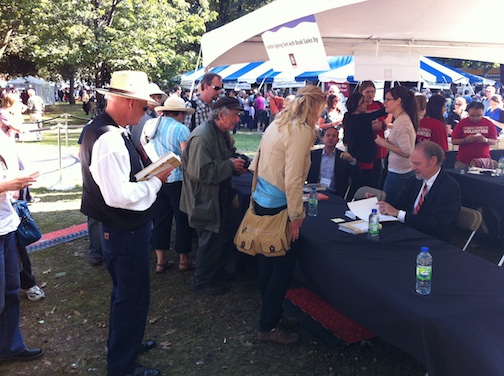
The second “first” is that, after a “Q and A session,” I am led to the “Authors Signing Tent.” There I shyly sign seven (maybe even eight!) copies, and find myself guiltily resenting the pals who stand at the front of the line to chat, not buy. As the line-up disappears I have time to notice that within twenty metres is the superb black  statue of my old friend Al Purdy, characteristically in a relaxed sitting pose, his hair drooping to the very life. I published him at M&S and, in addition to routine, in-office chats, we became friends after I went out to High Park to support him at a sweltering outdoor reading. Backstage, I remember, he was really glad to see me, and we both were bathed in sweat. I hope that the campaign run by Jean Baird to try to preserve his A-frame house in Prince Edward County is going well. I should have done more to help.

There’s still time though, and efforts to save the house continue. On November 23, Margaret Atwood is giving a special presentation at Picton’s Regent Theatre. Her provocatively titled presentation “Bulldozing the Mind: The Assault on Cultural and Rural Heritage” follows a reception with Ms. Atwood at Books & Company featuring County food and wine. More details can be found here.

— Douglas Gibson