“WHAT’S IT LIKE, BEING MARRIED TO MARGARET ATWOOD?”

Every so often, as I roam around book Festivals, or other literary events, a conversation with a nice stranger will take an odd turn. They ( and they’re usually women, but not always) will start to ask what it’s like  “having two writers in the family”. I’m able to laugh this off, explaining that Jane is much too sensible to get into writing, ha, ha. But sometimes they are more direct, asking about what  “Margaret” or even “Peggy” is up to these days.

And it becomes clear that they think that I’m Graeme Gibson.

Now Graeme is a very fine fellow, and I’m pleased to call him a friend, even if we’re not related. But we both suffer ( at least I hope he suffers from people telling him how much they enjoyed his publishing memoirs) from having a very common Canadian surname, in the narrow confines of the world of books, which leads to our being mistaken for one another.

We are both keen birders, and have worked for Adventure Canada, and are members of The Writers’ Union of Canada(which he helped to found) and I have published him with pride in the past, so life often throws us pleasantly together.

Never more pleasantly, however, than in August at Port Medway in Nova Scotia. After I had performed my stage show, I signed books at the local Fire Hall. The excited volunteers told me at the end that I had sold 29 copies of my book, the most ever in the 12 years of the Readers’ Festival…matched only by Graeme Gibson.

WORKING HARD AT LAKEFIELD

  Three years ago I was the Lakefield Festival’s host/interviewer at an evening celebrating Michael Crummey’s Galore and Linden MacIntyre’s The Bishop’s Man. With those two fine writers and performers crooning their readings at the entranced audience, how could it go any way other than very well indeed?

  But the Lakefield Festival organisers (this means you, Stephanie) remembered me with affection, and this year presented me with an offer I could not refuse. I would give my solo Stories About Storytellers Show at 2.30 on Saturday afternoon, then act as host/interviewer for the evening session at 8.00, with three authors — count them, three. Then, presumably, I would collapse off-stage, but the show would be over by then.

   Ruthless people, those Lakefield folks.

   On the Friday evening we had dinner with Orme Mitchell (W.O.’s son) , his wife Barb, and  Norman Jewison and his wife, our dinner enlivened by Norman’s tales of his Caledon neighbour , Robertson Davies, and his Hollywood friend Sean Connery, whom I can imitate shupremely well.

  Saturday was spent roaming around Lakefield, before we went to the superb theatre at Lakefield School. After many careful sound checks the lapel mike was working really well… until, after a kind introduction by Lewis MacLeod (son of you know who), I went on stage, to find that squeaking feedback was now, mysteriously, a constant enemy.

   In the end Jane (urged by the sound man) strode on to the stage, demanding the slide-changing “clicker”, which she handled off-stage, and we soldiered on, to good effect. There was even a standing ovation, which is a surprisingly humbling experience (“You really liked it that much?”). Then Lewis conducted a kindly Question and Answer session, and I went off to sign books.

  So many books were sold, and signed, that the local bookseller ran out, and we were able to replenish her supplies with extra copies from the car. Ah, the glamorous life of a touring author.

  The evening session featured three very fine novelists, reading from their recent books, then chatting about them with me. The final part of the evening allowed the audience to throw questions at any of the authors.

  The books in question were very different: Annabel  by Katherine Winter tells the story of a hermaphrodite baby raised as a boy in Labrador in the 1970s:  The Empty Room by Lauren B. Davis tells the modern story of a day in a middle-aged Toronto woman’s life when her alcoholism catches up with her: The Purchase by Linda Spalding is set on the violent Virgina frontier around 1800 when an abolitionist Quaker finds himself the owner of a slave.

  All very different, all very good. I recommend each one of them whole-heartedly, and am proud that our discussion centred exclusively on the books, as opposed to the prizes won, or the brothers or husbands (including Ron Davis, an excellent photographer) who might have earned a mention. Our main problem was that we ran out of time before all the audience’s questions could be answered. But the books are there to be read.

And I did not collapse, on-stage or off, and even attended a post-show party, before sleeping very soundly that night.

Stories About Storytellers Audiobook

dougstudioSummer has arrived, and with it long drives for much-needed vacations. If you’d like the companionship of this author, and the multitudes within Stories About Storytellers, the audiobook is available for order from Audible, and provides over 17 hours of company on the road.

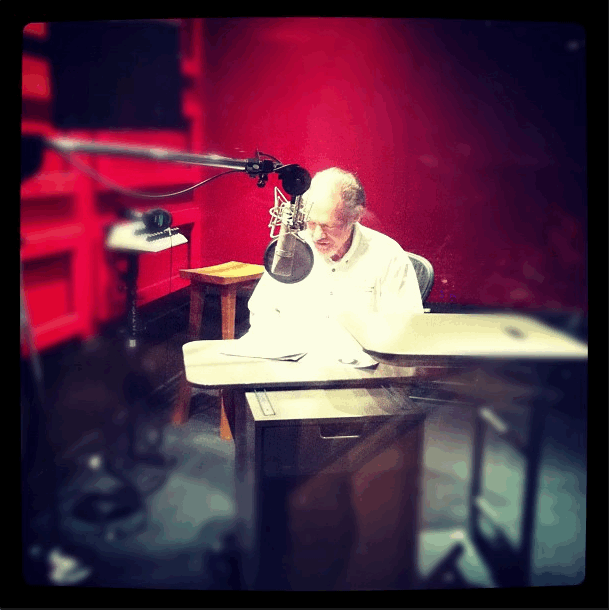
Points of interest about this particular incarnation of the book include that (a) the Introduction by Alice Munro is read by my multi-talented editor, Jen Knoch [ed. note: a daunting task!] and (b) that although I have read more than 100 movie reviews for CBC microphones over the years, it was a shock for me to find out how reading a book aloud is very, very hard work. To be precise, with gulps of air and gulps of hot soup to keep the Scottish-accented voice healthy, day after day, it took me over 20 hours of reading over 5 days to get the whole book on tape.

The good news, of course, is that when the book (as in this case) is written in the first person, and read by the writer, the listener knows that this is the way the author meant it to sound. It does add to the listening experience, which is why I did it.

And, of course, being a professional reader in the studio day after day, accompanied by the patient Kevin at the controls, was a fascinating new experience for me. I’m still working  at expanding my resume. You never know.

DOUG GIBSON’S TRIBUTE TO ANTHONY JENKINS AND HIS CARICATURES

If you like the caricatures that begin each chapter of my book, I have very good news for you. A new book has just appeared entitled A Fine Line: The Caricatures of Anthony Jenkins. It’s published by the small independent Nestlings Press, and the ISBN is 978-0-9691456. It contains over 100 of the best caricatures ever produced by my friend Tony Jenkins; you may even recognise a few of them from my book.

I had the chance to talk about just how much I admire his work in The Foreword.

Here is what I wrote:–

Anthony Jenkins is a dangerous man. I alarm the good people who come to see my stage show, Stories About Storytellers, by warning them that I am going to whisk them through a list of interesting authors by showing them Tony Jenkins’ caricatures of each writer. I stress, however, that this is a perilous business, because he is clearly in touch with devilish powers that would frighten off a sensible Faust. Or perhaps he drinks potions that endow him with the same sort of magical powers that Oscar Wilde revealed in The Picture Of Dorian Gray, where the flesh-and-blood Dorian remains eternally youthful while the portrait at home does all of his aging for him.

Tony Jenkins, I explain, is clearly in touch with the same dark powers. “When he produces a not-altogether-flattering portrait of you” (and here I put on the screen the Spring 2011 portrait of me that appears on this page) “day by day, week by week, month by month, you will come to look more and more like that portrait!”

The terrifying process continues to this day. So I am very keen to do everything I can to stay in his good books.

This book is one of them. When the publisher, my old friend Warren Clements, invited me to contribute a Foreword, I instantly agreed to do so, out of fear. But there was something else, too—admiration. Not to mention regret that in my publishing days I was never smart enough to think up this book.

In those days (and I was the publisher of McClelland & Stewart from 1988 till 2004, so I can’t plead lack of time), I was keenly aware of Tony’s excellent work in The Globe & Mail. On occasion I would suggest to our Art Department that he would be perfect for this or that book cover. One example that still gives me pleasure is William Weintraub’s 2005 comic novel, Crazy About Lili, in which an earnest young McGill student meets and falls for a famous Montreal stripper. Tony’s cover art, involving a dangling McGill pennant and a dangling scarlet bra, is perfect. And I once, as a private citizen, made a pilgrimage to Tony’s office to buy a wonderful portrait of Alice Munro, which now hangs in our front room.

But I, like other Canadian book publishers, simply didn’t wake up to see, and develop, this amazing talent in our midst.

In 2011, however, when I was writing my own book I finally saw the light. I realized that Stories About Storytellers, its 21 chapters devoted to descriptions of 21 authors, needed to show the authors. A book with no illustrations would seem dull, possibly even (shudder) earnestly academic. A book that used photographs of the authors would seem overly serious. Witty caricatures of the authors at the opening of each chapter was clearly the way to go. And for these caricatures, Tony Jenkins was the man, without question.

So, defying the usual publishing practice where the Publisher chooses the Illustrator, I approached Tony directly, long before I had a Publisher. I gave him a list of the authors in the book, and we made a private arrangement whereby I acquired the rights to use his portraits in the book, and in promoting the book on stage and screen (I was already thinking strange promotional thoughts). In most cases, when the author was Robertson Davies or Brian Mulroney, he already knew the look of the authors very well. In other cases, such as the cowboy author R.D. Symons, I sent along photographs to guide him. In a surprisingly short time, and after very few revisions, I had my 21 superb caricatures, which I thought caught the spirit of my book so well.

When I approached interested publishers, I stressed that these caricatures were part of the deal, thanks to a private arrangement between us. And the wise people at ECW Press recognized what an asset we had, and contributed to the cost, and made good use of his artwork. Tony’s caricatures attracted widespread admiration, both in book reviews and in general comments from readers. After my stage show, despite my opening warning, the most frequently asked question is: “Who did you say did the wonderful portraits?”

Let me step aside here, away from my own experience, to discuss what I think Tony Jenkins is doing. I believe that he is trying to scale the same mountain that has challenged artists from the dawn of art: to catch, in two dimensions, the essence of another person.

People have been trying to do this from the days when cavemen drawing on the wall ranged from showing deer and other prey worth hunting to portraying the faces around the fire. Children still do it every day with crayoned portraits of Mommy. And we all know how hard it is to create a straightforward, “realistic” portrait. Graham Sutherland, a veteran portrait painter of great skill, once bitterly described a portrait as a painting “with something not quite right about the mouth.”

Some cultures and religions even frown on the whole concept of portrait-painting, recognizing that these attempts to catch the essence—perhaps we might daringly use the expression “the soul”—of another person represent very dangerous territory. I think most thoughtful Westerners respect the alarm felt by distant peoples that a photographer catching their image is perhaps stealing something from them.

Western art, of course, has produced many superb specialists in portraiture, too many to name here. In the case of Rembrandt, scholars estimate that at least two-thirds of his work consisted of portraits. And while the Old Master was frequently hired to produce portraits that would look good on the preening Amsterdam merchant’s wall, he took the art much further. One biographer, Jakob Rosenberg, in his Rembrandt: Life and Work goes so far as to claim that by the end of his life, his “mature” portraiture was more than a caught moment in time: “[W]e feel, to a certain degree, the sitter’s past coming into the present, and even some premonition of the future.”

Another dangerous man.

We are clearly in the realm of great imagination here, far beyond mere “photographic” representation. Yet to complicate matters, here is the famous photographer, Yousuf Karsh, writing about what he tries to do in his portraits. He begins his first book, Portraits of Greatness, with this paragraph (and liked it so much that he opened his next book, Karsh Portraits, with precisely the same words): “The aim and art of the portraitist who works with a camera are not merely to produce a likeness but to reveal the mind and the soul behind the human face.”

“Mind” and “soul” revealed by the camera. Consider, then, the challenge facing the brave artist armed only with brushes and paint, and pens and ink, who hopes with a skillful eye and a steady hand to catch that same “mind” and “soul” in a piece of art that the Oxford English Dictionary defines as a “caricature; grotesque usu. comic representation of a person by exaggeration of characteristic traits, in a picture, writing or mime.” Interestingly, the word derives from the Italian caricare, which means “load, exaggerate.”

A “cartoon” is defined by the same source as “a humorous drawing in a newspaper, magazine esp. as a topical comment.” We are on familiar ground here. Every reader knows, and to a greater or lesser extent enjoys, editorial-page cartoons where recognizable (possibly even labelled) figures act out embarrassing scenarios, or spout amusing, often incriminating words. Tony Jenkins can play that game very well, too, as Globe and Mail readers in the past were reminded by the occasional appearance of his fine political cartoons.

Canadians, I think, are reluctant to place living cartoonists in the highest ranks of the art. (Someone more cynical than your humble servant might expand that to “living artists of any sort”.) Many were startled when the American critic Edmund Wilson, in his survey of Canadian culture, O Canada, devoted a section to the Toronto Star’s political cartoonist, Duncan Macpherson, boldly putting him in the august company of the greats like Gilray and Cruikshank. Today, kind words about our leading exponents like Aislin (Terry Mosher) might produce the same reaction; the everyday is rarely associated with the eternal.

Yet when you, dear reader, roam through the pages of this book, I think that you will start to conjure up names of the great caricaturists of the past. Tony Jenkins may have a very different style from Hogarth, Daumier and Grosz, or the more modern masters Ronald Searle, David Levine, Gerald Scarfe and Ralph Steadman. But there is a very definite style here, one that is notably spare, using one line where others might use ten. Unused space—it would be wrong to call it “blank space”—is put to remarkable use.

Famously, defying the old proverb that “the eyes are the window of the soul”, Tony Jenkins has often seen fit to dispense with one of these valuable windows, preferring to let one eye speak for two. Again and again in these portraits, also, we see a tiny detail apparently catching the essence of the character, what in bolder times would have been called “the soul”. See for yourself.

As for me, I admire the art in this book immensely. These excitingly varied portraits constitute almost the work of a lifetime. They give us all a book to cherish by a superb artist—and a dangerous man.

Douglas Gibson

Toronto, February 2013
Douglas Gibson on being Hugh MacLennan

The National Post books blog, The Afterword, featured a piece by Doug on his experience being Hugh MacLennan for Canada Reads this year.

It all began with a very tentative email from a nice woman at CBC Radio in November. She explained that the five books that would be finalists for Canada Reads had been selected. The publicity leading up to the week of on-air debates in February would begin soon, involving not only the advocate for the book on the jury, but also the author.

But they had a problem. One of the books was Two Solitudes, by Hugh MacLennan. And Hugh had passed away in 1990 (a sad fact that I knew all too well, since I had spoken at his funeral). Would I, just possibly, she wondered, be willing to step in to speak on Hugh’s behalf, if that wouldn’t be too much trouble?

Read the rest on The Afterword.

The Al Purdy Event (Part Two)

In the end, the fundraising event at Koerner Hall on February 6 was such a success that it’s worth celebrating the people who put it together. I’m reminded that a 19th century British Cabinet was once famously described as the Cabinet “of all the talents.” I think that the Al Purdy event organisers deserve the same description.

Let me say the names here: George Goodwin, our fearless (and tireless) Chair, a former McClelland & Stewart colleague now working for the Weston organization; his son Christopher Goodwin, a banker who knows a lot about fundraising and how to close a deal and how to represent a younger generation; Leslie Lester, the Executive Director & Managing Director of Soulpepper Theatre Company with many excellent contacts in the worlds of poetry and rock, and who knows how to go about putting on a good show; Don Oravec, who, before he was felled by ill health, as Executive Director of  The Writer’s Trust had learned all there was to know about fundraising for the literary world; Alexandra Manthorpe, a young lawyer, who could keep us all out of jail, and who stickhandled the purchase of the A-frame itself on just 10 days’ notice; Valerie Jacobs, the superhuman organiser who once ran my life at M&S, and who was now given the task of running the Silent Auction; Duncan Patterson, the young architect who had made detailed plans of exactly how the Purdy A-frame had to be repaired – and who had spent every summer of his life in Prince Edward County; Patrick White of the Globe and Mail, a son of Howard White, one of the founders of the movement to save the A-frame, along with Jean Baird (Jean and Howie were distant but very active members of our planning group); Marni Jackson, the author who can turn her hand to any writing task, including the creation of the script for this show that had such a marvellous flow that it was able to lull or startle the audience, as required, on the night. (Marni’s husband, Brian D. Johnson of Maclean’s fame, played a major role behind the scenes, acquiring amazing film footage and creating a tribute video to Al that appeared for the first time that night.)

Finally, this group of unpaid volunteers shrewdly hired Laura McLeod, a theatre professional, to make sure that the event happened, including such details as having tickets available at the box office, and having the cast show up on the night, knowing what was expected of them.

As those who were there know (and will happily tell you), we pulled it off. And it was indeed “all right on the night.”

But not before much nail-biting anguish. High drama, indeed. If you like a comfortable, predictable life, do not ever put on a one-night stand-alone show. Unless your show is an annual event, or part of a series, with a predictable – and contactable – audience, you are in for a testing time, a roller-coaster ride for your emotions.

To over-simplify:  if you can charge $200 for each ticket you will raise funds very fast, if you can sell them. By lowering the price of our tickets to $50.00 we were gambling that we could sell enough of them to cover our costs, plus . . . Although all of our artists, musicians and poets and actors alike, were generously donating their time, we found that renting a superb, central space like Koerner Hall (and heating it, not to mention having the stage lit, and having ushers etc., etc.) costs a lot of money, and we had to sell several hundred seats to break even. So for all of us, the two weeks up to the event were dominated by emails describing the Daily Ticket Sales, sent along by Laura McLeod.

They were terrifying. With roughly one week to go we had sold only about 200 tickets. We were going to lose lots of money on this fundraiser.

It was time for emergency action. Since people reacted well when they heard about the event (“That sounds great. When is it, again?”), the trick was to spread the word. Any way we could. Emails flew to surprised friends and professional contacts. Our committee worked their contacts in the media (“Hey, we’re in NOW!”). Eventually this led to fine things like an A-frame article in the Toronto Star (which neglected to mention the date and location of the fundraising event, requiring a sly Letter to the Editor, praising the piece and just happening to mention “Koerner Hall” and “Wednesday”).

Even better, CBC Radio came through, inviting me (an internal CBC document praised my ability to “yak”) to talk about the forthcoming show on Metro Morning on Tuesday. I stressed that I was just part of the organizing committee, but this message was embarrassingly elided at the end, so that it seemed that I was The Organising Principal.

The next morning I was on Ontario Today, urging people outside Toronto to come in for the show. I think some did come. Certainly as I mingled gratefully with the crowds I met lots of people who were Metro Morning listeners.

And we sold over 700 tickets! As for the show itself, watch for my next installment.

The Al Purdy Event (Part One)

I published Al Purdy, which meant that I knew him a little, and liked him a lot. He was a larger than life character, in every sense. As Publisher of McClelland & Stewart I had issued standing orders that whenever authors came to visit our office, I wanted to see them;  this was to establish, on all sides, the key importance of our authors to our company. When he breezed into our corridors, a big, loud, informal figure (he was one of the few people able to shamble even while sitting down), he brought a breath of fresh, country air with him. We knew he was there. In The Al Purdy A-frame Anthology I wrote of those visits . . .  “the office corridors seemed to course with energy when he came in, and I felt that people went about their business with extra pleasure because of his presence.”

In my own book I deal with him only in passing. I write about a scorching encounter we both had when we flew too close to the Russian Sun King, Yevgeny Yevtushenko. That was at a famous Toronto Harbourfront event, and Al and I both had our wings singed.

But I remember another very hot encounter when Al was reading at the outdoor Shakespeare in the Park stage in Toronto’s High Park. It was the middle of summer, and even as darkness fell over the crowds sitting on blankets on the grassy slopes in front of the stage, it was sweltering, very hot and very humid. Al sweated his way through a grand reading, to great applause. When I went up to him at the end, he was as pleased and surprised to see me as if I had just swum Lake Ontario to get there. I think that before that sweaty evening he’d seen me as an uptight, tie-and-blazer-wearing publishing type, a representative of the bourgeois urban values that were, let’s say, not a feature of his own irreverent, unbuttoned life.

So a few years ago I was glad to be able to lend moral support when Jean Baird in Vancouver, an old friend of Al and Eurithe, along with Howard White, the fine West Coast publisher who brought out Al’s last books, started a movement to save the old A-frame house in Ameliasburgh. My support, I should stress, was mostly moral, supplying a brief quote for The A-frame Anthology, with no active involvement.

When my old friend George Goodwin (who had left the banking world to join M&S largely because of his love of poetry) told me early in 2012 that he was forming a committee to try to raise funds for the Purdy A-frame, I was very glad to sign up. Throughout the summer and fall we met over lunch, to plan our fundraising strategy. The challenge was clear: the trick was to come up with an interesting event in Toronto that would cost very little but would draw a very large crowd that would pay lots of money to attend, and go home happy.

But what sort of event? Where? When? And charging how much? Charging $200 per head raises money very fast – but it’s not a good idea if that high price draws only 20% of the crowd who would have come for a price of $50. How do you decide these things? And how does the price affect the programme, and the expectations of the audience?

Our group (whom I’ll celebrate later, in a further blog) soon hit on Koerner Hall as the perfect venue, because of its location, its excellence as a hall, and its association with poetry, thanks to Scott Griffin’s very successful Griffin Prize events there. (And Scott, I should note, was one of the generous donors to our event.)

But the question remained, what sort of event? At several lunch meetings (including one where we realised that a Fall 2012 event was simply too hard to plan and carry out in a crowded, onrushing season, and decided on February 2013 as the best time) we thrashed it out, based on the availability of various figures named Enright or Pinsent, and various poets and musicians, all of whom were eager to contribute their talents, if their schedules allowed. Right from the start we had decided to build the event around Al Purdy’s poetry, while providing lots of variety on-stage. This, we were determined, was going to be a very special show.

(TO BE CONTINUED . . .)

Alice Munro Rules Scottish Rugby

Alice Munro is renowned around the world for her superb short stories, and she has the prizes and the reviews to show why many claim her as the world’s best. An American reviewer for The Atlantic magazine said simply, “She is the living writer most likely to be read in a hundred years.”

To my delight, Alice wrote the introduction to my memoirs, Stories About Storytellers. In the book I talk proudly about our long association as author and editor, now amounting to fourteen story collections. I note that one of the happy coincidences that brought us together was the fact that Alice grew up in Huron County, Ontario, which is a landscape dominated by many branches of one river, the Maitland. Thanks to my mother, I bear that fairly uncommon family title as my middle name, as in Douglas Maitland Gibson.

Alice’s own semi-fictional memoir, The View From Castle Rock, begins with the story of her own family, the Laidlaws, in the Scottish Borders. The earliest ancestor she found, Will Laidlaw, was born around 1700, and gained such local fame that his tombstone epitaph in Ettrick Kirkyard reads: “Here lyeth William Laidlaw, the far-fam’d  Will o’ Phaup, who for feats of frolic, agility and strength, had no equal in his day.”

That epitaph was written by his prominent literary grandson, James Hogg.

Yes, yes, you say. We know that Alice’s wonderfully perceptive short stories may range beyond her usual Huron County settings, sometimes as far as Australia, Albania, or even the world of a 19th century Russian female mathematician, as in “Too Much Happiness.” But what on earth does she have to do with the manly sporting world of Scottish rugby in 2013?

Last week the Scottish national rugby team played their annual grudge match against the English rugby team. They lost heavily. But every single Scottish point was scored by three men.

Their names were Maitland, Laidlaw and Hogg.

Remembering Brenda Davies

On Tuesday, January 14th, I went to the funeral of Brenda Davies. It was held in the University of Toronto’s Trinity College Chapel, where in 1995 the funeral of her husband, Robertson Davies, also took place.

That earlier funeral was a major national event, and I held the role of Honorary Pallbearer. It was a bitterly cold December day, I recall, and we were required to stand outside by the hearse for what seemed a very long time, while sotto voce comments were made about freezing funerals causing further losses. I, foolishly, was wearing only a raincoat, and the bitter experience led me to buy a fine warm, formal overcoat, which has seen many funerals since. This piece of sartorial history came to my mind as I solemnly put on that coat to attend Brenda’s funeral.

We all owe her a great debt. Ever since the day in 1940 when she, a young Australian, married Rob, a young Canadian, in besieged London, they were a full partnership. Not only did they raise three daughters together, Brenda brought her organising talents as a stage manager to their many stages in life. So she ran their household in Toronto when Rob worked at Saturday Night, then organised their lives in Peterborough when he was the editor of the Examiner (and thus a major local figure), then adapted to the role of chatelaine at Massey College when her husband became its founding Master, and later ran their lives in retirement in mid-town Toronto and at their country place in Caledon.

Throughout all this, she was the organising principle in his life. She was the driver in the family, and in more ways than those merely involving automobiles. Her great contribution was to clear the decks for Robertson Davies to get on with the intellectual, creative work that has enriched us all.

There seemed to be a general awareness of this at the affectionate but formal funeral, which filled the large Chapel, with many in attendance wearing the Massey College gown as a special gesture of respect. In my pew (as we sang “Guide me, O Thou Great Jehovah” to the grand old Welsh tune “Cwm Rhondda”), I was struck by memories of her kindness to me over the years, at Massey, at their mid-town apartment, and at the Caledon retreat, where I was a guest even after Rob’s death. Her kindness stretched to very near the present: when my book came out, she described my chapter on her husband saying “Douglas Gibson has written an excellent account of Robertson Davies as the clever, witty, wise man that he was.”

He was indeed. And we shall never know exactly how much he owed to his wife, the remarkable Brenda Davies.

Editing Tips from Douglas Gibson (#31)

In this recurring feature, we’re sharing tips for editors from the desk of Douglas Gibson. Good for those starting out or old hands who need a reminder, these guidelines form an engaging guide for sharp-eyed wordsmiths.

Tip # 31 Choosing A Title

Often an editor will find herself/himself involved in choosing the perfect title for a book. Sometimes this will be controversial. Sometimes the controversial choice will be the right one.

A case in point is Alison Wearing’s new book Confessions Of A Fairy’s Daughter: Growing Up With A Gay Dad. Many people will recoil from this title. But the chances are that they will not want to read the book, excellent though it is. So the title serves as fair warning for potential readers.


Tip #29: Partial to Partial

Because the adjective “partial” implies “fond of” or even “biased towards,” the adverb “partially” should not be used as a synonym for “partly.”

In fact, “partly” should be the editor’s choice every time, unless bias is specifically involved, and implied. So, no more buildings “partially destroyed” by a great wind, please.