South to Windsor

Jane and I drove to Windsor for a double-billed event: a publishing panel at 2:00 p.m., followed by the one-man show (60-minute version) at 4:00. So after a long drive we were proud of our timing when we checked in at our hotel at 12:00. Only to learn that the Writers Festival folks had been calling the hotel in a panic. Didn’t I know that the show had been moved forward . . . to 11:30?

Well, no. So in horror I learned that 60 people had sat there eagerly awaiting me, to go away disappointed, with the news that my event would run later (against a popular already scheduled 4 o’clock event). We got about half of them back, but it was an embarrassing case of broken telephone.

The publishing panel, with Jack David (my publisher, and thus a model of wisdom in all things), Alana Wilcox from Coach House, and Jack Illingworth from the Literary Press Group, and me, was led by local publisher Dan Wells. I’m not sure that we left our audience feeling joyful optimism about where publishing is headed, but we spoke truth to lack of power.

My show was notable for being conducted in a fine Group of Seven Gallery. I had to apologize to a gallery visitor as we put up the screen in front of an especially fine MacDonald landscape, while he peered around it. And we filled the seats available, with Alistair MacLeod arriving late (he was involved with the rival event) just in time to miss my properly admiring account of his work. But as he came in, I said, “Oh, I’m going to have to stop saying rude things about Alistair . . . he’s just come into the room.”

Martin Deck, who runs the university bookstore, gave me a fine introduction, and vote of thanks, and I rushed off to sign lots of books (“Best Windsor wishes”).

On the way back the next day we took a side trip to Point Pelee. The birds were otherwise engaged, but I got to dip my toe in the water at the very southernmost inch of Canada’s mainland. Nearby teenagers were amused by this Tip Dip.

— Douglas Gibson
Friends new and old in Waterloo

Outside Words Worth bookstore I learned that my book contained a lie. The Epilogue tells authors flatly, “You will never see your book in a bookstore window.” Yet there were four copies of my book (not “sun-bleached, warped, and topped by dead flies”) in a window that advertised my appearance in the store that night. This amazing sight had to be captured for posterity, and Jane took a photo of me standing shyly beside the window display. At this a passer-by, a man of around 60, came up and said, “Are you Doug Gibson?” I had barely admitted the fact, when I saw that my wife was throwing herself into the arms of this stranger, emitting glad cries. They had gone to high school together.

The coincidences continued with my audience including a former M&S colleague, a man I met at Alice Munro’s 80th birthday party in Wingham, and Erica, a bookstore employee who once interned at M&S.

The best coincidence of all took place at the Giller Prize the previous evening. Jane and I were chatting with Andrew O’Hagan (a Scot who comes about 12 miles away from my home village), when he broke off to talk with a couple who were waiting politely beside us. In due course he directed their attention to me, saying, “And do you know Doug Gibson?”

Amazement all round because as they, David and Mandy, put it, “Know him? No, but he’s coming to our store in Waterloo tomorrow!” So I was among friends, and after a generous introduction from David (I asked Jane if she was taking notes) we had an interview, then I told stories about authors requested by the full-house audience. It was great fun for me, and at the end David gave a highly memorable quote to the crowd, describing my work as “a damn near perfect book.”

Would I make this up?

Talking of that, I’m so impressed by the attention and publicity produced by the Giller Prize that I’m starting to hope that some readers will accuse me of inventing stories. Then . . . Ta Da! . . . I can classify my book as fiction, and enter it for next year’s Giller Prize.

— Douglas Gibson

A fine place, Ottawa

A Sunday afternoon in a Presbyterian church is not normally my idea of a time and place for fun, but Sean Wilson’s successful Ottawa festival has made the church hall at Lisgar and Elgin a fine centre for literary events.

I followed a lively debate about Israel between two authors with widely differing views, and was delighted to see that my audience included authors like Charles Gordon and Denise Chong, political actors whom I published like Eddie Goldenberg, political columnists/friends like John Ivison and Jeffrey Simpson, and many old friends.

Although the podium could not be moved onstage (which left me strolling about at audience level, in front of the stage) the show seemed to go well, and my old bookselling friend David Dolan proceeded to sell out of all 25 copies he had ordered for the signing. Signed copies are a verifiable measure of success, very welcome in a world of vague compliments.

Much better than vague compliments were the comments on the blog of Ottawa’s Nigel Beale, who tells people to “run” to see my show, going on to compare it to performances by “Stephen Leacock. Charles Dickens even.” If you don’t believe it, see for yourself. I think I can state that this is the first and last time that I‘ll be compared to Charles Dickens, but I’m enjoying the moment.

The perceptive Nigel, who interviewed me later, liked the book, too. A fine place, Ottawa.

— Douglas Gibson

On IFOA and “The Floating World” of Authors

For many writers, the Toronto IFOA has such a pedigree that it marks a high point in their promotional lives. If, however, you’re on the tour, it’s just another meeting of the “Floating World” of authors. So the hospitality suite is a place of festival reunions (“Hey, I missed you after Banff. How was Vancouver?”), and I was glad to catch up with many friends from earlier festivals, and with old friends like Elizabeth Hay, who once graced the delightful Tepoztlan Canadian festival in Mexico, and whom I’m proud to have published.

I ran into David Adams Richards, and learned that one chapter in my book is out of date. Talking about Jack Hodgins, I lament the fact that perhaps I gave him bad advice by urging him to stay far away from Toronto. To make my point I note how well my friend David’s career has developed since he abandoned New Brunswick and moved to Toronto. David gently reminded me that after many years in Toronto, he moved back east, to Fredericton, two years ago.

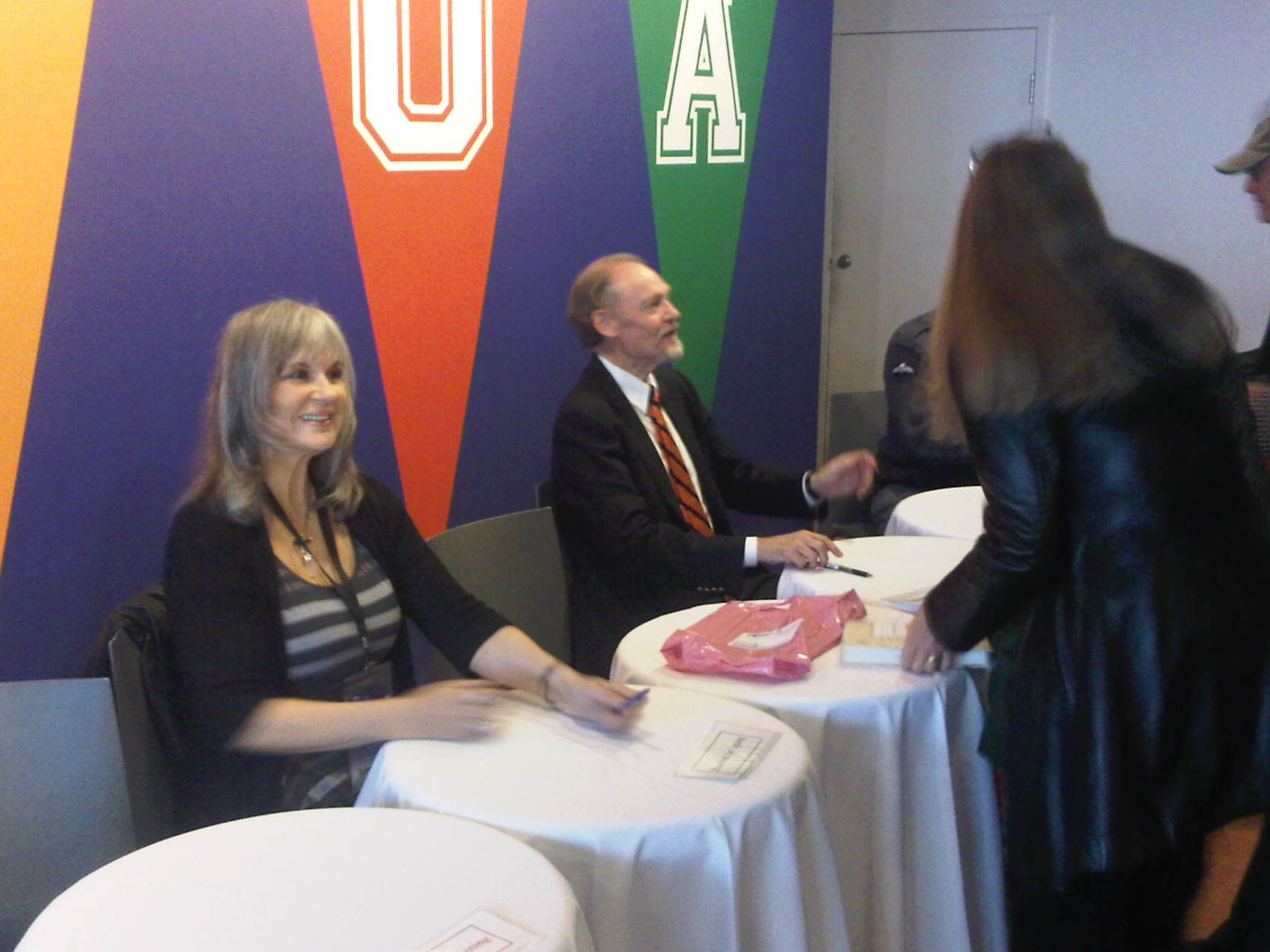
Signing after their IFOA event, Sylvia Tyson and Douglas Gibson.

As for the show, I had the surprising honour of having Sylvia Tyson precede me (“I once had Sylvia Tyson open for me” is a good boast for posterity. ) Her reading from her novel was punctuated by occasional songs. When I followed her, in the course of my one-hour show, I sang one line, which gives me room for a tiny singing boast. I’m still working on it.

— Douglas Gibson

A Stop at Brock

I was delighted to be a keynote speaker at Brock’s Annual Two Days of Canada conference. I gave the full 90-minute show, punctuated by my ripping off a malfunctioning lapel mic and shouting my way through whenever I strayed from the mic behind the podium. There is a rule that no mic works immediately when you’re setting up, or consistently, when you are set up. So adaptability is not just a virtue, but a necessity. But a stage show with the performer tethered behind a podium is a reduced version of the real thing.

I was kindly looked after by my faculty hosts, Scott and Marian, and stunned by a case of extraordinary academic memory retention. One fine man kindly remembered a talk on Hugh MacLennan that I gave nineteen years ago!
A high point for me came from the name of the room where I performed: Pond Inlet. There I was, recreating a polar bear attack in a room (almost as far south as Niagara Falls) entitled Pond Inlet, with the room’s nameplate using English, French, and Inuktitut.

Signing books afterwards allowed me to chat with Shelley Martin, of the Brock bookstore, who is a veteran who has worked with most of the authors in my book. My book signing is getting better. When in doubt, I  write “Best wishes.” The encouraging slogan “Good reading!” can sound awfully close to boasting, a description rather than an exhortation.

— Douglas Gibson

The Grand Farewell Tour

One of the most interesting aspects of this tour is that people treat it as a Grand Farewell Tour. They come forward to remind me of long-forgotten incidents. I guess it’s much better than waiting for the post-funeral reception, when (mostly) affectionate stories about the Dear Departed circulate.

Three examples. The admired novelist Catherine Bush reminded me that as a young person she was once complaining  to me about how many books she already had, so that she was reluctant to buy any more. Apparently I scolded her, saying, “If people like you don’t buy books, who do you think is going to buy them?” The scolding worked, and has stayed with her.

Carolyn Wood, now the head of the Association of Canadian Publishers, volunteered the information that when she applied for a first job in publishing she sent out dozens of letters. Most went into a black hole. Four or five received a form reply. One received a personal letter, apparently from me, which she has never forgotten. This, I hope, will go some way to atone for the thousands of rejection letters, the millions of unreturned phone calls (a publishing world satirical show in the 1980s had Anne Ledden, posing as an M&S phone receptionist, apologising to irate callers with the words, “Mr. Gibson is not familiar with the use of his instrument”) and all the other rudenesses that besmirch my publishing career.

Finally, Linwood Barclay recalls a conversation where he, a genuinely modest man, was marvelling at the upturn in his fortunes which mean that his new books now hit Number One on the U.K. Bestseller lists. I, apparently, assured him “that he was now just accepting his due.” He liked that. Linwood has a wonderful/terrible story of how fate slaps new authors around. When his first book came out, he shyly went to the bookstore in the local mall. To his delight he found a pile of his books, with the tag “Recommended by Jamie.” Lyndon went in search of this perceptive staff member, who had taken the opportunity to give his book a personal recommendation. He found “Jamie” and, eagerly shaking his hand, told him how delighted he was to be singled out for his personal praise. Jamie seemed a little surprised. When Linwood, still babbling, took him to the pile of books, Jamie reacted irritably. “Oh they moved that,” he said, taking the “Recommended by Jamie” sign out from Linwood’s pile and inserting it into a neighbouring stack of books by another author. Linwood watched, open-mouthed. And remembered.

— Douglas Gibson

The Vancouver High Wire

The Granville Island Hotel is the centre of the Vancouver International Writers’ Festival, run by a dedicated staff under Hal Wake. The usual suspects assembled there although Jane and I were also lucky enough to attend the opening night Gala Dinner. This was a Bollywood-themed extravaganza, with much merriment, where I was delighted to meet the splendid non-fiction writer John Vaillant. I told him that he was mentioned in my book, where I bitterly regretted that despite my Haida Gwaii knowledge, I never had the chance to publish his superb book The Golden Spruce. (I have now read his latest book, The Tiger, which I recommend – but not for bedtime reading.)

The MC of the dinner was the admirable Bill Richardson, who met up with me to recall a publishing prize-giving ceremony in Toronto where I accepted his challenge to accept a prize using “interpretive dance.” He claimed at the time that generations of my ancestors were spinning in their graves.

The prize, by the way, was for doing good environmental work. The truth of the matter is that Alice Munro twisted my arm to have Hateship, Courtship, Loveship, Marriage printed on recycled paper, which at the time was both eccentric and expensive. By doing it with this major bestseller, M&S broke the log-jam, and now it is usual, sensible publishing practice. But the credit all goes to Alice.

On the Tuesday evening I was thrown to the lions (and tigers), doing a one-man show at the Improv Theatre, where I told the audience from the empty stage that my book consisted of stories about these 20 authors, then asked for the names they’d like me to tell stories about.  It was an exciting high-wire act, and it seemed to work, right down to my friend, Paul Whitney, calling the event to a halt with a request for “one last story.” It must have worked, since the head of the Sunshine Coast Festival was in the audience, and later invited me to their Festival next August.

A new life beckons.

One behind the scenes story: I was in the Green Room backstage with seven minutes to go, when I thought it prudent to visit the washroom. “Not that one,” I was told,  “the one in the corridor.” Nobody added the words. “But don’t close the door, or you’ll be trapped inside.” You can imagine the rest, including the thunderous beating on the door until I was released just in time. You will understand why Jane was appalled for the next 75 minutes as I strode around at the very front of the stage with my zipper at half mast. All part of the excitement of the unscripted show.

Afterwards I signed copies for a crowd including the woman I first met as a seven-year-old next door in Toronto, and a downstairs neighbour from a later apartment. My life flashed across my eyes. The best surprise of all occurred in Banff when Robin Spano, the fine novelist published by ECW, greeted me with the words,  “Hi, you once came to talk to my high-school class.” And so I did, at Jarvis Collegiate twenty years ago.

Everything connects.

— Douglas Gibson

Being an Author Is Hard

For a new, first-time author sentences  like “I love you and want to bear your children” or “Congratulations, this is the Lotto Corporation calling to tell you that you have just won a million dollars!” pale into insignificance compared with the magic words “Hey, Doug, I’m really enjoying your book!”

That was the greeting I received from Ron Graham (the well-known author, and, obviously, highly intelligent and discerning reader) as I entered Massey College at the U of T yesterday.

Thrilled, I went on to confide to him my shy first steps as an author, doing things like trying my hand at autographing books in the store (which, by the way, I have now done by invitation). He told me of his first visit to a bookstore to see a pile of his just-published first book, lying there throbbing. He hung around, sensing that something was bound to happen.

Sure enough, a young man, browsing through the store, came to his book and picked it up. He leafed through it, read a couple of passages, and then, to Ron’s almost audible horror, put the book down and walked away.

A minute later he came back, and started to leaf through it again. Ron, quivering with excitement and unable to stand the suspense, was on the point of going up to him and offering to buy the book for him. Before he could do that, however, the young man looked around, slipped the book into his bag, and walked briskly out of the store.

Ron, left standing there with his mouth open, is still not sure what he should have done.

Being an author is hard.

— Douglas Gibson

New frontiers not far from home . . .

Though this Dispatches section will have tales of the Adventures of Douglas Gibson all across our fine country, for a new author, there are adventures to be had at home as well as abroad. Our intrepid author headed to his local Book City, and after locating his book (defying the Murphy’s Law that governs such things), Doug signed a few, and afterward took the time to write a note to the manager about his new experience:

Greetings,

Although you don’t know it, you have just played a major role in the transformation of your friend Doug Gibson, editor and publisher, into Doug Gibson, typical author.

This morning my wife and I went into your Danforth store. We found 5 copies of my book and I carried one to Hanna at the front desk (in case I needed proof, I suppose, if challenged) and shyly confessed that I was . . . ahem . . . the author of this book, and . . . er . . . um . . . would she like me to sign the copies in the store?

She responded very kindly, and stood by with “Autographed” stickers, while I adorned the books with a signature that she generously described as “cool.”

Then, after buying another, different book, Jane and I exited. It was my very first in-store signing, and a frontier has definitely been crossed.

— Douglas Gibson

A few words on Word on the Street

Toronto’s Word on the Street. Great weather means an attendance ten times the rain-swept version. Queen’s Park looks perfect with crowds of adults and kids and dogs  and tents, prompting the question: why doesn’t the city make more frequent use of this fine, central park?

A series of “firsts” for me. The very first public  reading from my book, and it takes place in a tent labelled (are you ready?) “Vibrant Voices Of Ontario.” The tent is flatteringly full, and Stuart Woods of Quill & Quire introduces me efficiently. I explain that my book is a series of profiles of authors that I edited, but that I’ve chosen to read the book’s Epilogue, “What Happens After My Book Is Published?”, which consists of the Awful Warnings I used to give to first-time authors. As usual, most of the crowd laughs happily at the examples of Murphy’s Law in action – and authors and publishers shake their heads in  sad recognition.

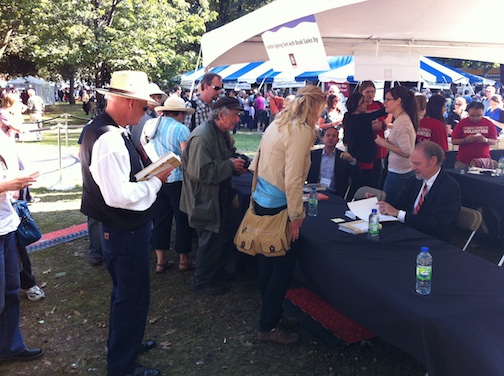
The second “first” is that, after a “Q and A session,” I am led to the “Authors Signing Tent.” There I shyly sign seven (maybe even eight!) copies, and find myself guiltily resenting the pals who stand at the front of the line to chat, not buy. As the line-up disappears I have time to notice that within twenty metres is the superb black  statue of my old friend Al Purdy, characteristically in a relaxed sitting pose, his hair drooping to the very life. I published him at M&S and, in addition to routine, in-office chats, we became friends after I went out to High Park to support him at a sweltering outdoor reading. Backstage, I remember, he was really glad to see me, and we both were bathed in sweat. I hope that the campaign run by Jean Baird to try to preserve his A-frame house in Prince Edward County is going well. I should have done more to help.

There’s still time though, and efforts to save the house continue. On November 23, Margaret Atwood is giving a special presentation at Picton’s Regent Theatre. Her provocatively titled presentation “Bulldozing the Mind: The Assault on Cultural and Rural Heritage” follows a reception with Ms. Atwood at Books & Company featuring County food and wine. More details can be found here.

— Douglas Gibson