Christmas Holidays

And indeed I did retire for the Christmas season, which was devoted to the usual family stuff, with the usual range of turkey and vegetarian dishes on offer, and kids pausing only occasionally to sit down at the table. They obviously had never studied any Norman Rockwell paintings.

One unique aspect of this Christmas is that friends and neighbours would show up at the door asking me to sign the books that they had bought as gifts (for especially lucky loved ones). I was always happy to do it. We even considered hanging a sign on the door . . . “Books Signed Here.”

Marching to the Beat of a Different Drummer in Burlington

This was the last pre-Christmas show, and in several ways it was the biggest.

Ian Elliot at A Different Drummer Books had bravely booked the new Burlington Arts Centre (recently opened by Stephen Harper, and then filled in its main space by Sarah McLachlan). Even more bravely, he had asked me to do the full 90-minute version of the show.

The hall (the smaller of the two) was so new that the sound guys were still finding out which system worked. This delayed the start, meaning that the crowd was kept in the lobby, outside the closed theatre doors. I took the chance to go out and roam around, explaining that there was just a brief technical hitch, and we’d be starting soon. The best part was that I was able to meet lots of old friends and colleagues and to make some new ones, so when the show started I felt at home.

In the end 125 people showed up to fill the place, paying $10.00 for the privilege. Best of all, Ian reported that a staff usher on duty, who had been disgruntled at not being assigned the (very expensive) Sarah McLachlan show, felt compensated, at least partly.

People in the audience seemed to like it, with an enthusiastic minority giving me a standing ovation . . . or perhaps their legs were cramping after 90 minutes. I was delighted when Ian reported that one man told him, “I had no idea what to expect of the evening . . . but, God, he was good!” I’m going to retire now.

Another Bookstore Lesson

I dropped in on Book City’s Danforth Avenue store, fresh from buying a Big Carrot tofurkey for the vegetarian troublemakers around our Christmas table.

The elder statesman of the Toronto chain, the eminent Frans Donker, happened to be in the store, and greeted me warmly. He urged me to sign the two copies of my book, then went looking for a third copy out on the shelves. He returned, shaking his head over that copy. The flap had been carefully folded over to mark a place two-thirds of the way through the book. Some anonymous browser had apparently been working his or her way through the book, and was nearing the end — without any messy expenditure of dollars.

I’m torn between pleasure that this discriminating reader would sacrifice a part of lunch-hour each day to drink in my stories — and outrage that the book is being devoured for free. I’d love to meet the culprit. We could have an interesting conversation.

As for the life of a bookseller, who could have predicted this?

— Douglas Gibson

Back in Toronto

On November 30th (St. Andrew’s Day, a big day for haggis-eaters everywhere), I was lucky enough to be the first speaker in a lunch series hosted by the Literary Review of Canada and the Gardiner Museum, which provided the venue. At the top floor’s southwest corner we all gathered in a pleasant room with tables and chairs arrayed before the screen.

While people munched through their paper-bag lunch (yes, it was a brown bag), I whizzed through the Tony Jenkins caricatures, then asked the audience for suggestions about which authors they’d like to hear about. The questions came thick and fast (they always do) and I was able to be a polar bear gutting James Houston’s husky or Morley Callaghan knocking down Ernest Hemingway, and so on.

At the end I signed a dozen copies or so. As I was leaving my signing place, compliments still ringing in my ears, I was approached by an elderly member of my audience. I stooped graciously to accept her comments.  “I notice,” she said, severely, “that frequently you use ‘who’ when it should be ‘whom.’  ‘Who’ is the subjective, and ‘whom’ the objective case.”

I thanked her, as objectively as I could.

Barnstorming, Day 3: Guelph

The London morning starts with a visit to “the oldest brick house in London,” now occupied by our friends Robert Collins and Mary Lake. Not only did they take our gang to dinner last night, they bought 10 copies of my book, and I’m delighted to spend much of the morning signing them. Then a London lunch with friends and relatives Judy and Peter Castle, before we hit the trail to Guelph.

First destination was the University Art Gallery, where Judy Nasby, knowing of my James Houston-inspired love of Inuit Art, took us around a behind the scenes Inuit display. An interesting gallery.

Downtown we park near The Book Shelf, and Jane starts the set-up with Dan, who runs the show there. I return from the car with the computer hearing Jane’s voice saying, “One, two, three, testing, testing . . . ” She really is into the “techie”( even the “roadie”) role!

The theatre setting there is in the upstairs café, and the stage is about two paces wide. But I am now an old pro, Dan is very helpful on the sound system and the show goes on, in front of an audience that includes Daniel, son of Alistair MacLeod (and I claimed that I had to tone down my criticism of his father, due to his presence); Jacquie, daughter of Max and Monique Nemni;  J.R. Tim Struthers, the critic; and Stephen Henighan (ditto, and an interesting writer on the publishing world, as I’m pleased to tell him). Above all, the crowd of perhaps 50 includes my old friend, the distinguished editor Jonathan Webb, who writes an unexpected review of the show that pleases me a lot. I’m especially amused by his description of me as a “self-deprecating, self-assured Scot.”

The Guelph evening ended with kind words from Dan and a fine dinner in the café, courtesy of my old friend Doug Minett. And so, back home, arriving just before midnight.

This bookselling business is hard work.

— Douglas Gibson

Barnstorming, Day 1 & 2, Sarnia & London

Day One, Sarnia:

The day starts with a fine interview with Allan Gregg at TVO. The make-up woman tells me that high-definition has altered the rules for TV make-up. No more pancake trowelled on to conceal wrinkles, since every trowel mark shows up. So instead of trying soft-focus tricks, you blast maximum light at the face, with the fierce reflection preventing detail from showing up. Who knew? Now I do, and so do you.

Jane picks me up from the studio around noon, and we set off for Sarnia. After sharing the driving, as always, we make it to The Book Keeper, impressively run by my old M&S sales colleague friend, Susan Chamberlin. Chatting at the front of the store we meet a man coming in, clutching a newspaper clipping about me. He can’t make it to the theatre that night, but I sign a book for him, clinching the sale. Two more in-store sales happen, by happy chance.

After a desktop take-out meal with Susan, we made it to the downtown Library Theatre. All goes well, and 29 books are sold and signed. It’s great to sell my book and to help out worthy independents  like Susan, who did a remarkable job in producing posters to promote my event. I see a framed one in my future.

We stayed overnight with our Sarnia friends Sue Brighton and Chris Curran. Morning dawned to show that we were right beside Lake Huron, and we had a stroll along the beach.

Day Two, London:

Arrived  in time to visit the Oxford Bookshop, en route to lunch with one of Jane’s cousins. Then on to our friends’ home where we’ll spend the night. (Hey, this is a book tour, where every penny counts!) We leave Nick and Anne’s downtown place after dinner, and find the Wolf Hall Theatre in the main library. The stage is enormous, with the screen very close to the front of the stage, but by now the old pro can adapt to almost anything.

The performance goes well, with the help of a very sound sound man, and Mark, the bookseller, is pleased to sell around 25 copies. Sheila Li, of the London Library System, does a fine job of introducing me, and arranging a Q&A  session. Afterwards, I sign for some people I know, and a friend of Alice Munro’s. Alice is well-known here, where she studied for two years.

To Montreal, Still Asleep

To get from Ottawa to Montreal on a  Sunday morning for brunch (after an evening event) requires you to catch a 5:45 a.m. flight. No comment.

Fortunately the Paragraphe Books and Brunch event at the Sheraton was well worth a little lost sleep. I spoke last, after David Gilmour (who was mysteriously unable to join the rest of us at the Authors’ Table), then David A. Wilson (who ended his talk about his book on D’Arcy McGee with a penny-whistle rendering of a lament for his death) then Kathy Dobson, the author of With a Closed Fist (about growing up tough in “the Point”). I talked about three Montreal authors in my book, Hugh MacLennan, Mavis Gallant, and Pierre Trudeau, who almost killed me right outside the doors of the Sheraton. The audience liked that idea.

After a chat with my friend Simon Dardick, who runs Véhicule Press, I went off to Le Salon du Livre. This extraordinary exhibition of Quebec literary culture attracts hundreds of thousands over a long November weekend. They line up, pay an entrance fee, then roam around to look at publisher’s booths, where they pay full price for any book that catches their eye. There may, or may not, be an author on hand to sign their copy, but the sense of literary excitement is palpable.

Attendance should be compulsory for all Toronto publishers. I used to attend as often as possible, and this year I was hosted by my old friend, Rene Bonenfant, who chairs the event. I also saw my one of my favourite authors, Yves Beauchemin, who signed a copy of his new novel to me, telling me to “keep on going!” And I met a number of publishing friends, including  Erwan Leseul, who had just launched the French edition of Trudeau Transformed, the book by Max and Monique Nemni that I published in English. I was delighted to find that the authors, in the French edition, had described me as “un editeur chevronné.”

I had a drink with Linda Leith (whose friendly Globe review of my book noted that we had never even had a drink together, which I was glad to fix) then took off for the West island to spend the night with Mark and Annie Abley. The next day Mark kindly took me to my radio interview with Tommy Schnurmacher at CJAD, a force in English-speaking Montreal. Storytelling works well on radio.

Then it was time for a nostalgic visit to the Chateau Versailles, where Hugh MacLennan delivered his last manuscript to me. I traced his path back to the apartment on Summerhill where he lived for so many years, then followed the walk he loved, along Sherbrooke Street to the McGill Gates. After a fine lunch with Pat and Norman Webster, it was time to take the fancy new airport bus and return to the bosom of my family.

— Douglas Gibson

To Ottawa, Once Again

A very different trip, this time, from the literary pleasures of the Writers’ Festival. Here I had two missions. First, to deliver a (very speculative) speech to a group assembled at the U. of Ottawa by the Canadian Conference of The Arts (a pro-arts lobby group that I volunteered for in the mid-’80s). The Exec. Director, Alain Pineau, spoke about the situation for Quebec publishers, and I talked about the scene in English Canada, for publishers and writers, and the dangers of prediction. To stress the uncertain climate I quoted both the Book of Proverbs (“the movement of a lizard on a rock”) and October’s Vanity Fair (“half of New York’s publishing companies will be out of business within five years.”) About a dozen of my books were sold, perhaps as a result of panic buying.

The second speech wrapped up the ACSUS Conference, of teachers of Canadian Studies at U.S. universities, with over 500 people in attendance. I roamed around the sessions for a couple of days (intervening once to say that, no, I didn’t believe that Canadian newspapers would systematically decide not to review a novel because it was critical of the oil industry). I then learned that, plenary or no plenary, it is not good to be the final Saturday speaker at a four-day conference. So my host-interviewer Robert Thacker and I simply moved down from the remote speaker’s platform onstage and produced a very informal session at floor-level for the die-hards remaining, some of whom had found copies in Ottawa bookstores for me to sign. Best of all, the session allowed me to spend time with Bob Thacker, the world’s greatest authority on Alice Munro, and her biographer, and a man very complimentary about my book – which benefits greatly from his work on the amazing Alice.

— Douglas Gibson

The Launch Party

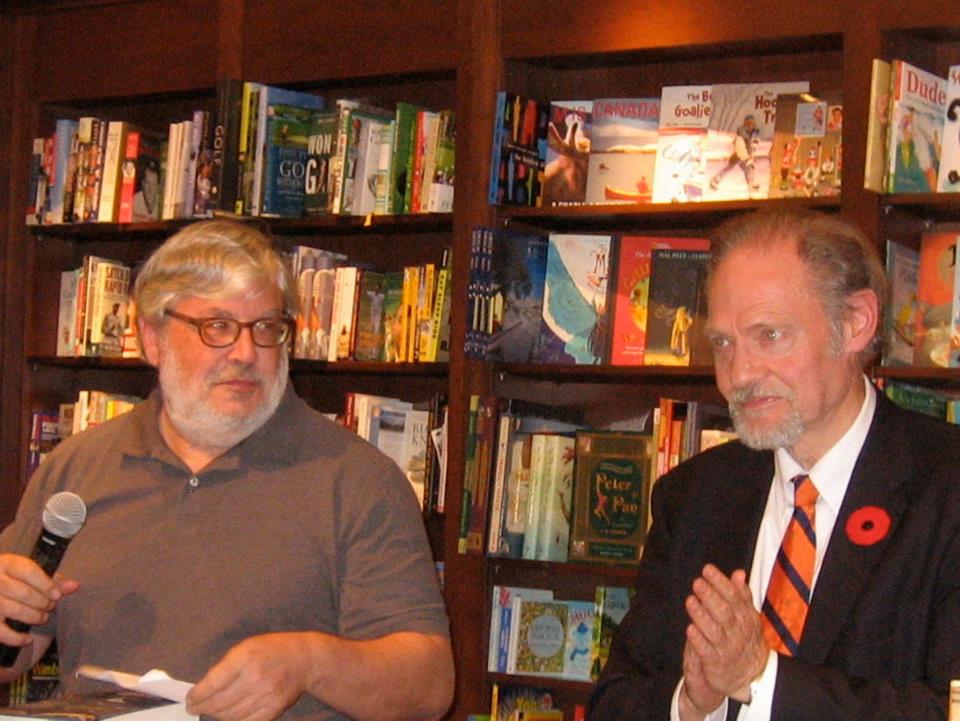
Doug being introduced by ECW Publisher Jack David

During my days as publisher at M&S I took a jaundiced view of launch parties for individual books. It turned our hard-working publicity department  people into almost full-time cocktail party organisers, and provided expensive free drinks for thirsty media types who couldn’t remember the name of the book they were supposedly celebrating, and writing or broadcasting about. To get away from this pattern, we held one big celebration, at the AGO (with all of our authors distinguished by a rose or corsage). It became a major attraction of the fall season, year after year, with a huge turn-out. It was so successful that Quill & Quire complained mildly about the company’s “Imperial style.”

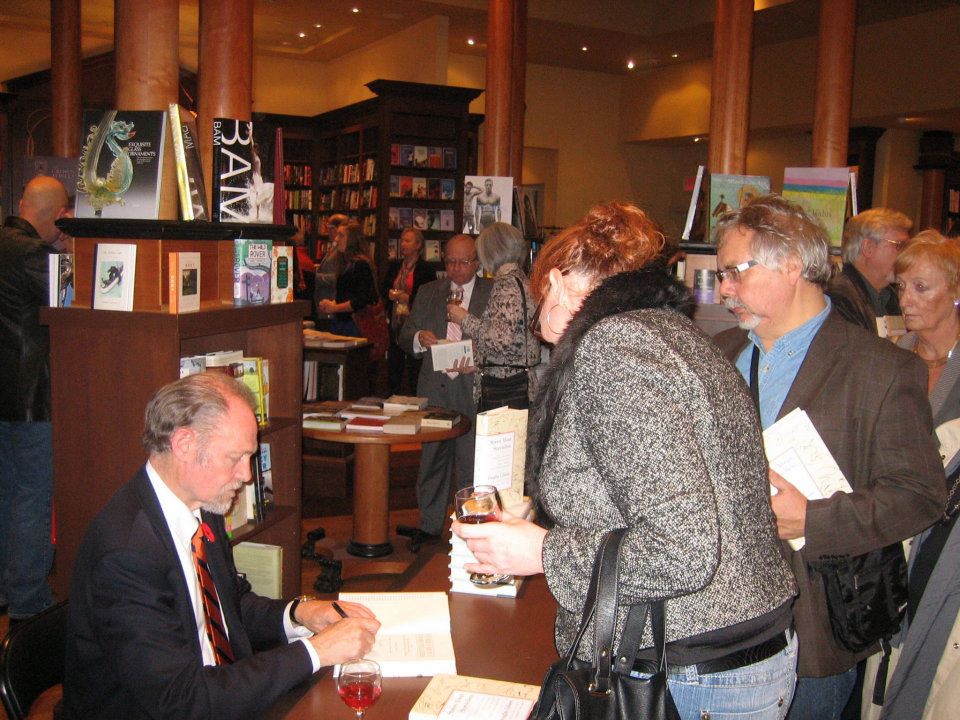
Now that I’ve had the experience of attending a launch party for one single book, and one single author  — me – it occurs to me that I underestimated the sheer selfish pleasure that an author experiences in that brief spell in the sun, as congratulations beam around. Certainly, the event at Ben McNally’s store (which in my brief speech of thanks I called “a beacon of enlightenment in the dark canyons of Bay Street”) was a very pleasant one, with friends popping up from all over. I was tied down at the signing desk from the start, and so wasn’t really at the party. But my friends played their part so nobly that we ran out of books to sign (with over 120 gone) and the ECW gang was pleased.

The next morning, like a sitcom character I was swinging my right arm and wondering aloud what was wrong with it. Jane pointed out that I’d just signed over 120 copies of my book. This is an occupational hazard I could learn to enjoy.

— Douglas Gibson

Doug's permanent position for almost three hours.