Gibson’s Stage Show Returns to Toronto

After around 50 performances, in places from Haida Gwaii to Halifax, Douglas Gibson’s Stories About Storytellers stage show is returning for a rare midtown Toronto performance. On Tuesday, May 7th at 7:30 p.m., Doug will be bringing his memoir to life at the Heliconian Club (35 Hazelton Ave.). For tickets, call 416-922-3618.

Update: This show is now sold out. Watch the events page for more Toronto shows.

Politics and the Pen

For many years now the Writers’ Development Trust has sponsored a very successful fundraising event in Ottawa. The March dinner at The Chateau Laurier is now a fixture on the Ottawa social scene, with guests promised that their table will feature both a politician and an author.

In the past I used to attend the dinner as a Publisher. In fact, my book tells the story that I first met Sheila and Paul Martin when I was placed at the Prime Minister’s table because an organizer had said, “Oh, Doug can talk to anyone.” And I always had a good time, especially when my authors (such as Max and Monique Nemni) were winning the evening’s big award, The Shaughnessy Cohen prize.

After my book came out, however, I was upgraded, and became An Author. This meant that I was invited to attend, free, flown to Ottawa, and very well cossetted at the dinner, where all authors are issued a medal and a colourful ribbon (green last year, red this year) to hang the medal around the neck like a Nobel Prizewinner. It’s all very good fun, and an excellent cause.

Before the dinner I had the perfect Ottawa afternoon. First I met with Sean Wilson, who runs the Ottawa Book Festival. It’s a very successful series that helped me a lot. In the Fall of 2011, when my book was just days old, and I had hardly started to tour my show, Sean took a chance on the stage show, and we were both relieved when it worked out well — and we sold out of every copy of my book. The future seems bright for his festival, although arts programming is never easy.

Next I spent a fascinating half hour at the office of my old friend Jeffrey Simpson, of the Globe and Mail. He’s always full of  interesting ideas (the man’s a columnist, after all!) but he’s also a fascinating witness to major changes in the Canadian Book business. He has produced non-fiction best-sellers about Canadian public issues in the 1980s, the 1990s, the 2000s, and right up until last year, when his book about our medical system hit the stands.

He tells me that everything has changed from the “magic carpet” days when your publisher would whisk you around the country from city to city, from one book talk show to the next. Now it’s up to the author to behave as his or her own publicist (he used the adjective “brazen”) and he estimated that of the 40 or so public appearances/speeches he made to promote his new book, he personally arranged 75% of them. He and I were excitedly confirming each other’s findings that the new world out there demands ever more active author involvement in promotion — although I can’t promise a one-man stage show from Jeff Simpson in the near future.

My final stop was at the CBC building, where my wife’s niece, Amy Castle, the Producer of the daily TV show, Power and Politics, invited me to sit in on the control room. Fascinating!

Everyone knows about the number of screens up there at the front of the room, and the constant directions to switch to this camera or this piece of film, but the instant typing of the links for the host  on the teleprompter, and the guy at the front choosing which tweets to add as crawlers to the screen were new to me. I was supposed to be quiet and anonymous – my desired state, of course – but when a Liberal backbencher was introduced and there was loud uncertainty in the room about the spelling of her first name, I was able to announce “Kirsty” very decisively; she’s a friend.

After that it was time to rush to the Chateau Laurier and don my 48-year-old dinner jacket, plus medal, and mingle. I suspect that few guests were able to range as widely on the political spectrum, chatting with old friends from Ed Broadbent to Preston Manning. Among the authors I enjoyed chatting with at the loud cocktail party were Lisa Moore (fresh from her victory in Canada Reads), Lawrence Martin, Paul Wells, and David Miller (who is a good enough friend that I have never raised the name Rob Ford in his presence). And I later was able to tell Justin Trudeau stories about his father that he had never heard, including my “Trivial Pursuit” moment, when he almost killed me. (It’s in the Trudeau chapter.)

At our table I had a very good time, but did not shine. In my role as Author, I went around the table to meet my companions. I found myself sitting beside a very pleasant woman named Diana, who spoke with an English accent. Because we had just established that our neighbours were Swiss diplomats, and since she had mentioned that she was moving back to England very soon, I asked her if she, too, was in the diplomatic service. Not exactly, she replied, she was moving to England because her husband had just been appointed the new Governor of the Bank of England.

Nice work, Doug.

Douglas Gibson on being Hugh MacLennan

The National Post books blog, The Afterword, featured a piece by Doug on his experience being Hugh MacLennan for Canada Reads this year.

It all began with a very tentative email from a nice woman at CBC Radio in November. She explained that the five books that would be finalists for Canada Reads had been selected. The publicity leading up to the week of on-air debates in February would begin soon, involving not only the advocate for the book on the jury, but also the author.

But they had a problem. One of the books was Two Solitudes, by Hugh MacLennan. And Hugh had passed away in 1990 (a sad fact that I knew all too well, since I had spoken at his funeral). Would I, just possibly, she wondered, be willing to step in to speak on Hugh’s behalf, if that wouldn’t be too much trouble?

Read the rest on The Afterword.

The Al Purdy Show (Part Three)

So we came to the night of the show, February 6 at 7:30.

As the whip-cracking Director of the show, Laura McLeod was tough on all of us who were going to appear onstage, insisting on everyone showing up for sound checks at 6:15. This allowed us lots of time to mingle in the Koerner Hall Green Room, where I got to meet  Alex Gagliano, from Upper Canada College, the young man who was going to be reciting a Purdy poem from memory, on behalf of Scott Griffin’s poetry-promoting project. The room was loud with poets renewing old acquaintance, and there was an air of pleasure as well as the usual backstage excitement. We were all very glad to be part of this.

purdy

Photos courtesy John Degen

In my dual role, performer and front-of-house-greeter, I was able to roam among the audience in the drinks area, where I saw lots of friends, thanking them for coming, and pointing out the amazing silent auction items that Valerie Jacobs and her crew had spent much of the afternoon laying out. Later the Random House blogger for Hazlitt was to report that in the cocktail party crowd somebody pointed me out as “the bearded guy,” kindly describing me as “Al Purdy’s first publisher.” (Wrong! In fact, Sandra Campbell’s forthcoming biography of Lorne Pierce of Ryerson Press, Both Hands, establishes that this grand old man, usually associated with poets like Bliss Carman, Charles G.D. Roberts, and Duncan Campbell Scott, was actually Al’s first publisher, with a 1945 chapbook!) I even met Josh Knelman, who kindly recalled my days as a soccer coach for youngsters like him. Then I was able to join my family group (including my second cousin, Claire Caldwell, who as a young poet made the ideal guest) and enjoy the first half of the show.

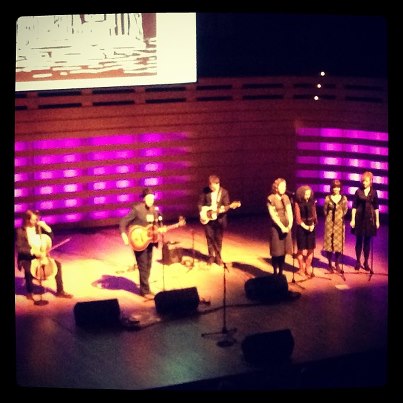
Because I had seen the script, I knew the opening was going to be spectacular. With a black and white photograph of the A-frame filling the screen onstage, the house lights went down and Al Purdy’s voice filled the hall, reading the opening lines of “The Country North of Belleville.” After a few lines, the house lights slowly rose and Gordon Pinsent walked onstage. As Al’s voice faded away, Gordon seamlessly took up the poem with the words:

“Yet this is the country of defeat
Where Sisyphus rolls a big stone
Year after year up the ancient hills . . .”

Gordon finished the poem, to enraptured applause, and introduced the rest of the evening  as a “ literary barn-raising.”
And we were off.

Marni Jackson’s brilliant script was based around two principles. Everything should centre around Al and his poetry; and there should be constant variety on the stage. So Gordon Pinsent was followed by Gord Downie, the lead singer of The Tragically Hip, who read “At the Quinte Hotel” then sang a song and played guitar.

Steve Heighton turned the event into a fashion show by wearing one of Al’s distinctive shirts (and recommending other items at the Silent Auction) before reading “Necropsy of Love.”

It was time for a Greek Chorus, with Gillian Savigny, Leigh Kotsilides (no typecasting there!), and Moez Surani, led by Robert Priest. They sang and then produced a choral version of “In Search of Owen Roblin.” Then Robert introduced young Alex Gagliano, who recited “Thank God I’m Normal” with its ringing final line, “ Why — why the sonsabitches!”

Michael Enright then brought his CBC gravitas to the proceedings, telling us the story of Al Purdy’s life. Then, in the role of M.C., which he was to adopt increasingly, he introduced more music in the form of author-musician Dave Bidini, of The Rheostatics, here appearing along with Bidiniband and The Billie Hollies. bidiniband

That rousing musical interlude led to the 35-minute intermission, where two of Patrick White’s friends, reluctant attendees, were exulting that this Al Purdy was clearly “the coolest guy ever!”

Here my account of the evening becomes scattered, because after the intermission I was backstage throughout (except for my moment in the sun, when I got to talk about my role as Al’s publisher, to pay tribute . . . very briefly . . .  to George Goodwin and the organising committee — “You’ll find their names in the programme” — before praising Eurithe, and Jean Baird “with us tonight from Vancouver.” Then it was “on with the show,” and an introduction for Ken Babstock).

But from my perch in the Green Room, watching the fuzzy screen, or from the wings, I enjoyed the video produced by Brian D. Johnson, then Phil Hall and Karen Solie doing their duet reading of “Shall We Gather at the River,” George Elliott Clarke, as Toronto’s Poet Laureate, reading “In Cabbagetown,” and then the Skydiggers (Andy Maize, Josh Finlayson and Michael Johnstone), who filed off, brushing shoulders with me as the applause from their music still rang around the hall.

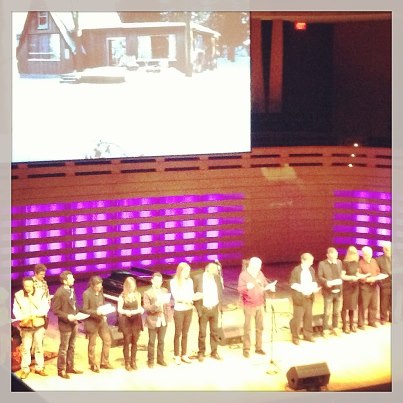
After Ken Babstock, Michael Enright brought Margaret Atwood onstage for a sit-down interview (hey, we haven’t had an interview yet!), which was great fun (as listeners to The Sunday Edition were to learn). It ended with Margaret reading “Wilderness Gothic.” Dennis Lee then talked briefly about Al and read “In My Grandfather’s Country,” which sounded even better from the wings, where the cast was assembling for the Finale, where George Bowering led us in “Say the Names,” with chosen poets hollering out “Lillooet” or “Nahanni” on cue.

saythenames

For this finale, which turned into a curtain call, Michael Enright and I bracketed the poets ranged along the stage. Beside me was Gordon  Pinsent, whom I had telephoned so many months ago to ask if he would perhaps be interested in helping with this event we were planning. To be with him as the waves of applause . . . no, more than that, the waves of affection . . . came washing over us from the audience was unforgettable. Then in an unrehearsed way we waved to the audience and walked off, dazed and delighted.

Later, when I was able to leave all the happy handshaking backstage, the audience was still filing out, and were clearly delighted, saying very kind things.

And, after the nail-biting lead-up, we ended up selling over 700 tickets! In fact, we ran out of programmes, because we had to set the number of the print run a couple of days in advance, when printing 500 seemed sensible. And we made money, and Duncan Patterson’s plans to fix up the A-frame can now go forward.

And, yes, as I had predicted to the Metro Morning audience, it was the sort of once-in-a-lifetime event where others will say . . . “You were there?”

The Al Purdy Event (Part Two)

In the end, the fundraising event at Koerner Hall on February 6 was such a success that it’s worth celebrating the people who put it together. I’m reminded that a 19th century British Cabinet was once famously described as the Cabinet “of all the talents.” I think that the Al Purdy event organisers deserve the same description.

Let me say the names here: George Goodwin, our fearless (and tireless) Chair, a former McClelland & Stewart colleague now working for the Weston organization; his son Christopher Goodwin, a banker who knows a lot about fundraising and how to close a deal and how to represent a younger generation; Leslie Lester, the Executive Director & Managing Director of Soulpepper Theatre Company with many excellent contacts in the worlds of poetry and rock, and who knows how to go about putting on a good show; Don Oravec, who, before he was felled by ill health, as Executive Director of  The Writer’s Trust had learned all there was to know about fundraising for the literary world; Alexandra Manthorpe, a young lawyer, who could keep us all out of jail, and who stickhandled the purchase of the A-frame itself on just 10 days’ notice; Valerie Jacobs, the superhuman organiser who once ran my life at M&S, and who was now given the task of running the Silent Auction; Duncan Patterson, the young architect who had made detailed plans of exactly how the Purdy A-frame had to be repaired – and who had spent every summer of his life in Prince Edward County; Patrick White of the Globe and Mail, a son of Howard White, one of the founders of the movement to save the A-frame, along with Jean Baird (Jean and Howie were distant but very active members of our planning group); Marni Jackson, the author who can turn her hand to any writing task, including the creation of the script for this show that had such a marvellous flow that it was able to lull or startle the audience, as required, on the night. (Marni’s husband, Brian D. Johnson of Maclean’s fame, played a major role behind the scenes, acquiring amazing film footage and creating a tribute video to Al that appeared for the first time that night.)

Finally, this group of unpaid volunteers shrewdly hired Laura McLeod, a theatre professional, to make sure that the event happened, including such details as having tickets available at the box office, and having the cast show up on the night, knowing what was expected of them.

As those who were there know (and will happily tell you), we pulled it off. And it was indeed “all right on the night.”

But not before much nail-biting anguish. High drama, indeed. If you like a comfortable, predictable life, do not ever put on a one-night stand-alone show. Unless your show is an annual event, or part of a series, with a predictable – and contactable – audience, you are in for a testing time, a roller-coaster ride for your emotions.

To over-simplify:  if you can charge $200 for each ticket you will raise funds very fast, if you can sell them. By lowering the price of our tickets to $50.00 we were gambling that we could sell enough of them to cover our costs, plus . . . Although all of our artists, musicians and poets and actors alike, were generously donating their time, we found that renting a superb, central space like Koerner Hall (and heating it, not to mention having the stage lit, and having ushers etc., etc.) costs a lot of money, and we had to sell several hundred seats to break even. So for all of us, the two weeks up to the event were dominated by emails describing the Daily Ticket Sales, sent along by Laura McLeod.

They were terrifying. With roughly one week to go we had sold only about 200 tickets. We were going to lose lots of money on this fundraiser.

It was time for emergency action. Since people reacted well when they heard about the event (“That sounds great. When is it, again?”), the trick was to spread the word. Any way we could. Emails flew to surprised friends and professional contacts. Our committee worked their contacts in the media (“Hey, we’re in NOW!”). Eventually this led to fine things like an A-frame article in the Toronto Star (which neglected to mention the date and location of the fundraising event, requiring a sly Letter to the Editor, praising the piece and just happening to mention “Koerner Hall” and “Wednesday”).

Even better, CBC Radio came through, inviting me (an internal CBC document praised my ability to “yak”) to talk about the forthcoming show on Metro Morning on Tuesday. I stressed that I was just part of the organizing committee, but this message was embarrassingly elided at the end, so that it seemed that I was The Organising Principal.

The next morning I was on Ontario Today, urging people outside Toronto to come in for the show. I think some did come. Certainly as I mingled gratefully with the crowds I met lots of people who were Metro Morning listeners.

And we sold over 700 tickets! As for the show itself, watch for my next installment.

The Al Purdy Event (Part One)

I published Al Purdy, which meant that I knew him a little, and liked him a lot. He was a larger than life character, in every sense. As Publisher of McClelland & Stewart I had issued standing orders that whenever authors came to visit our office, I wanted to see them;  this was to establish, on all sides, the key importance of our authors to our company. When he breezed into our corridors, a big, loud, informal figure (he was one of the few people able to shamble even while sitting down), he brought a breath of fresh, country air with him. We knew he was there. In The Al Purdy A-frame Anthology I wrote of those visits . . .  “the office corridors seemed to course with energy when he came in, and I felt that people went about their business with extra pleasure because of his presence.”

In my own book I deal with him only in passing. I write about a scorching encounter we both had when we flew too close to the Russian Sun King, Yevgeny Yevtushenko. That was at a famous Toronto Harbourfront event, and Al and I both had our wings singed.

But I remember another very hot encounter when Al was reading at the outdoor Shakespeare in the Park stage in Toronto’s High Park. It was the middle of summer, and even as darkness fell over the crowds sitting on blankets on the grassy slopes in front of the stage, it was sweltering, very hot and very humid. Al sweated his way through a grand reading, to great applause. When I went up to him at the end, he was as pleased and surprised to see me as if I had just swum Lake Ontario to get there. I think that before that sweaty evening he’d seen me as an uptight, tie-and-blazer-wearing publishing type, a representative of the bourgeois urban values that were, let’s say, not a feature of his own irreverent, unbuttoned life.

So a few years ago I was glad to be able to lend moral support when Jean Baird in Vancouver, an old friend of Al and Eurithe, along with Howard White, the fine West Coast publisher who brought out Al’s last books, started a movement to save the old A-frame house in Ameliasburgh. My support, I should stress, was mostly moral, supplying a brief quote for The A-frame Anthology, with no active involvement.

When my old friend George Goodwin (who had left the banking world to join M&S largely because of his love of poetry) told me early in 2012 that he was forming a committee to try to raise funds for the Purdy A-frame, I was very glad to sign up. Throughout the summer and fall we met over lunch, to plan our fundraising strategy. The challenge was clear: the trick was to come up with an interesting event in Toronto that would cost very little but would draw a very large crowd that would pay lots of money to attend, and go home happy.

But what sort of event? Where? When? And charging how much? Charging $200 per head raises money very fast – but it’s not a good idea if that high price draws only 20% of the crowd who would have come for a price of $50. How do you decide these things? And how does the price affect the programme, and the expectations of the audience?

Our group (whom I’ll celebrate later, in a further blog) soon hit on Koerner Hall as the perfect venue, because of its location, its excellence as a hall, and its association with poetry, thanks to Scott Griffin’s very successful Griffin Prize events there. (And Scott, I should note, was one of the generous donors to our event.)

But the question remained, what sort of event? At several lunch meetings (including one where we realised that a Fall 2012 event was simply too hard to plan and carry out in a crowded, onrushing season, and decided on February 2013 as the best time) we thrashed it out, based on the availability of various figures named Enright or Pinsent, and various poets and musicians, all of whom were eager to contribute their talents, if their schedules allowed. Right from the start we had decided to build the event around Al Purdy’s poetry, while providing lots of variety on-stage. This, we were determined, was going to be a very special show.

(TO BE CONTINUED . . .)

Alice Munro Rules Scottish Rugby

Alice Munro is renowned around the world for her superb short stories, and she has the prizes and the reviews to show why many claim her as the world’s best. An American reviewer for The Atlantic magazine said simply, “She is the living writer most likely to be read in a hundred years.”

To my delight, Alice wrote the introduction to my memoirs, Stories About Storytellers. In the book I talk proudly about our long association as author and editor, now amounting to fourteen story collections. I note that one of the happy coincidences that brought us together was the fact that Alice grew up in Huron County, Ontario, which is a landscape dominated by many branches of one river, the Maitland. Thanks to my mother, I bear that fairly uncommon family title as my middle name, as in Douglas Maitland Gibson.

Alice’s own semi-fictional memoir, The View From Castle Rock, begins with the story of her own family, the Laidlaws, in the Scottish Borders. The earliest ancestor she found, Will Laidlaw, was born around 1700, and gained such local fame that his tombstone epitaph in Ettrick Kirkyard reads: “Here lyeth William Laidlaw, the far-fam’d  Will o’ Phaup, who for feats of frolic, agility and strength, had no equal in his day.”

That epitaph was written by his prominent literary grandson, James Hogg.

Yes, yes, you say. We know that Alice’s wonderfully perceptive short stories may range beyond her usual Huron County settings, sometimes as far as Australia, Albania, or even the world of a 19th century Russian female mathematician, as in “Too Much Happiness.” But what on earth does she have to do with the manly sporting world of Scottish rugby in 2013?

Last week the Scottish national rugby team played their annual grudge match against the English rugby team. They lost heavily. But every single Scottish point was scored by three men.

Their names were Maitland, Laidlaw and Hogg.

The Al Purdy Show in Toronto

Al Purdy For months a group based in Toronto has been building on the work started by Jean Baird and Howard White in B.C. to preserve Al Purdy’s historic A-Frame house in Prince Edward County. Thanks to Jean and Howie’s inspired work over the years, the building has recently been bought. Now it’s up to us to save it and  restore it so that it can be used as a literary centre.

Hence the February 6 fundraiser at Koerner Hall. I’m part of the local committee, chaired by George Goodwin, and involving the talents of Marni Jackson, Leslie Lester, Christopher Goodwin, Alexandra Manthorpe, Patrick White, Don Oravec, Duncan Patterson, and Valerie Jacobs. The event itself is being organized by the excellent Laura McLeod.

I’ll be appearing on-stage in a modest role in what looks like being a great and memorable event, an affectionate celebration of Al Purdy, whom I knew well, and published with pride.

Now read on and buy your tickets while you can . . . and spread the word!


THE TRAGICALLY HIP’S GORD DOWNIE
TO APPEAR AT AL PURDY TRIBUTE

“When Al Purdy died, among the stuff in the newspapers was
his answer to this same question:
‘I write like a spider spins webs and much for the same reason,
to support my existence.’ I really liked that.”
— Gord Downie

For immediate release

TORONTO, ON  (January 9, 2013) The Al Purdy A-Frame Association announced today that Gord Downie, Canadian poet and lead singer of The Tragically Hip, will be appearing in the THE AL PURDY SHOW on February 6.

Downie considers Al Purdy an important influence as a poet and lyricist.  In addition to Gord’s performance, the show will include readings from Margaret Atwood, Ken Babstock, George Bowering, George Elliot Clarke, Michael Enright, Phil Hall, Steven Heighton, Dennis Lee, Gordon Pinsent, Robert Priest and Karen Solie, as well as musical guests, Bidiniband with The Billie Hollies, and The Skydiggers.

Proceeds from the evening will support the Al Purdy A-Frame Association’s efforts to conserve the late poet’s home and to maintain it as an educational resource and a place for writers to come together and work for years to come.  The show will take place at Koerner Hall — The TELUS Centre for Performance and Learning — 273 Bloor Street West in Toronto at 7:30 pm. Ticket prices range between $25.00 and $50.00.

“This event is a true celebration of one of the most popular and important Canadian poets of the 20th century,” said Jean Baird, President of the Association. “Al loved hanging out with people, talking about poetry and having a good time. We want the evening to capture this spirit. Plus, we have some nifty surprises planned.”

Al Purdy and his partner Eurithe began building the A-Frame cabin on the shores of Roblin Lake, in Prince Edward County, in 1957.  It was here that Purdy came into his own as a poet, and the A-Frame became a gathering place for many of the writers who would shape Canadian literature.  Over their 43 years at the A-Frame, Al and Eurithe hosted Margaret Laurence, Milton Acorn, Michael Ondaatje, Margaret Atwood and hundreds of others in the writing and arts community. The menu usually included spaghetti, and lots of Al’s wild-grape wine.

“This event will be very exciting for Purdy fans,” said Jean Baird. “For the first time, Eurithe Purdy has donated books and other items from Al’s personal collection for auction.”

These include Purdy’s signed and numbered editions from his own extensive library, rare first editions by other poets, and original artwork from Leonard Cohen.  Book-lovers, mark your calendars!

In October 2012, using donated funds, The Al Purdy A-Frame Association, a national non-profit organization, acquired the property.  As part of its mandate to promote Canadian literature and Canadian writers, the Association’s first goal is to preserve the home as an educational resource and a work retreat for future generations of writers.

Tickets can be purchased by calling 416-408-0208 or by visiting alpurdy.ca

#  #  #

For further information:
Laura McLeod
Producer
647-631-6000
lschatzker@gmail.com

Tom Wolfe at the Door

I have always been a fan of Tom Wolfe, ever since his first book came out in 1965 with the modest title The Kandy-Kolored Tangerine-Flake Streamline Baby. I have followed his work through the years with admiration , as he combined his Yale Ph.D. analytical intelligence with his journalist’s love of getting deep into sweaty crowds, and his shameless . . . Heeeewack! . . . love of dramatic utterances on the page.

It deserved the title, “The New Journalism,” and he was the ultimate master of the form.

I was delighted when after The Right Stuff, in 1979,  he turned his hand to fiction, and was not surprised when his first novel, The Bonfire of the Vanities (1987) was a spectacular success, selling 800,000 copies in hardcover and being hailed (to the rage of the Updike, Mailer, and Irving old guard) as the great American novel of the decade.

When a not very successful movie was made of his fine book, Wolfe was asked, anxiously, how he felt about the movie. His reply was perfect: “I cashed the cheque.”

And of course, he has made a success of his novels since then, turning his laser-like attention to different groups in a variety of American cities. His latest book, set in Florida, is entitled Back to Blood. An unusual title, and it rang faint bells. I went back to my edition of The Bonfire of the Vanities, and started to read the opening scene. The Jewish Mayor of New York is up in Harlem at a public meeting, and is getting a very rough ride from the hostile crowd. As the volume of racial hostility swells, he thinks about how basic all this is:

“Oh, she’s afraid like all the rest! She knows she should stand up against this element! They’ll go after black people like her next! They’ll be happy to do it! She knows that. But the good people are intimidated! They don’t dare do a thing! Back to blood! Them and us!”

Fascinating. That phrase occurs on page 6 of a 659-page novel published  in 1987. In 2012 the phrase Tom Wolfe invented re-appears as the title of his new book. Has he been waiting all those years to use it again, this time as a title?

How authors arrive at titles is often surprising and revealing. Not many people know, for example, that although Two Solitudes seems to be such a perfect title for Hugh Maclennan’s 1945 novel, he only came across it (in a book review!) when the novel was two-thirds written. Surely there must be room for a worthy Ph.D. thesis here . . . did Scott Fitzgerald try the phone book, aware that The Great Smith didn’t really work? Did Morley Callaghan comb through the Bible, rejecting And His Ox and His Ass in favour of More Joy in Heaven? And did some authors fixate on a perfect title, then invent a book to go with it?

Start your engines.

A final Tom Wolfe note. When I was a boy editor, around 1970, my company, Doubleday Canada, distributed Tom Wolfe’s books. So when he came to Toronto to give a speech promoting one of his new books (it may have been Radical Chic & Mau-Mauing the Flak Catchers) I joined the carload taking him up to York University. In those days York was perched away on the edge of Toronto, more part of the flat hinterlands than of the (now-encroaching) city. As I explained the history of the young university to our visitor, he gazed around at all of the widely spread new buildings. He thought hard, then said: “It’s kind of like Brasilia, isn’t it?”

My York University friends, including my daughter-in-law Lauren, who teaches there, are restrained in their enthusiasm for this comment.

“Apart from the incident, Mrs. Lincoln, how did you like the show?”

It was around 1960, and I was an irreverent kid in high school. Part of the irreverence involved me and a friend in writing comedy sketches for our (very traditional) school pantomime. So I paid keen attention to what was happening in the world of jokes.
In America Mort Sahl was happening, and a great revolution was producing the very first “sick joke” . . . which you can see above. When I first heard it,  I had the “watcher of the skies / when some new planet swims into his ken” feeling — as P.G.Wodehouse, a very different type of humourist, once put it, to describe a sense of discovery of something totally new. The Lincoln joke showed that suddenly nothing was out of bounds. There were no things that you “just couldn’t joke about.” Not anymore.

I rode the new wave enthusiastically. Even in my first university year at St. Andrews, I was involved in writing and performing comedy sketches with a group of friends. There was no money involved, but we got free tickets to the fancy, formal Balls for which we provided the half-time entertainment. By the second year I was the MC of an occasional student night-club in an empty church hall. For reasons hidden in the mists of time we called it GAP (too bad there was no copyright on the commercial use of the title we invented) and although we didn’t bother with a liquor licence, we drew packed crowds to dance and enjoy the music and the unforgettably witty sketches. (We even drew unruly crowds at the door, but that, and the fight with a head-butting sailor, is another story.)

These were the days when “That Was the Week That Was” ruled BBC  TV on Saturday night, and satire was a big part of what we wrote and performed. Sick jokes made an occasional appearance: I remember one “bedtime story for little ones,” read by a leering uncle figure. It was a variant on the traditional story of Greyfriars Bobby, the little dog that charmed all of Edinburgh by his daily trips to sit sadly at his master’s grave. Our variant, I’m sorry to say, involved Bobby (a bone-loving little dog) in seeking daily sustenance at the grave. The howls of outrage as the implications dawned on the crowd were very pleasing to us.

Later in that second year I had a minor role in a real stage performance (Ionesco’s The Leader) which involved me in shouting, “The leader, the leader” very loudly and excitedly. The director was a student friend, Alan Strachan, who in later life went on to be the famous head of The Greenwich Theatre in London. Alan formed a group of us — four men and two women – to produce a comedy revue, a little like “Beyond the Fringe.” We took over the town theatre, The Byre, for a week of evening performances. We even ran matinees of “Six After Eight” on Wednesday and Saturday, when the show proved to be a hit.

I wrote and performed  and even sang! One of the high points was when I appeared, front and centre, to produce a Malcolm-Muggeridge-style lecture on “Trends in Humour.” I told the audience that “Satire has come and gone. Now, many experts in the field are predicting that the new trend will be slapstick.” Before I could continue, a bare arm reached around the curtain and smashed a large cream pie into my face. Blackout and delighted laughter! I had to be led, blinded by banana cream, off-stage by a kind stage manager. Even in the dressing room as I gasped to clear my face to breathe again, I could hear the audience still laughing.

When people who see the current stage show Stories About Storytellers ask if I’ve done much stage work in the past, I tend to say, “Not really, but I did a little back in university.” Now all of the interest in the new movie about Lincoln has brought back memories of the impact of that original Mrs. Lincoln joke. Lincoln may have been involved in things like waging the American Civil War, and freeing the slaves. But, as you can see, he had a continuing role in what we might call my dramatic life.