THE PIGGERY TAKES FLIGHT

 North Hatley is a very special place in Quebec’s  Eastern Townships, near Sherbrooke. If you don’t know it, try to arrange a visit. If you can afford to stay at Hovey Manor, take the chance. If, however, you’re invited to stay with Pat and Norman Webster at their house on Lake Massawippi just beyond Hovey Manor, cancel all appointments and head off there as fast as you can, because you’re in for a wonderful time.

  North Hatley played a large part in my life, since I married into a summer family, and Sally and I spent many happy summers in North Hatley (and winter visits to ski cross-country), and her family’s lakeside cottage is still there. As my readers know, that was where I first met another cottager named Hugh MacLennan.

  So when Pat Webster suggested that I contact the Piggery Theatre (and you’ll never guess what the building was before it became a theatre) to offer to give my show, I was delighted. After a few phone conversations with Ruth McKinven, representing the little theatre, we were all set.

  I stupidly failed to specify the sort of equipment that my show would require, but this is a rural community where everyone helps out in an emergency just before a show. Miraculously, a screen came from here, a projector was picked up from there, and we started just 20 minutes late. The old Piggery held about 100 people, in comfortable seats, and the show seemed to go well, with Alison Pick commenting that the contents had really changed since she saw it in Moose Jaw. I had made special local changes to deal with Hugh MacLennan and the North Hatley book, I’ll Tell You A Secret by Anne Coleman about her teenage infatuation with “Mr. MacLennan”. I even produced a literary reason why Hugh, immersed in writing The Watch That Ends The Night, might be eager to spend so much time with this teenaged girl.

   After the show I received a remarkable email from an old friend, Michael Ogilvie, who had been in the audience. He had been struck by my story about Hugh’s funeral at the McGill Chapel, and wanted me to know how that had come about. My book records how McGill stupidly removed from his office this iconic teacher who had been with them since 1951. Hugh left feeling hurt, and relations between him  and his wife Tota and McGill were badly strained.

  When Hugh died in 1990, however, Michael Ogilvie realised that his aged aunt, Tota, was in no condition to organise a funeral for her late husband. He himself was flying off to the Maritimes, but he knew that this was a crisis. So although he had never met David Johnstone, the Principal of McGill… and now Canada’s very popular Governor General… at Dorval Airport he looked up his home phone number and called him at 6.30 in the morning, introducing himself to the surprised female family member who answered the phone as “Hugh MacLennan’s nephew.”

  David Johnstone came to the phone (think pyjamas, and a bathrobe) and cut short a possibly complicated conversation with the breathtakingly wise and generous words “I assume you’re calling, Michael,  to give us a chance to bring Hugh home….”

  Michael was very grateful, and McGill proceeded to organise the whole fine event in the Birks Chapel, from the string quartet playing Hugh’s favourite music, to the four speakers honoured to be asked to talk about his life, including the most grateful of all, his Publisher.

   We are very lucky to have a Governor General like David Johnstone.

A Montreal Coincidence

In July I gave my show at a Westmount residence for seniors named Place Kensington. It’s a fine, lively place (or Place) and the residents include two authors of mine, the charming Ted Phillips and my friend William Weintraub, the author of City Unique. Bill Weintraub is also famous for the  classic novel Why Rock The Boat?  and I proudly edited his last novel , Crazy about Lili,  providing  it with a very funny cover illustration by the wonderful Anthony Jenkins, whose path was later to cross mine, as my readers know.

In the course of my show, when I was talking  about James Houston going into the North, an older man in the audience asked me, “When was this?”

“In 1948,” I replied.

“Yes, that sounds about right.”

He went on to explain that he was setting up his medical practice around then, and had wandered into the Canadian Handicrafts Guild shop, and had come across a very fine portrait of a young woman (in those days a young “Eskimo” woman) in full sealskin traditional outfit. He stood there admiring this piece of finely drawn art that revealed another world, far from Montreal. Then another customer, a young dark-haired man, came and stood beside him, looking over his shoulder at the drawing.

“Do you like it?” the stranger asked.

“Yes, I do,” said the young doctor, “but I’m just setting up my medical practice, and I’m sure I can’t afford it.”

“Can you afford $50?” asked the man.

“Yes,” said the surprised doctor, and James Houston made the deal with him right there and then, remarking that this was the first of his Northern drawings that he had ever sold.

The doctor told us that he still had James Houston’s drawing, after all these years. And I told the audience that we had all been part of the sort of coincidence that weaves its web around us every day, in unexpected ways.

Later that evening Jane and I had dinner in Old Montreal, celebrating the coincidence that had brought us together at The Couchiching Conference, so that exactly 11 years earlier we had got married.

ALICE MUNRO SAYS GOODBYE TO THE WRITING LIFE.

 In 2006, Alice Munro said that she was not going to write any more. Many journalists seized on this terrible news and reported it as fact, and it flashed around the Canadian literary world like summer lightning

 Wiser heads, however, checked with me, her long-time editor, and found me dismissing the idea, with the words that “Alice is a born writer, and she’s not going to stop writing.”

   Fortunately for the world, I was right, and she has produced two collections of stories since then.

  Sadly, I’m not saying that this time.

   In fact, when she came to Toronto in June, to accept the Trillium Prize for Dear Life, I was with her in a private room at the Toronto Reference Library when the enterprising Mark Medley interviewed her and asked her about her future writing plans. When she told him that she had no such plans, and had stopped writing, (“I’m probably not going to write anymore”), I stayed silent.

  Recently Charles McGrath, of the New York Times, visited her in Clinton and returned with the same story. His fine July 1 article, “Alice Munro Puts Down Her Pen To Let The World In” reflects the fact that he is an old friend and editor of Alice’s work, and a great admirer. It’s a superb account of Alice’s life and work, and I recommend it highly.

  So what has changed? For a start, Alice is now 82. In April she lost her beloved husband, Gerry Fremlin, and life is harder now. On the subject of growing old, which Charles McGrath rightly notes is “a subject that preoccupies some of her best stories”, she says “I worry less than I did. There’s nothing you can do about it, and it’s better than being dead. I feel that I’ve done what I wanted to do, and that makes me fairly content.”

   “Fairly content”…now there’s an Alice Munro expression, (just like “better than being dead”). I suppose I can say that the millions of readers around the world who know her work can be “fairly content” that she wrote a lifetime’s worth of wonderful short stories that can be read and re-read for ever. My own recommendation, by the way, is The Progress Of Love, which I discuss on my Book Club website, complete with 20 Discussion Points.

   I accompanied Alice to two award sessions in Toronto in June, in both cases whisked by limo to the event, then escorted (with me hovering at Alice’s elbow, the escort escorted) to the reception and the dinner. At both the Libris Awards session, where I spoke to introduce Alice to the nation’s booksellers, who were giving her a Lifetime Achievement Award, and at the later Trillium Prize event, there was a strong sense that people in the audience knew that this was a special moment towards the end of a long , unmatched career. The affection and respect in the sustained, standing ovations were very obvious, almost tangible. And the people who took the opportunity to come to our table to greet Alice (“Yes, I once met Alice Munro!”), sometimes were literally kneeling to greet her , and were always visibly affected when they staggered away, dazed by the experience of meeting her, although she was always friendly and unaffected (“Who do you think you are?”)
It was wonderful to be so close to such powerful experiences, although my role was to watch for signs of strain, then to swoop Alice back to her limo, and back to the family waiting for her at the hotel.

Stories About Storytellers Audiobook

dougstudioSummer has arrived, and with it long drives for much-needed vacations. If you’d like the companionship of this author, and the multitudes within Stories About Storytellers, the audiobook is available for order from Audible, and provides over 17 hours of company on the road.

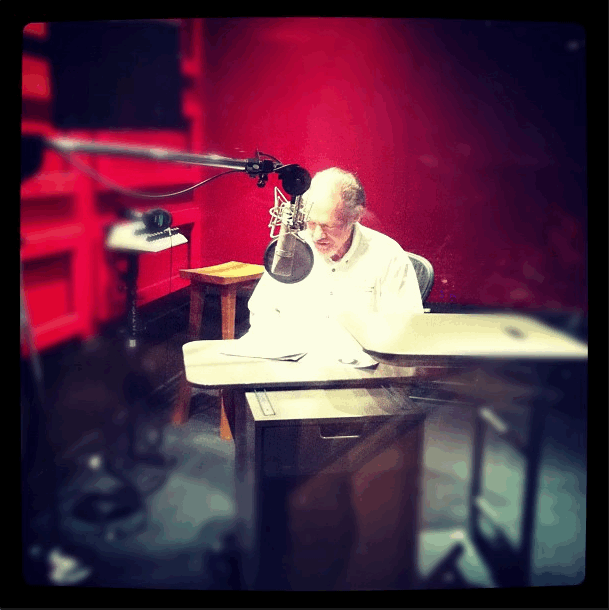
Points of interest about this particular incarnation of the book include that (a) the Introduction by Alice Munro is read by my multi-talented editor, Jen Knoch [ed. note: a daunting task!] and (b) that although I have read more than 100 movie reviews for CBC microphones over the years, it was a shock for me to find out how reading a book aloud is very, very hard work. To be precise, with gulps of air and gulps of hot soup to keep the Scottish-accented voice healthy, day after day, it took me over 20 hours of reading over 5 days to get the whole book on tape.

The good news, of course, is that when the book (as in this case) is written in the first person, and read by the writer, the listener knows that this is the way the author meant it to sound. It does add to the listening experience, which is why I did it.

And, of course, being a professional reader in the studio day after day, accompanied by the patient Kevin at the controls, was a fascinating new experience for me. I’m still working  at expanding my resume. You never know.

My New Book Club

We all know how important the avid readers who belong to informal book clubs are to the world of books.

I’m doing something new for them. I’ve produced a Storyteller’s Book Club where I deal with five classic Canadian books, and provide 20 Discussion Points about each one of them for the club members.

What’s special here is the I edited all the books I discuss. Well, with one exception. I didn’t edit Hugh MacLennan’s great novel The Watch That Ends the Night, but I did edit books by my friend Hugh, which allows me to talk about how I might have edited the book. As for the others, I can take the club members behind the scenes with Alice Munro, Mavis Gallant, Robertson Davies and Alistair MacLeod.

Check it out at on the Storytellers Book Club page.

DOUG GIBSON’S TRIBUTE TO ANTHONY JENKINS AND HIS CARICATURES

If you like the caricatures that begin each chapter of my book, I have very good news for you. A new book has just appeared entitled A Fine Line: The Caricatures of Anthony Jenkins. It’s published by the small independent Nestlings Press, and the ISBN is 978-0-9691456. It contains over 100 of the best caricatures ever produced by my friend Tony Jenkins; you may even recognise a few of them from my book.

I had the chance to talk about just how much I admire his work in The Foreword.

Here is what I wrote:–

Anthony Jenkins is a dangerous man. I alarm the good people who come to see my stage show, Stories About Storytellers, by warning them that I am going to whisk them through a list of interesting authors by showing them Tony Jenkins’ caricatures of each writer. I stress, however, that this is a perilous business, because he is clearly in touch with devilish powers that would frighten off a sensible Faust. Or perhaps he drinks potions that endow him with the same sort of magical powers that Oscar Wilde revealed in The Picture Of Dorian Gray, where the flesh-and-blood Dorian remains eternally youthful while the portrait at home does all of his aging for him.

Tony Jenkins, I explain, is clearly in touch with the same dark powers. “When he produces a not-altogether-flattering portrait of you” (and here I put on the screen the Spring 2011 portrait of me that appears on this page) “day by day, week by week, month by month, you will come to look more and more like that portrait!”

The terrifying process continues to this day. So I am very keen to do everything I can to stay in his good books.

This book is one of them. When the publisher, my old friend Warren Clements, invited me to contribute a Foreword, I instantly agreed to do so, out of fear. But there was something else, too—admiration. Not to mention regret that in my publishing days I was never smart enough to think up this book.

In those days (and I was the publisher of McClelland & Stewart from 1988 till 2004, so I can’t plead lack of time), I was keenly aware of Tony’s excellent work in The Globe & Mail. On occasion I would suggest to our Art Department that he would be perfect for this or that book cover. One example that still gives me pleasure is William Weintraub’s 2005 comic novel, Crazy About Lili, in which an earnest young McGill student meets and falls for a famous Montreal stripper. Tony’s cover art, involving a dangling McGill pennant and a dangling scarlet bra, is perfect. And I once, as a private citizen, made a pilgrimage to Tony’s office to buy a wonderful portrait of Alice Munro, which now hangs in our front room.

But I, like other Canadian book publishers, simply didn’t wake up to see, and develop, this amazing talent in our midst.

In 2011, however, when I was writing my own book I finally saw the light. I realized that Stories About Storytellers, its 21 chapters devoted to descriptions of 21 authors, needed to show the authors. A book with no illustrations would seem dull, possibly even (shudder) earnestly academic. A book that used photographs of the authors would seem overly serious. Witty caricatures of the authors at the opening of each chapter was clearly the way to go. And for these caricatures, Tony Jenkins was the man, without question.

So, defying the usual publishing practice where the Publisher chooses the Illustrator, I approached Tony directly, long before I had a Publisher. I gave him a list of the authors in the book, and we made a private arrangement whereby I acquired the rights to use his portraits in the book, and in promoting the book on stage and screen (I was already thinking strange promotional thoughts). In most cases, when the author was Robertson Davies or Brian Mulroney, he already knew the look of the authors very well. In other cases, such as the cowboy author R.D. Symons, I sent along photographs to guide him. In a surprisingly short time, and after very few revisions, I had my 21 superb caricatures, which I thought caught the spirit of my book so well.

When I approached interested publishers, I stressed that these caricatures were part of the deal, thanks to a private arrangement between us. And the wise people at ECW Press recognized what an asset we had, and contributed to the cost, and made good use of his artwork. Tony’s caricatures attracted widespread admiration, both in book reviews and in general comments from readers. After my stage show, despite my opening warning, the most frequently asked question is: “Who did you say did the wonderful portraits?”

Let me step aside here, away from my own experience, to discuss what I think Tony Jenkins is doing. I believe that he is trying to scale the same mountain that has challenged artists from the dawn of art: to catch, in two dimensions, the essence of another person.

People have been trying to do this from the days when cavemen drawing on the wall ranged from showing deer and other prey worth hunting to portraying the faces around the fire. Children still do it every day with crayoned portraits of Mommy. And we all know how hard it is to create a straightforward, “realistic” portrait. Graham Sutherland, a veteran portrait painter of great skill, once bitterly described a portrait as a painting “with something not quite right about the mouth.”

Some cultures and religions even frown on the whole concept of portrait-painting, recognizing that these attempts to catch the essence—perhaps we might daringly use the expression “the soul”—of another person represent very dangerous territory. I think most thoughtful Westerners respect the alarm felt by distant peoples that a photographer catching their image is perhaps stealing something from them.

Western art, of course, has produced many superb specialists in portraiture, too many to name here. In the case of Rembrandt, scholars estimate that at least two-thirds of his work consisted of portraits. And while the Old Master was frequently hired to produce portraits that would look good on the preening Amsterdam merchant’s wall, he took the art much further. One biographer, Jakob Rosenberg, in his Rembrandt: Life and Work goes so far as to claim that by the end of his life, his “mature” portraiture was more than a caught moment in time: “[W]e feel, to a certain degree, the sitter’s past coming into the present, and even some premonition of the future.”

Another dangerous man.

We are clearly in the realm of great imagination here, far beyond mere “photographic” representation. Yet to complicate matters, here is the famous photographer, Yousuf Karsh, writing about what he tries to do in his portraits. He begins his first book, Portraits of Greatness, with this paragraph (and liked it so much that he opened his next book, Karsh Portraits, with precisely the same words): “The aim and art of the portraitist who works with a camera are not merely to produce a likeness but to reveal the mind and the soul behind the human face.”

“Mind” and “soul” revealed by the camera. Consider, then, the challenge facing the brave artist armed only with brushes and paint, and pens and ink, who hopes with a skillful eye and a steady hand to catch that same “mind” and “soul” in a piece of art that the Oxford English Dictionary defines as a “caricature; grotesque usu. comic representation of a person by exaggeration of characteristic traits, in a picture, writing or mime.” Interestingly, the word derives from the Italian caricare, which means “load, exaggerate.”

A “cartoon” is defined by the same source as “a humorous drawing in a newspaper, magazine esp. as a topical comment.” We are on familiar ground here. Every reader knows, and to a greater or lesser extent enjoys, editorial-page cartoons where recognizable (possibly even labelled) figures act out embarrassing scenarios, or spout amusing, often incriminating words. Tony Jenkins can play that game very well, too, as Globe and Mail readers in the past were reminded by the occasional appearance of his fine political cartoons.

Canadians, I think, are reluctant to place living cartoonists in the highest ranks of the art. (Someone more cynical than your humble servant might expand that to “living artists of any sort”.) Many were startled when the American critic Edmund Wilson, in his survey of Canadian culture, O Canada, devoted a section to the Toronto Star’s political cartoonist, Duncan Macpherson, boldly putting him in the august company of the greats like Gilray and Cruikshank. Today, kind words about our leading exponents like Aislin (Terry Mosher) might produce the same reaction; the everyday is rarely associated with the eternal.

Yet when you, dear reader, roam through the pages of this book, I think that you will start to conjure up names of the great caricaturists of the past. Tony Jenkins may have a very different style from Hogarth, Daumier and Grosz, or the more modern masters Ronald Searle, David Levine, Gerald Scarfe and Ralph Steadman. But there is a very definite style here, one that is notably spare, using one line where others might use ten. Unused space—it would be wrong to call it “blank space”—is put to remarkable use.

Famously, defying the old proverb that “the eyes are the window of the soul”, Tony Jenkins has often seen fit to dispense with one of these valuable windows, preferring to let one eye speak for two. Again and again in these portraits, also, we see a tiny detail apparently catching the essence of the character, what in bolder times would have been called “the soul”. See for yourself.

As for me, I admire the art in this book immensely. These excitingly varied portraits constitute almost the work of a lifetime. They give us all a book to cherish by a superb artist—and a dangerous man.

Douglas Gibson

Toronto, February 2013
The Canada Trip

This summer, Jane (my “techie”– though no tattoos so far) and I are going to be travelling widely to give my show in various parts of Canada. As usual, I’m preparing by consulting the 1997 classic, The Canada Trip, by Charles Gordon.  

  You may know him as a former writer for The Ottawa Citizen, or a witty columnist for Maclean’s. Even better, you may know him as the author of the classic At The Cottage and the follow-up Still At The Cottage. His other books include an affectionate satire on life in Ottawa (The Governor General’s Bunny Hop), The Grim Pig, a novel based on the newspaper world , and Canada’s answer to the wave of hyperbolic self-improvement books from the U.S.A., brilliantly entitled  How To Be Not Too Bad. All of them reveal Charles as a man with a finely understated style that is a delight to read, and a dry sense of humour so Canadian that  it deserves to occupy our seat at the United Nations.

   In the summer of 1996 he and his wife Nancy (known in the book, to her slight irritation, as “The Business Manager”) set out from Ottawa in the family car to drive across Canada and back. The result is a wonderful book that shows what typical travellers will find as they enjoy the trip. It is not an earnest “Whither Canada?” book, as much as a “Whither the moose?” or even a “Whither the washroom?” book, and we are all grateful for it. Check it out.

  I am especially grateful for what my old friend Charles wrote about me in his Acknowledgements:  “My publisher, editor, and fellow Scot, Doug Gibson, was as encouraging as always on this, our fourth project together. In his editing,  Doug consistently amazed me with his knowledge of what is where in Canada. Many times he was able to tell me that I could not have been looking at what I thought I was looking at from a given spot – a sunset, a mountain, an ocean – because I was facing the wrong way. This invariably sent me back to my map collection and invariably forced me to conclude he was right – except maybe for once in Saskatoon.” (Ah, Saskatoon, where the reliable old north-south Idylwyld Freeway treacherously turns east, south of the river.)

   Jane and I will have a chance to expand our knowledge of the country as we roam around with my show, this summer. Maybe we’ll meet you along the way. It should be fun.


Quebec City

Thanks to local friends like Neil Bissoondath I was lucky enough to be invited to the Quebec City InterNational authors event, an English-language event that takes place in the heart of the old city every spring. The organizer, Elizabeth Perreault, is so calm and efficient on e-mail that I was expecting a much older person than the fresh-faced young woman who greeted Jane and me.

She runs a top-class festival, too, with authors like Charles Foran, Emma Donoghue, and Guy Vanderhaeghe in attendance. We saw readings in two remarkable rooms in The Morrin Centre, in the heart of old Scottish Quebec. If you think I exaggerate there, The Morrin Centre (named after a Scottish doctor from the early 19th century) is on the Chaussée des Écossais, and is right opposite the old Scottish Church and the “Kirk Hall.”

Inside, the great hall of the Centre (housing The Literary and History Society)  is constructed on 19th century Scottish traditional lines, so that the electric light bulbs seem almost like an intrusion. The library is equally famous, with its wooden statue of Wolfe casting a dramatic arm from a corner of the two-story ranks of shelves. Louise Penny fans will be familiar with the setting, and after seeing Peter Dube talking about his books there, I learned that ancient authors from Charles Dickens to Mark Twain had given readings there.

After Guy Vanderhaeghe entertained us with tales of Western History in this Eastern city, I recalled for him that it was exactly 30 years earlier that he and I celebrated his Governor-General’s Award win for Man Descending in this city. The actual award was given in an ancient room in the Laval campus downtown, but Guy remembered that the evening dinner was held in the Royal 22 (the Van Doos) Regiment’s Mess room at the Citadelle, with the waiters in full red mess uniforms. I was in a daze of delight that evening because as the Publisher at Macmillan I was celebrating two Governor- General’s Awards that year, for Guy’s short stories and Christopher Moore’s superb history book, Louisbourg Portraits.

On the Sunday afternoon I gave my show in the grand old hall, introducing a Guy Vanderhaeghe anecdote from my book that doesn’t usually feature in my stage show. It’s the story of my edgy walk back into Saskatoon alongside a gigantic guy who had just exited a bar, running very fast, and who asked me, in a challenging way, “Are these women’s boots?”

The crowd seemed to like that story, and the rest, so that at the end they gave me a standing ovation. (Jane, I must report, far from leading this excellent development, said to Elizabeth Perreault, “Do I have to stand up?” If anyone wonders about my being a grounded sort of fellow, look no farther than this story for a reason.) But a standing ovation in Quebec City is something worth recording, if I can find a suitably capacious tombstone.

The rest of our visit was taken up with a wonderful dinner chez Bissoondath, and three days of strolling around old Quebec from our central base at the Hotel Clarendon.

One feature of the weekend involved a coincidence that no fiction writer would dare to attempt. In the appreciative crowd for Guy Vanderhaeghe was a nice fellow who proved to be the American consul-general, Peter O’Donohue. What led to his appointment here, we wondered. Well, he grew up in Connecticut and knew Quebec well. Where in Connecticut, Jane wondered, because she had an uncle and aunt in Norwalk. Norwalk! What were their names? The Finlaysons, my God, I practically grew up in their house!

It turned out that Jane and he had been at cousins’ weddings, and two of her cousins are going to stay with him at his amazing house overlooking the slide on Dufferin Terrace, near the Chateau Frontenac

The next day the coincidences continued, because our sight-seeing stroll took us past the magnificent Consulate just as his wife was in the doorway, greeting a friend. We ended up with a tour inside, and spent time gazing over the St. Lawrence from Levis to L’Ile D’Orleans. A magical view, and a magical weekend. And almost 20 more books sold!

Montreal

The Atwater Library is based in the former Mechanic’s Institute building, which means that it has an impressive background in social democratic movements that believe that education and advancement should not be restricted by class. Even today the building houses writers organisations and other fine, progressive but penny-pinched groups.

I enjoyed my tour around with the Newfoundland-born Librarian, Lynn Verge, then watched 60 or so literary types assemble for my talk/show, including authors like Mark Abley and George Tombs, and my old historian friend Desmond Morton. Also there was my fellow-publisher Simon Dardick (who confirmed sympathising with my attempt to cut Mavis Gallant’s speech short, which led to the famous jacket quote “I’ll kill him! — surely a first in the history of jacket blurbs). It was a show where I whizzed through all of the Tony Jenkins caricatures then asked the crowd who they’d like to hear stories about. The requests came thick and fast, including a tricky question from my hostess, Pat Webster, who asked if I edited political memoirs differently from other books. Very interesting. Good questions make you think hard.

What was special about this show was that I had lots of Montreal scenes to recall, and a remarkable new James Houston story to tell. In the train from Toronto I was near Cornwall when I was puzzling over  how best to talk about Jim’s Montreal connections. I happened to look out of the train window, and saw strings of geese heading north. At first there were just three or four v-shaped groups heading north, then ten then twenty, then fifty, sixty, then hundreds. Soon there were scores of thousands of geese filling the skies, all heading north to James Houston’s Arctic. I looked around the train, and nobody else seemed to be aware of the miracle that was filling the skies above us.

At the end of the show we sold about 20 books, which leaves a few potential readers in Montreal still to be tapped. I shall return.

In the evening I filled a major gap in my all-Canadian education by attending, with Norman Webster, my very first Habs’ home game. They won!

The skies above the train on the way back to Toronto were empty.

Stratford and Me

I’m getting more and more excited  about my show at the Stratford City Hall on Saturday, May 11, at 8 p.m.

It’s part of the famous SpringWorks festival, and I’ll also be giving a special show for schools on the Friday afternoon. This has set me wondering just how well a young audience will react to stories from behind the scenes in the world of books, a world that alarmists warn is increasingly remote from their own world. Maybe a Harry Potter comparison or two would be helpful . . . especially the story of idiot publishers turning down J.K. Rowling’s first Harry Potter manuscript!

I’m spending some time recalling my own Stratford connections. As a publisher I was proud to bring out the official  Festival history, Stratford: The First Thirty Years by John Pettigrew and Jamie Portman in 1985. That handsome two-volume edition was published by me at Macmillan of Canada, with a Foreword by Robertson Davies. I note with pleasure that he dated his Foreword “March 1, St. David’s Day,” and we, sparing no expense, ran his distinctive signature in blue ink. I forget why blue was regarded as the ideal colour for the signature of this avid supporter of the festival from its earliest years. Blue?

Later, the link between Robertson Davies and the festival was made clear, in the saddest of settings. Along with John Fraser, RD’s successor as the Master of Massey College, I was involved in arranging the Celebration of the Life of Robertson Davies at Convocation Hall in Toronto in 1995. I asked Richard Monette, then the Artistic Director of the Stratford Festival, to join the group of speakers paying tribute to the Master’s life, and Richard did a superb job, speaking of RD as a Stratford supporter, and as a man of the theatre. That memorable evening had two other speakers with Stratford links: Timothy Findley, a festival alumnus, and Jane Urquhart, for many years a Stratford resident.

Like most Ontarians I have warm memories of many fine visits to Stratford, usually theatrical, but sometimes involving visits to friends like Geoff Hancock, Lynn Schellenberg, or Lucille Roch. I have even met Alice Munro for lunch there. But usually my meetings with Alice were at her home in Clinton or in Goderich. This meant that to follow the old Huron Line I would take a right turn at Stratford City Hall, and head west into Alice Munro Country. It’s appropriate that the building I used as my landmark for that turn to visit Alice will now house my show, with its tribute to Alice and her achievements . . . although the caricature of Alice bears the mischievous subtitle  “Not Bad Short Story Writer.”